ACTIVISION is reportedly developing a complete ground-up reboot of 'HALO' built on the 'Call of Duty' IW engine following Microsoft's massive restructuring of Halo Studios. GameSpot
Insiders claim the project will introduce a large-scale, standalone 'HALO' battle royale mode alongside a grounded military-sci-fi campaign aimed at reclaiming the franchise's dominance on Xbox, PS5, and PC.
Something that really makes me sad is that Halo Infinite's Forge will probably be the last map editor iteration we'll ever get, since Activision isn't exactly known for developing tools for the community to make their own creations.
#Halo
When you feel exhausted remember that you are powered by an ancient engine, the collective stamina of every soul in your lineage who refused to give up.
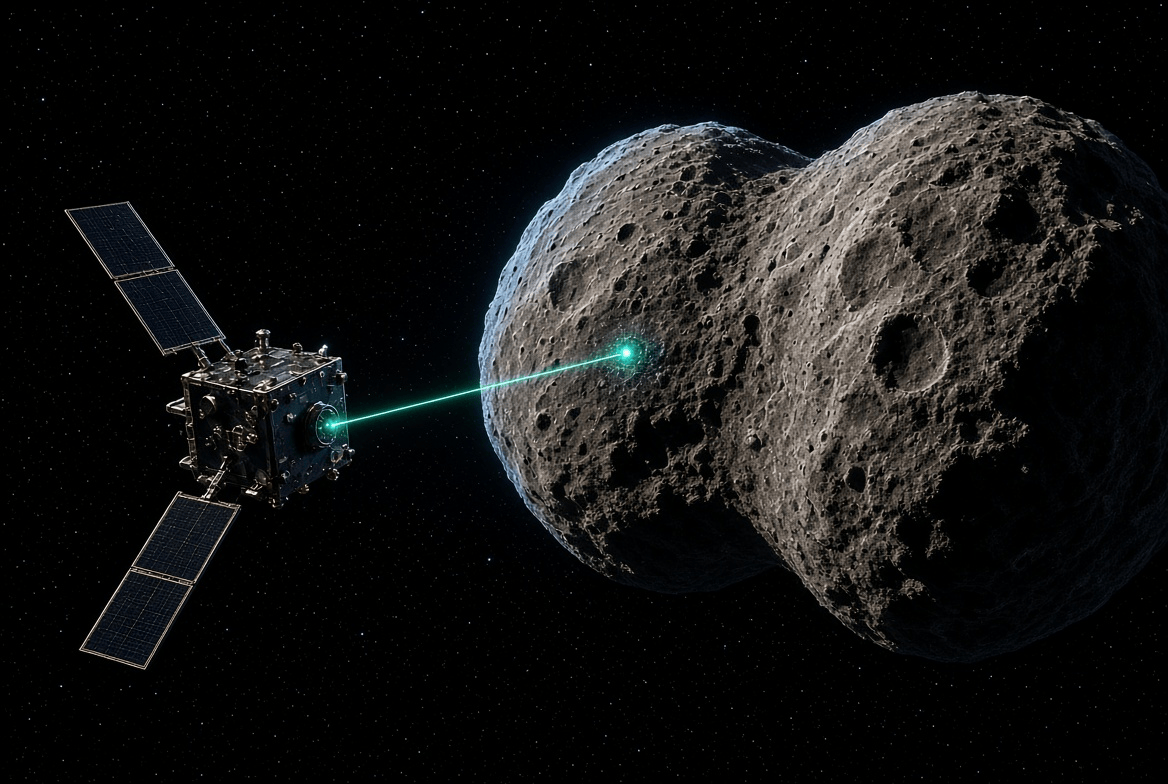
Hayabusa2 just tagged an asteroid with a laser — a first for any flyby.
Laser ranging does more than put a ruler on a pretty space photo. It pins down the size, position, and path of small bodies with the kind of precision planetary defense actually needs: if a rock might someday threaten Earth, you want its orbit known, not guessed.
During its July 5, 2026 dash past asteroid Torifune, JAXA’s veteran probe pulled off the first laser-ranging shot of an asteroid at flyby speed. The instrument was LALT, a laser altimeter descended from Kaguya’s lunar lidar and already proven at Ryugu. It fired twice — from about 20 km and then 15 km, only 4 and 3 seconds before closest approach. Hayabusa2 was screaming past at 5.3 km/s. The beam footprints on the surface were tiny: roughly 30 m, then 23 m.
That is a hard shot. The beam is narrow, the target is small and fast, and background noise wants to drown the echo. The team still hit twice. Combined with tracking data, those two pulses will sharpen Torifune’s orbit and feed better risk estimates. Analysts are now hunting the exact spots where the laser kissed the surface.
A spacecraft built for a leisurely rendezvous just proved it can also take a snapshot of a speeding asteroid with light. 🛰️🔭
The war against Iran has cost the US roughly $37.5 billion, Defense Secretary Pete Hegseth told lawmakers Tuesday.
He said President Trump deserved "praise" for the operation. Eighteen US service members have died so far, including three over the weekend https://t.co/cTzQVMmi75
A former NASA engineer says his team has identified an electrostatic "New Force" that can generate thrust without any propellant, potentially challenging established physics and enabling devices capable of countering Earth's gravity.
Dr. Charles Buhler, a longtime NASA veteran and co-founder of Exodus Propulsion Technologies, claims that his group has uncovered a novel force produced purely through electric fields. Their experimental propulsion system creates directional thrust without expelling mass, unlike conventional rockets that rely on large amounts of heavy fuel. If validated, this propellantless technology could revolutionize spaceflight by slashing spacecraft weight and making sustained, fuel-free exploration of deep space possible.
The broader scientific community remains cautious. A reactionless drive of this kind would appear to contradict Newton's third law and the conservation of momentum. Earlier claims for "impossible" engines, such as the EmDrive, were ultimately debunked after careful testing eliminated experimental artifacts.
Buhler's extensive expertise in electrostatics, developed at NASA's Kennedy Space Center, gives the announcement more credibility than most fringe proposals. Nevertheless, the results require rigorous independent replication and peer-reviewed validation before they can be accepted as a genuine breakthrough.