Listening to Gen (Rtd) Fred Ibingira recount how, during the insurgency of late 1990’s, commanders were required to sign letters accepting the ultimate consequences should they fail to stop the advance of the abacengezi, was a powerful reminder of what accountability looked like when Rwanda’s very survival was at stake.
The point is not the firing squad itself. It is that the responsibility to protect the nation was made unmistakably real.
This made me reflect on a question for all of us.
What is the equivalent, in our own fields, of that level of accountability? What consequence, standard or commitment is strong enough to keep us focused on the mission of rebuilding Rwanda and ensuring that our country never again falls into the hands of those who sought to destroy it?
Nations are not only protected by soldiers at the front. They are also protected every day by citizens, public servants, teachers, entrepreneurs, artists and leaders who refuse complacency and take their responsibilities seriously.
These were commanders who had already faced death on the battlefield. Yet what shook them was not simply the prospect of dying—it was the prospect of failing in the duty entrusted to them.
That distinction says something profound about Rwanda’s sense of leadership.
@AssumptaMuke@wasac_rwanda@PromesseK14@wasac_rwanda iRI saranganya ntaryageze kumucyo ukwezi kurashize nkuko Assumpta abivuze,abashinzwe iyi zone (Kicukiro,Kanombe, Rubirizi) ntibakinitaba ama telephone. Mudufashe
Thank you @umutoninadia7@JackieLumbasi for highlightin autism, special education,and inclusion on @RwandaTV. As a parent of a child w/ SEN, I
appreciate these conversations.We need strong collabo btn @RwandaHealth and @Rwanda_Edu to make inclusive education more affordable.
UPDATE: 8 South Sudanese University students from INES Ruhengeri, in Northern Rwanda, deported this week after investigations linked them to acts of violence & thefts. The students were accused of assaulting motorcycle taxi operators, intimidating residents, and carrying weapons.
“Confronting historical responsibilities requires real courage, because it generates fierce opposition by those with a case to answer. You need a strong sense of humanity to see it through. President Macron, I want to commend you on both counts: courage and humanity.
You acknowledged that France could have stopped the genocide, but did not. In response, I described your words as something more valuable than an apology: namely, the truth. This door was first opened by President Nicolas Sarkozy, and I wish to commend him today.
The Genocide against the Tutsi was foreseeable, and in fact foreseen, and France was in a unique position to observe and to act. It took too long for France to come to terms with its role, causing additional pain. And on some points, we still have not found consensus. I fully understand the feelings of those survivors and advocates, who remain dissatisfied with the official record. But I believe that our common work has initiated a journey towards truth, which is irreversible.
And France was not alone in falling short, far from it. Many other countries did so as well, but none has gone as far as France in setting the record straight and accepting its part in the tragedy.” President Kagame | Inauguration of Monument in Paris honouring the victims of the 1994 Genocide Against the Tutsi.
Rwanda : Emmanuel Macron et Paul Kagamé ont inaugurés à Paris un nouveau mémorial en hommage aux victimes du génocide perpétré contre les Tutsis en 1994. Une double stèle, œuvre de l'artiste Grada Kilomba. Les précisions de Timothé Marouzé.
🔴 La Caméra d'or, qui récompense le meilleur premier film dans toutes les sections du festival, revient à la réalisatrice rwandaise Marie-Clémentine Dusabejambo pour "Ben'imana".
#Cannes2026
Rwanda keeps raising the standards that most African countries are neglecting.
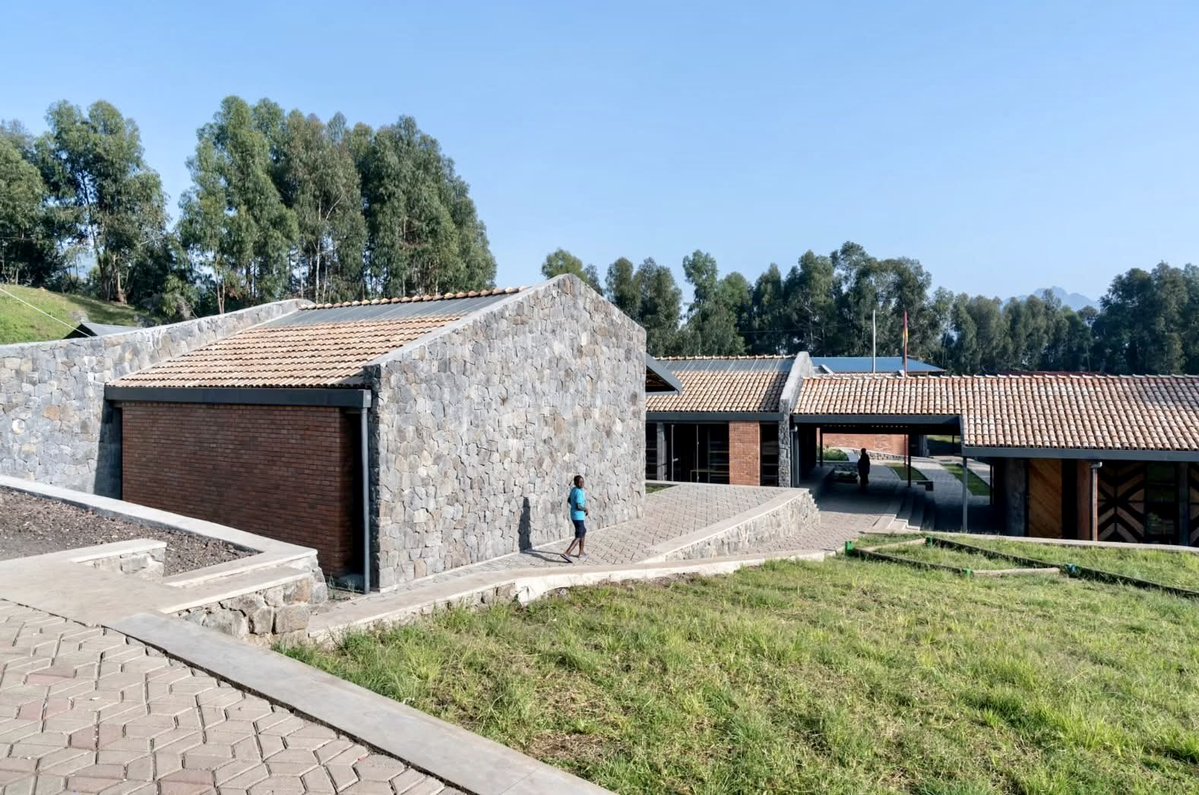
Ruhehe Primary School sits along a gently curving wall of local volcanic stone, paying homage to Rwandan craftsmanship. Volcanic rock on the walls. Clay roofing tiles that muffle rainfall so lessons continue through storms. Woven bamboo and bark panels filtering light and absorbing sound. 80 percent of construction materials sourced within 50 kilometres of the site. 75 percent of the budget spent inside Ruhehe Village and Musanze district. 110 local workers hired. 35 percent of them women.
Now look at what we build and call a school across most of this continent. A cement block box. Plastered over. Painted yellow on top and ox-blood red at the bottom. No ventilation strategy. No acoustic consideration. No connection to the landscape or the culture. A building that could exist anywhere and therefore belongs nowhere.
The material knowledge is here. The stone is here. The clay is here. Rwanda proved that building well does not cost more and it costs differently, and it pays back in ways a painted cement box never will.
This is not a foreign standard. This is an African one.
Ruhehe Primary School, Musanze District, Rwanda 🇷🇼 | MASS Design Group + African Design Centre | 1,120 students | 2018 | 📷 Iwan Baan
"Sanctions or different measures are meant to hurt people, in a way we are hurt. But I think it would hurt more by not doing what we are doing."
- President Paul Kagame
#RBANews#ACF2026
It's about time for some attention to the suffering of Congo's Tutsis. All focus seems to be on what Rwanda is doing wrong while the DRC's Govt gets a pass. Justice for Congo's Tutsis is a foundational problem which a long-term solution must address!
https://t.co/4h5OMOC9Tf