For more biblical encouragement about spiritual growth and God's purpose for mankind, I invite you to follow America in Prophecy on Facebook: https://t.co/GjSqquDe5U -- Bob S., Founder of @ThingsAboutGod.
ARE WE SEEING LIFE FROM GOD'S PERSPECTIVE -- OR THE WORLD'S?
Have you ever considered how much of our thinking is influenced by the world around us? Every day, we are exposed to news, opinions, entertainment, and ideas that shape how we view life. Without realizing it, we can begin measuring success, happiness, and even right and wrong by society's standards rather than God's. The apostle Paul reminds us that our thinking must be directed toward something far greater than this present physical world.
In Colossians 3:1-2, Paul wrote, "If then you were raised with Christ, seek those things which are above, where Christ is, sitting at the right hand of God. Set your mind on things above, not on things on the earth." Paul was describing the spiritual change that begins when we repent, are baptized, and receive God's Holy Spirit. We are raised from the waters of baptism to walk in newness of life, as Romans 6:4 explains. We have not yet been born into God's Family as immortal spirit beings. That transformation awaits the resurrection at Christ's return.
But our thinking must begin changing now. Setting our minds on things above does not mean neglecting our families, responsibilities, or daily lives. It means allowing God's Word to guide how we approach them. Our priorities, decisions, relationships, and conduct should increasingly reflect His way of life rather than the attitudes of the surrounding world.
Jesus Christ prayed to the Father in John 17:17, "Sanctify them by Your truth. Your word is truth." Notice that God's Word does more than provide helpful advice. It reveals His standards of right and wrong, His purpose for mankind, and the way we should live.
We should never place human reasoning above God's revealed truth. Yet that does not mean God expects us to stop thinking or examining what we believe. He tells us to prove all things, search the Scriptures, and develop understanding. Our reasoning must be guided by His Word rather than used to explain away what He commands.
Proverbs 3:5 reminds us, "Trust in the LORD with all your heart, and lean not on your own understanding." There will be times when God's instructions conflict with popular opinion or our personal preferences. Genuine faith means trusting His wisdom enough to obey Him, even when doing so requires us to change.
And what a remarkable future God has placed before His called children! We are being prepared to become immortal members of His Family, serving with Jesus Christ in the Kingdom He will establish upon this earth. Keeping that purpose in mind gives meaning to the ordinary decisions we make today.
Seeing life from God's perspective begins when we allow His truth to change the way we think, the choices we make, and the people we are becoming.
Are we allowing the world to shape our thinking, or are we allowing God to transform it?
For more biblical encouragement about spiritual growth and God's purpose for mankind, I invite you to follow America in Prophecy on Facebook: https://t.co/2UjnGA54mc -- Bob Schenfield, Founder of @ThingsAboutGod.
THE RICH MAN AND LAZARUS -- THE GREAT GULF AND THE TRUTH ABOUT IMMORTALITY
What really happens when we die? Do we possess immortal souls that immediately go to heaven or descend into an eternally burning hell? The account of the rich man and Lazarus in Luke 16:19-31 is often used to support that belief. But when we examine Jesus Christ's words alongside the rest of Scripture, we discover something very different.
Jesus described a wealthy man who lived in luxury while a poor beggar named Lazarus suffered outside his gate. Eventually, both died. Lazarus was pictured in Abraham's bosom, while the rich man experienced torment. Abraham then told him, "And besides all this, between us and you there is a great gulf fixed" (Luke 16:26).
What does that great gulf represent? It illustrates the permanent separation between those who receive immortality and those who ultimately face the second death. Jesus was teaching through a parable, not describing immortal souls living consciously in heaven or hell immediately after death.
The Bible plainly teaches that human beings are mortal. Ecclesiastes 9:5 states, "For the living know that they will die; but the dead know nothing." Abraham himself died without receiving the promises (Hebrews 11:13). He awaits the resurrection, along with God's other faithful servants.
Immortality is not something we already possess. Paul wrote, "For this corruptible must put on incorruption, and this mortal must put on immortality" (1 Corinthians 15:53). God's firstfruits will receive that glorious change at Christ's return, becoming immortal spirit-born members of His Family. Revelation 20:6 confirms that the second death will have no power over them.
But what happens to those who ultimately reject God? Romans 6:23 declares, "For the wages of sin is death, but the gift of God is eternal life in Christ Jesus our Lord." Notice the contrast. The punishment is death, not everlasting conscious torment. Malachi 4:1-3 describes the wicked being burned up and becoming ashes. Revelation 20:14 identifies the Lake of Fire as the second death.
This does not mean everyone who dies without understanding God's truth is condemned. Following the Millennium, the second resurrection will restore to physical life those who never received their genuine opportunity for salvation. They will be taught God's way and judged during the Great White Throne Judgment (Revelation 20:11-12).
The rich man and Lazarus account also teaches the importance of responding to God's Word. Abraham warned that those unwilling to hear Moses and the prophets would not necessarily be persuaded even by someone rising from the dead (Luke 16:31).
God's purpose is not endless torture, but the gift of eternal life to those who ultimately choose His way. The great gulf reminds us that the final separation will be irreversible. We should therefore treasure the truth God has revealed and faithfully respond to His calling.
For more biblical teaching about immortality, the resurrections, and God's plan for mankind, I invite you to join Observers of the Sabbath and Holy Days on Facebook: https://t.co/R75vde4xmt -- Bob Schenfield, Founder of @ThingsAboutGod.
THE KINGDOM WE PROCLAIM -- THE WAY WE MUST LIVE
What do we teach at @ThingsAboutGod? We proclaim the coming Kingdom of God and explain the way of life that Kingdom will establish throughout the earth. God’s commandments reveal His standards of conduct. His Sabbath and Holy Days help us understand His purpose. The message we share should also be visible in the lives we lead.
Jesus announced the gospel of the Kingdom. After His resurrection, His followers continued that work. Acts closes with Paul “preaching the kingdom of God and teaching the things which concern the Lord Jesus Christ with all confidence.” (Acts 28:31) Christ’s sacrifice, resurrection and role as our Savior are essential to that message. Through Him, we can receive forgiveness and prepare to enter God’s Family and Kingdom.
That Kingdom will transform this earth. When Pilate questioned Jesus, He answered, “My kingdom is not of this world.” (John 18:36) Its authority does not originate in this world’s political systems. At His return, Christ will establish God’s government over the nations and teach humanity the way to lasting peace.
Meanwhile, Scripture describes the spiritual condition surrounding us: “The whole world lies under the sway of the wicked one.” (1 John 5:19) Satan promotes deception, pride, greed and hostility toward God. His influence reaches into governments, religions, commerce and personal relationships. Yet his power remains subject to God’s authority and will not continue indefinitely.
During Christ’s temptation, Satan offered Him authority over the world’s kingdoms in exchange for worship. Jesus answered, “You shall worship the LORD your God, and Him only you shall serve.” (Luke 4:8) His response establishes our priority too. Our allegiance belongs to God.
Living here requires daily responsibilities, work and relationships with others. We should respect lawful authority, act honestly and serve our neighbors. But we must never allow political loyalty, personal advantage or social pressure to replace obedience to God. We cannot represent Christ faithfully while embracing the conduct He condemns.
Jesus told His disciples, “You are the light of the world.” (Matthew 5:14) He then explained how that light should be seen: “Let your light so shine before men, that they may see your good works and glorify your Father in heaven.” (Matthew 5:16) Our example should direct attention toward Him.
That witness takes practical form. Tell the truth when dishonesty would be profitable. Refuse cruelty when others applaud it. Keep God’s Sabbath when convenience suggests otherwise. Show patience, generosity and mercy. A message about righteous government loses credibility when our own conduct is ruled by selfishness.
We need God’s Spirit to develop that character. Through repentance, baptism and receiving His Spirit, we become His begotten children, preparing for birth into His Family at the resurrection. We are learning now the way of life we will help teach under Christ.
Jesus said the gospel of the Kingdom would be preached “as a witness to all the nations.” (Matthew 24:14) At @ThingsAboutGod, we seek to support that commission through clear biblical teaching and faithful example. We proclaim the government Christ will establish -- and strive to live under God’s rule today.
I invite you to join Sabbath-Keepers Church News & Commentary on Facebook for biblical encouragement, fellowship and discussion about living God’s way. https://t.co/VBVERumTKG -- Bob Schenfield, Founder of @ThingsAboutGod.
KEEP PRAYING -- GOD HAS NOT FORGOTTEN YOU
Have you prayed about something for so long that you hardly know what else to say? Perhaps an injustice continues, a burden remains or a difficult situation seems unchanged. Waiting can wear us down. Jesus understood that danger. He gave the parable of the persistent widow to teach us “that men always ought to pray and not lose heart.” (Luke 18:1)
The widow had an adversary and needed justice. She brought her case before a judge who neither feared God nor cared about people. For a time, he refused to act. Yet she kept returning. Eventually, he decided to address her complaint because he wanted an end to her continual appeals.
Christ then asked, “And shall God not avenge His own elect who cry out day and night to Him, though He bears long with them?” (Luke 18:7) Here is the assurance we must hold onto: our Father hears His children. Their suffering matters to Him, and He will bring justice.
The judge acted out of selfishness. God acts in righteousness and love. Jesus used the conduct of an uncaring man to help us appreciate how confidently we can approach our caring Father. We do not have to make ourselves troublesome enough to gain His attention.
Persistent prayer expresses our continuing dependence on God. Each time we return to Him, we acknowledge that we need His wisdom, strength and intervention. We can speak honestly about our discouragement while remaining determined to trust Him.
An answer that has not yet come does not mean God has forgotten us. He may be developing patience, preparing circumstances or working toward a purpose we cannot presently understand. We should avoid assuming we know the reason for every delay. We can trust His character even when we cannot explain His timing.
John wrote, “Now this is the confidence that we have in Him, that if we ask anything according to His will, He hears us.” (1 John 5:14) Prayer includes bringing our desires before God while yielding to His judgment. Persistence does not guarantee that every request will be granted exactly as we imagined.
Meanwhile, we must continue doing what God has placed before us. Keep His commandments. Fulfill responsibilities. Seek wise counsel and accept appropriate help. Waiting faithfully involves obedient living as well as prayer.
Christ ended the parable with a question that reaches directly into our time: “Nevertheless, when the Son of Man comes, will He really find faith on the earth?” (Luke 18:8) The issue extends beyond receiving relief from one trial. Will we remain faithful when waiting becomes difficult? Will we still trust God when the world pressures us to abandon His ways?
God’s coming Kingdom assures us that injustice will not have the final word. Jesus Christ will establish righteous judgment on this earth. Our Father’s promises reach beyond the circumstances we face today.
Bring the burden to Him again. Ask for the help you need today, and keep walking in His way. You do not need new words to be heard. Keep praying, trust His faithfulness and refuse to surrender your hope.
I invite you to follow America in Prophecy on Facebook for biblical perspectives on world events and the hope of God’s coming Kingdom. https://t.co/2UjnGA5CbK -- Bob Schenfield, Founder of @ThingsAboutGod.
MADE ALIVE TOGETHER WITH CHRIST
What does it mean to be made alive with Christ? Paul was writing to people who were physically alive, yet he described their former condition as being dead in their trespasses. Sin had separated them from God, and they stood under its penalty. Through Jesus Christ, forgiveness and a restored relationship with their Creator had become possible.
Paul wrote, “And you, being dead in your trespasses and the uncircumcision of your flesh, He has made alive together with Him, having forgiven you all trespasses.” (Colossians 2:13) This new life begins with God’s mercy. Christ’s sacrifice provides the forgiveness we could never obtain by pretending our sins did not matter or by trying to compensate for them ourselves.
We must understand what Scripture means by death. It is not a name for everything unpleasant, nor is it merely conscious existence apart from God. Death is the loss of life. “For the wages of sin is death, but the gift of God is eternal life in Christ Jesus our Lord.” (Romans 6:23) Sin separates us from God and, without His forgiveness, leads to that ultimate penalty.
Through repentance, faith, baptism and receiving God’s Spirit through the laying on of hands, we become His spiritually begotten children. We remain mortal human beings. Our birth into His Family as immortal spirit beings will come at the resurrection. Yet our relationship with Him and our preparation for that future begin now.
Baptism pictures a burial of our former sinful way of life. Paul explains that “just as Christ was raised from the dead by the glory of the Father, even so we also should walk in newness of life.” (Romans 6:4) Coming out of the water begins a life of learning to obey God, resist sin and grow in Christ’s character.
Being made alive with Christ does not mean we are already beyond illness, suffering or physical death. Faithful Christians still face trials. God’s promise reaches beyond them: the One who raised Jesus will also give life to His faithful children. Our hope rests in His power and faithfulness.
Our words should reflect that hope. Proverbs 18:21 teaches that the tongue has serious consequences. Words can encourage, deceive, wound or help restore a relationship. But speaking confidently does not give us power to create immortality or guarantee freedom from hardship. Acknowledging a difficulty does not cancel God’s promises.
Instead, let our speech express honest faith: God knows our circumstances. Christ has opened the way to forgiveness. We can ask for help, repent when we stumble and continue obeying even when life is difficult.
The question is whether our daily conduct reflects the life God has begun in us. Are we leaving behind dishonesty, bitterness and selfishness? Are we becoming more patient, faithful and willing to serve?
Being made alive with Christ gives us a new direction and a future beyond the grave. Treasure His forgiveness, remain close to Him and practice His way today as you look toward the resurrection and eternal life in God’s Family.
I invite you to join Observers of the Sabbath and Holy Days on Facebook for biblical encouragement, fellowship and discussion about God’s plan and way of life. https://t.co/R75vde4xmt -- Bob Schenfield, Founder of @ThingsAboutGod.
GET TO KNOW THE NEW YOU
When God calls us, He begins a work that changes how we think, what we value and how we live. Our past no longer has to determine our direction. Through repentance, forgiveness and the power of God’s Spirit, we can begin putting away sinful habits and developing the character of Jesus Christ.
Paul described that change: “I have been crucified with Christ; it is no longer I who live, but Christ lives in me; and the life which I now live in the flesh I live by faith in the Son of God, who loved me and gave Himself for me.” (Galatians 2:20)
Paul was describing the surrender of his former sinful way of life. He remained a mortal human being, but his life now belonged to Christ. His desires, decisions and conduct were to come under the direction of the One who had given Himself for him.
We need to understand what this means. We are physical human beings, living souls, with a human spirit that gives us understanding. We are not immortal spirit beings inhabiting disposable bodies. Through repentance, baptism and receiving God’s Spirit through the laying on of hands, we become His spiritually begotten children. Our birth into His Family as immortal spirit beings awaits the resurrection.
Meanwhile, conversion involves real work within us. Paul wrote that “our old man was crucified with Him, that the body of sin might be done away with, that we should no longer be slaves of sin.” (Romans 6:6) The “old man” describes the person we were under sin’s rule. Baptism pictures the burial of that former life and our commitment to walk in newness of life.
But baptism does not instantly remove every wrong desire or make us spiritually mature. We still face temptation. Old reactions can return. Pride, resentment, selfishness and impatience must be recognized and overcome through repentance and God’s help.
Getting to know the “new you” means understanding the person God is developing. Paul tells us to “put on the new man which was created according to God, in true righteousness and holiness.” (Ephesians 4:24) That requires renewed thinking followed by obedient action.
When someone offends you, practice patience and forgiveness. When dishonesty seems convenient, tell the truth. When your desires conflict with God’s commandments, choose His way. Christ living in us through God’s Spirit becomes evident in these everyday decisions.
Faith involves trusting God enough to act on His Word. Our minds have an essential part in that process. We study, consider His instructions and learn to distinguish truth from error. Feelings alone cannot tell us whether we are following Him.
As you read Scripture, ask what it reveals about God’s character and what needs to change in your own life. Pray for understanding and strength, then practice what you learn.
God has given His begotten children a remarkable future. We are preparing to share immortal life in His Family. Today, let that calling shape the person you are becoming -- with Christ living in you and His way increasingly reflected in your conduct.
I invite you to join Sabbath-Keepers Church News & Commentary on Facebook for biblical encouragement, fellowship and discussion about living God’s way. https://t.co/xryIDlQcFa -- Bob Schenfield, Founder of @ThingsAboutGod.
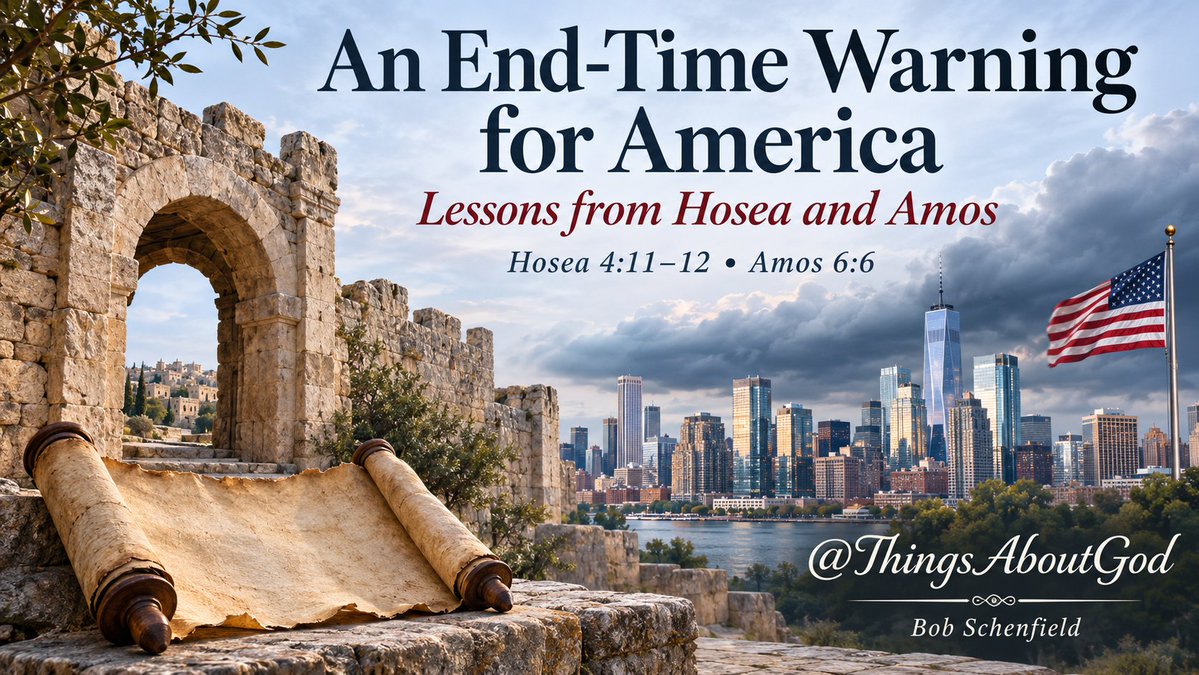
HOSEA AND AMOS -- AN END-TIME WARNING FOR AMERICA
Can a nation be prosperous, powerful and confident while approaching disaster? Ancient Israel was. Hosea and Amos warned a people enjoying material abundance while rejecting the God who had blessed them. Their messages reach beyond ancient history. They carry an urgent warning for the United States and other modern descendants of Israel as we approach the end of this age.
Both prophets confronted the northern kingdom before its fall to Assyria. Beneath its prosperity lay injustice, idolatry and spiritual decay. The people trusted their wealth and national strength while disregarding God’s commandments. They mistook outward success for lasting security.
Through Hosea, God declared, “Harlotry, wine, and new wine enslave the heart.” (Hosea 4:11) He described people seeking counsel from wooden idols instead of their Creator. Their loyalties had shifted, and their judgment had become corrupted.
America needs to consider that warning. Our wealth, technology and military strength cannot protect us from the consequences of rejecting God. As descendants of Joseph through Manasseh, Americans have inherited extraordinary national blessings. Those blessings bring responsibility, not permission to disregard the One who provided them.
Modern idols need not be carved from wood. Political leaders, possessions, entertainment and personal desires can command the loyalty that belongs to God. When popular opinion determines right and wrong, a nation can become spiritually intoxicated while congratulating itself on being enlightened.
Hosea identified the underlying failure: “My people are destroyed for lack of knowledge.” (Hosea 4:6) The verse goes on to explain that they had rejected knowledge and forgotten God’s law. Their problem was not a shortage of information. It was a refusal to accept God’s instruction.
Amos described people who “drink wine from bowls, and anoint yourselves with the best ointments, but are not grieved for the affliction of Joseph.” (Amos 6:6) They enjoyed their comforts while remaining unmoved by their nation’s condition. Prosperity had helped dull their conscience.
We must not let that happen to us. Do dishonesty, violence, injustice and broken families still trouble us? Or have we become so accustomed to them that we simply return to our entertainment? National decline becomes personal when we absorb the attitudes producing it.
These end-time warnings call for repentance. Recognizing America’s prophetic identity means little if we refuse to examine our own conduct. God’s Ten Commandments, including His seventh-day Sabbath, remain the standard. We must measure our choices by His Word and turn from the compromises we have excused.
Ancient Israel eventually discovered that prosperity could not shield it from judgment. America must not assume its power makes it immune. We cannot announce dates, but we can recognize the danger of repeating the sins God condemned.
Yet judgment is not the end of the message. Hosea and Amos also point toward restoration. Jesus Christ will return, establish God’s Kingdom on earth and teach the nations righteousness. God promises, “I will bring back the captives of My people Israel.” (Amos 9:14)
America needs that hope -- and the repentance these warnings demand. The time to listen is now.
I invite you to follow America in Prophecy on Facebook for biblical perspectives on America’s future and the coming Kingdom of God. https://t.co/2UjnGA54mc -- Bob Schenfield, Founder of @ThingsAboutGod.