Kano business leaders to Peter Obi: "Remember us when you become the president. We will vote wisely. We will vote with our conscience. Help us restore the economic status of Kano. We know that you are a businessman and you know what to do."
NIGERIANS, GO AND VERIFY (4)
Building a Healthy Nation: Our Health Sector Record in Anambra
Peter Obi
In the previous instalment of this series, I discussed our investments in education and explained why we considered human capital development central to the progress of Anambra State. Another sector that received considerable attention under our administration was healthcare. We understood that education gives people the tools to build their future, while good healthcare enables them to live healthy and productive lives.
When we assumed office in 2006, the healthcare system in Anambra faced serious challenges. Our health institutions required rehabilitation, medical equipment was inadequate, many communities lacked accessible primary healthcare facilities, and several medical training institutions had not secured accreditation. We therefore decided to approach healthcare as a comprehensive development priority, rather than concentrate resources on a few prominent hospitals.
Under our Anambra Integrated Development Strategy (ANIDS), we invested simultaneously in primary, secondary, and tertiary healthcare, medical training, maternal and child health, medical equipment, and partnerships with religious and private institutions.
Our approach was simple: healthcare should be accessible to people wherever they live, and the quality of treatment they receive should not depend on their status or whether they live in a city or a rural community.
Building a Teaching Hospital and College of Medicine
One of our most significant achievements was the establishment of the Chukwuemeka Odumegwu Ojukwu University Teaching Hospital at Awka.
We initiated, constructed, equipped, and secured accreditation for the institution, building it virtually from scratch. When I discovered that the state university was admitting medical students without having a teaching hospital through which they could complete their training, possibly with the intention of assigning them elsewhere, I considered the situation unacceptable. We therefore embarked on the construction of a modern teaching hospital to address this deficiency.
We constructed more than 25 buildings and provided facilities for the College of Medicine, laboratories, pathology, accident and emergency services, pediatrics, male and female wards, special wards, consultant clinics, and other essential departments.
We also provided vehicles, including ambulances and staff buses, to support the hospital and the College of Medicine as part of the accreditation requirements.
The objective was not merely to build another hospital but to establish an institution capable of providing specialist healthcare while training the next generation of Nigerian medical doctors.
Rehabilitating General Hospitals
We also recognized that a teaching hospital alone could not meet the healthcare needs of the population. General hospitals had to function effectively because they provide the essential link between primary healthcare and specialist treatment.
We rehabilitated and resuscitated 15 general hospitals across the three senatorial zones of Anambra State. We undertook substantial improvements in their buildings, wards, equipment, and general facilities.
In 2013, we provided ₦400 million for the ongoing renovation of 11 selected general hospitals, alongside other healthcare interventions.
Our intention was to ensure that people did not have to travel unnecessarily long distances to obtain basic secondary medical care.
Taking Primary Healthcare to the Communities
We believed that the best healthcare system is one that prevents illnesses and treats people early, rather than one that waits until minor health problems become emergencies.
That informed our extensive investment in primary healthcare. We built over 120 primary healthcare centers across communities in the 177 autonomous communities of Anambra State and rehabilitated existing facilities.
International Engagements to Strengthen Nigeria’s Democracy Continue.
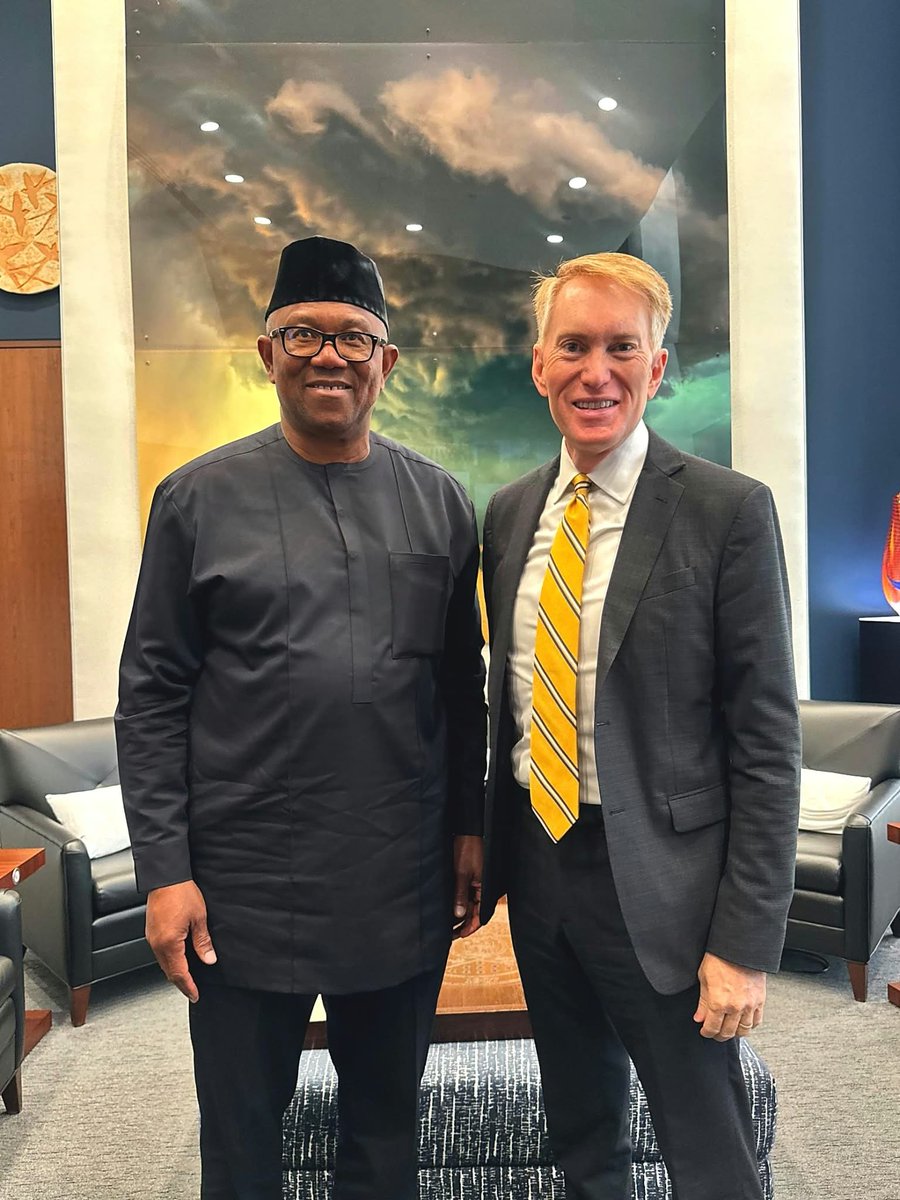
Yesterday, November 17, the second day of our engagements on Capitol Hill in Washington, D.C., we visited the United States Senate and met with some senators, including Senator James Lankford, who kindly invited me over to his office.
I am deeply grateful to Senator Lankford for his warm reception, generous time, and meaningful exchange of views on strengthening democratic institutions, fostering peace, and promoting our shared values.
Our conversations underscored the importance of international collaboration, effective governance, credible democratic processes, and the security and well-being of all Nigerians.
These engagements offer a further opportunity to deepen relationships and advance our shared vision of a peaceful, united, and prosperous Nigeria.
Our commitment to building a nation that serves every Nigerian remains steadfast.
A New Nigeria Is POssible! -PO
We also invested in sophisticated diagnostic equipment to strengthen specialist healthcare. These included CT scan machines, mammography machines, digital X-ray equipment, and ultrasound machines. We further procured ventilators to improve intensive care services, including the provision of four ventilators for the Teaching Hospital’s Intensive Care Unit.
The centre and these investments demonstrated our determination to move beyond basic healthcare and develop facilities capable of handling more complex medical conditions.
Strengthening Mental Healthcare: The Neuropsychiatric Hospital, Nawfia
We also recognised that healthcare must address not only physical illnesses but also mental and psychological conditions. Mental health is an essential component of human well-being and deserves adequate attention in our healthcare system.
We, therefore, invested in the development and modernisation of the Neuropsychiatric Hospital at Nawfia, in Njikoka Local Government Area, supporting improvements in its infrastructure and equipment to strengthen its capacity to provide specialised mental healthcare. The project received national recognition when Dame Patience Jonathan, then First Lady of Nigeria, commissioned the improved infrastructure of the hospital in September 2010.
We also supported the development of the School of Psychiatric Nursing to train professionals in specialised psychiatric care. These interventions reflected our belief that people living with mental health conditions deserve appropriate medical attention, professional care, and human dignity.
Our Partnership with Mission Hospitals
One of the most important aspects of our healthcare policy was our decision to work closely with religious institutions.
We recognised that the Church had historically played a major role in healthcare delivery in Anambra State. Mission hospitals had served communities for generations, often providing services where government facilities were inadequate or unavailable.
Rather than ignore these institutions because they were not government-owned, we decided to support them. We restored government grants, provided vehicles, and funded infrastructure, equipment, wards, theatres, and other facilities required to improve their services and secure accreditation.
Our interventions covered institutions including:
Our Lady of Lourdes Hospital, Ihiala.
Iyi-Enu Hospital, Ogidi.
Holy Rosary Hospital, Waterside, Onitsha.
St Joseph’s Hospital, Adazi-Nnukwu.
St Charles Borromeo Hospital, Onitsha.
Immaculate Heart Hospital, Nkpor.
Diocesan Hospital, Amichi.
In 2013, we released an additional ₦3 billion to selected mission and government-owned health institutions. At that time, Our Lady of Lourdes Hospital, Iyi-Enu Hospital, and St Joseph’s Hospital received ₦200 million each, Holy Rosary Hospital received ₦150 million, while Diocesan Hospital, Amichi, received ₦100 million. Other institutions also benefited from the intervention.
The funds were intended to improve facilities, purchase equipment, upgrade wards and theatres, and help institutions meet accreditation requirements.
This partnership produced remarkable results. Institutions that had previously struggled to meet accreditation requirements began developing recognised schools of nursing, midwifery, and health technology. Iyi-Enu Hospital and Borromeo Hospital have also developed into university teaching hospitals.
Our philosophy was that government should not monopolise healthcare delivery. If a mission or private hospital was providing quality services to our people, it deserved government support. What mattered was the service rendered, not who owned the institution.
Training and Accreditation of Healthcare Professionals
We also understood that buildings and equipment alone could not produce a functional healthcare system. We needed qualified doctors, nurses, pharmacists, midwives, laboratory scientists, and other healthcare professionals.
The experience we acquired in Anambra State, as well as the lessons we observed elsewhere, provides a practical foundation for this national ambition. What we did in a state can be adapted and expanded to serve a country of over 200 million people. The scale is different, but the principles of planning, prudent management, accountability and measurable results remain the same.
In the next instalment, Go and Verify (5), I will discuss our efforts in the road sector. -PO
It’s a lie. This myth must die. Right now Nigerians pay a fee to transfer money, pay a fee to withdraw money (in a cash heavy society), pay for electricity when it’s metered and they can use their eyes to see their usage etc, pay for water infrastructure by building boreholes and then paying for the light to pump periodically or literally buying it by the drum load in some areas.
Up until the protests at the toll gate, Nigerians paid. When I was a child and we travelled across the country, people paid at the toll gates then too
Most of these payments already exist directly, even more exist indirectly. This idea that Nigerians just won’t pay for shit is a myth that MUST die. There’s nothing that has an established use and bill structure and that works that Nigerians will not broadly pay for.
A former U.S diplomat and retired army colonel Al Short endorses Peter Obi and says Tinubu is a complete failure. He says Obi was exceptional as the governor of Anambra state and is the best to lead Nigeria come 2027.
So as an Urhobo person, you want to vote Tinubu, while Okuama people are still suffering in detention despite a valid court ORDER to release them??
I pour una early morning spit
"I'm a businessman and you can't talk about business in Nigeria without talking about Kano. There were over 300 factories working everywhere. I would come from London to Kano, I'm either selling raw materials or buying. I stay in Central Hotel and eat buffet at the biggest Chinese restaurant in Nigeria. We have to bring back the glory days of Kano."
- Peter Obi