Skill: Formal Proofs
What it is. A plugin that teaches your AI coding agent to prove that the riskiest part of your code keeps a promise, such as "a customer is never charged twice".
Why tests are not enough. A test tries a few situations you thought of. Many of the worst bugs appear only when things happen in an unlucky order: two requests arrive at the same moment, or the network drops halfway through. You rarely think to test those, and they rarely show up until production.
How it works.
- Pick the spot. The agent finds the code where a bug would cost the most, and names what the existing tests miss.
- Build a small model. It writes a simplified description of that code: the steps it takes and the rule it must never break.
- Try every order. A checker runs the model through every possible ordering of those steps, often hundreds of thousands. If any ordering breaks the rule, it shows the exact sequence that did it.
- Prove the check can fail. The agent breaks the model on purpose and confirms the checker catches it, so a pass means something.
- Tie it to the real code. The real code logs what it does during a run, and the checker confirms the model can follow that log step for step.
We read 5,692 GitHub "exploit" repos against the CVEs they claim.
6 in 10 were real.
66 were bait, built to compromise whoever runs them.
One had 383 stars and one hidden line that downloads and runs a program on your machine.
https://t.co/cRzgPNZYo5
#CVE
We have released v2.0 of Symbiont!
Symbiont is our open-source, Rust-based runtime for AI agents that run under policy. 2.0 is a major release. It tightens the boundary between what a model asks for and what actually runs.
Site and GitHub: https://t.co/8Uy62Df8oH
Anthropic has validated what we've been working on for 2 years with their Zero Trust eBook for AI Agents. @ThirdKeyAI and the https://t.co/WIZ8u0he7x even fill in the gaps.
I published a new security preprint:
VectorSmuggle: Steganographic Exfiltration in Embedding Stores and a Cryptographic Provenance Defense
The paper looks at an integrity gap in RAG infrastructure: embeddings are usually treated as opaque numerical artifacts, but vector stores generally lack native/default controls for embedding integrity or provenance.
The finding is nuanced: simple anomaly detectors catch many crude perturbations, but small-angle orthogonal rotation exposes a harder class of embedding tampering. Statistical detection helps, but it should not be the load-bearing control.
I propose VectorPin: a minimal cryptographic provenance protocol that signs a canonical commitment over the source, model, and vector bytes. If the vector is modified after pinning, verification fails.
Paper:
https://t.co/tPVU1is3zT
https://t.co/liGCeeb36t
AI agents are getting more powerful.
The trust layer around them is not.
Today, too much agent safety still depends on prompts, wrappers, and best-effort guardrails. That is not enough for systems that can actually take action.
Introducing OATS: the Open Agent Trust Stack.
OATS is an open specification for zero-trust AI agent execution built around tool contracts, identity, policy, and auditability.
It is also grounded in real implementation work. Symbiont has been applying these ideas in practice over the past year.
The goal: make safe behavior enforceable by design, not optional at runtime.
https://t.co/RBYFYOZdGJ
#AI #AISecurity #AgenticAI #OpenSource
New paper on how Symbiont uses the ORGA loop to secure agents.
"Typestate-Enforced Agent Loops: Making Policy Gates Unskippable at Compile Time"
https://t.co/VcSF8prJy7
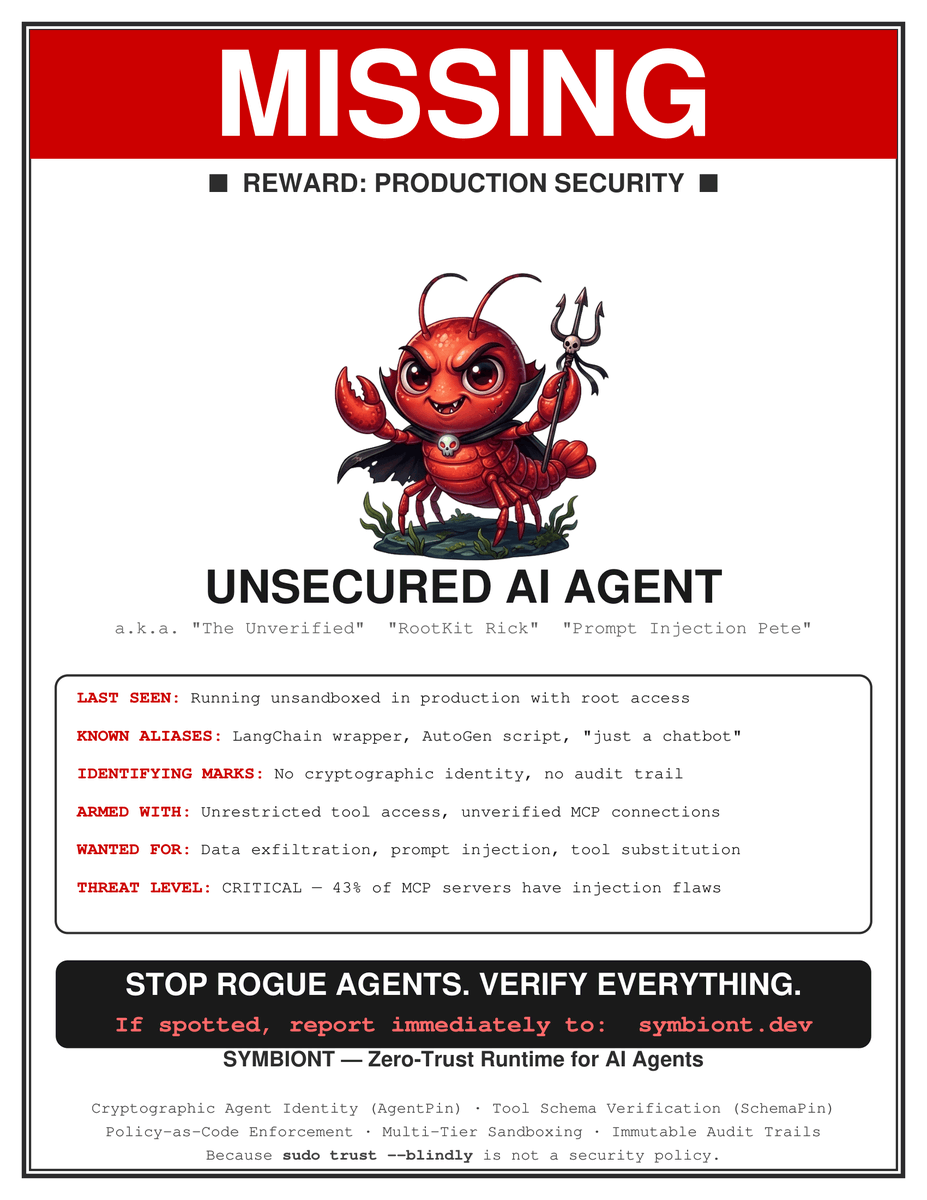
🚨 MISSING: One unsecured AI agent last seen running wild at #SCALE23x with root access and zero identity verification.
No audit trail. No sandboxing. No cryptographic identity. Armed with unverified MCP connections.
If spotted, report to https://t.co/LiimcfT0Ph
#AISecurity
We have updated both Symbiont and symbiont-sdk-python to v0.3.1 adding full REPL (aka Symbi Dojo) and many other new features for building secure, policy aware agents. JS and Go SDKs coming soon!