Advisor, founder, father, travel snob. I mostly tweet about fintech, the travel industry, and technology innovation. Still searching for a ten mile grace
@VerizonNews Are we going to get access to the texts that were sent and a record of the incoming calls that failed during the outage once the service is restored?
What happens when everyone is focused on performance in order to avoid getting laid off instead of actually #creating and #innovating? Good analysis here, esp as it relates to #RTO
https://t.co/VSTaPQ0fYp
Good piece here on the end of Southwest as we knew it. I was A List Preferred (or whatever it's called now) for 10+ years but don't have any reason to choose them these days. RIP #airlines#LUV#wildturkey
https://t.co/ZbVMTQ8ERN
The out of control surveillance state aspect of this story is awful plus it's a terrible look for @ARCtalk to be facilitating all of it
https://t.co/LwbcrDZ1zX
As usual, Ian Schrager gets it when it comes to #hotels, especially in NYC
“There was a time when New York was more open, more democratic,” Schrager says. “Now, it’s become too elitist.” 🎯
Looking forward to seeing how @PublicHotels continues to evolve
https://t.co/IyxHLDgup6
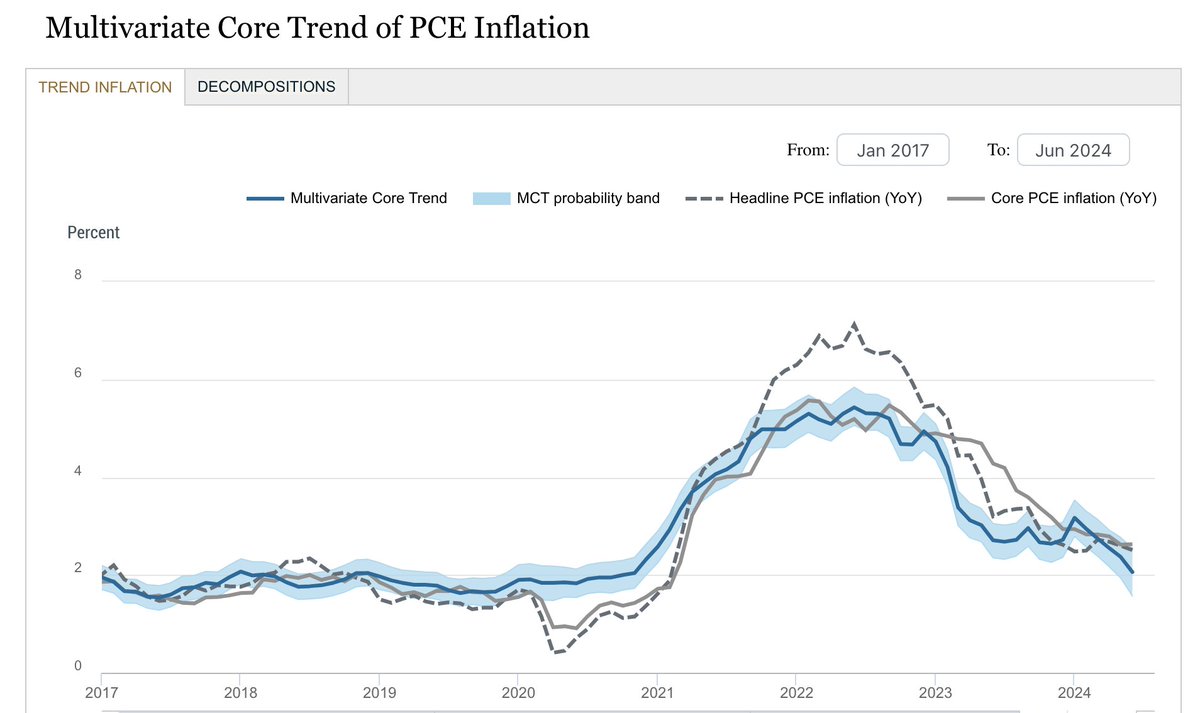
I’ve hesitated to say this at the risk of sounding hyperbolic, but with last week’s big GDP revisions, there is no denying it: This is among the best performing economies in my 35+ years as an economist. Economic growth is rip-roaring, with real GDP up 3% over the past year. Unemployment is low at near 4%, consistent with full employment. Inflation is fast closing in on Fed’s 2% target - grocery prices, rents and gas prices are flat to down over the past more than a year. Households’ financial obligations are light, and set to get lighter with the Fed cutting rates. House prices have never been higher, and most homeowners have more equity in their homes than ever. Corporate profits are robust, and the stock market is hitting a record high on a seemingly daily basis. Of course there are blemishes, as lower-income households are struggling financially, there is a severe shortage of affordable homes, and the government is running large budget deficits. And things could change quickly. There are plenty of threats. But in my time as an economist, the economy has rarely looked better.
Of the Silicon Valley founders I know who went on some of the psychedelic self-discovery trips, almost 100% quit their jobs as CEO within a year.
Could be random anecdotes, but be careful with that stuff.
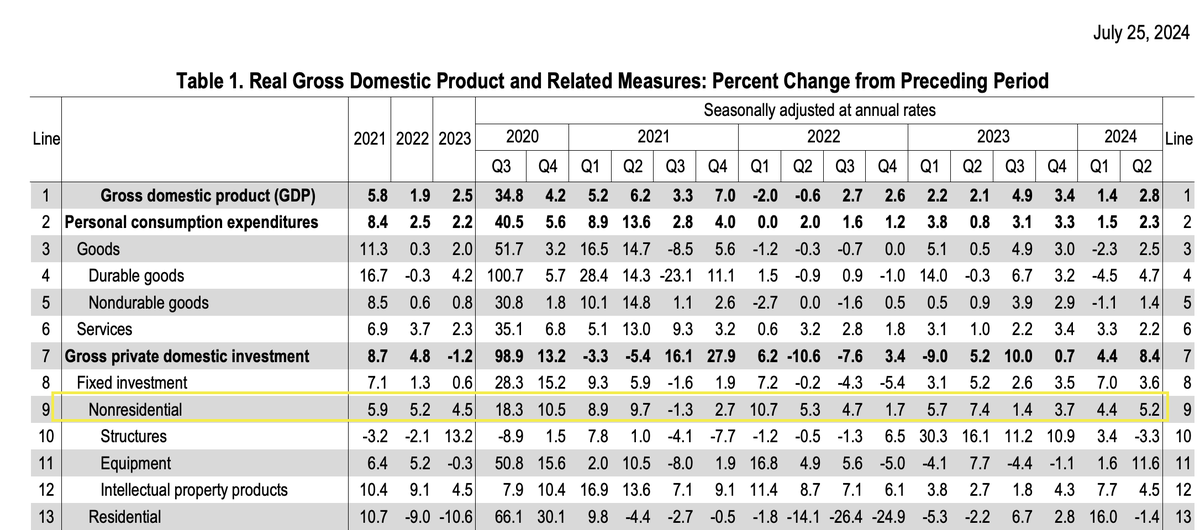
Important: Business investment continues to be really robust. Companies only invest if they are optimistic about the future.
+5.2% non-residential fixed investment in Q2 2024
That's the strongest in a year.
Bottom line: Companies believe in the "soft landing"
12-hour timelapse of American Airlines, Delta, and United plane traffic after what was likely the biggest IT outage in history forced a nationwide ground stop of the three airlines.
We (almost) all hate having too many #meetings, right? Insightful article here from @DKThomp illustrating with data how meetings culture is a real barrier to success
"The typical meeting is a leaky time suck, absorbing people’s attention in a way that cannot be fully measured by simply counting up the total number of hours blocked out for calls," writes @DKThomp: https://t.co/Bov0umqGZp
This true success story has mostly been underreported. Clean energy is a rare contemporary example of government policy driving significant private investment in a meaningful way ..... #solar#IRA#batteries#EVs
https://t.co/BaKmOvdGuc
The Great Flattening
Apple’s iPad ad might not have been good for Apple, but it was a profound encapsulation of what has happened on the Internet; the question is what it leads to next.
https://t.co/axltDoFmZL
The @business interview linked here is worth a watch in its entirety but tl;dr Jenny Johnson endorsing Franklin Templeton going all in on #blockchain for its core service offerings shows how far the #tradfi sector has come. More of this, please
https://t.co/EM8YBkOgr1
Yet another super-smart analysis here from @sytaylor about the areas in financial markets most ripe for technology #disruption. Highly recommend taking a few minutes to read this and #educate yourself
I think there are three disruptive forces reshaping Wall St
1. Fintech APIs
2. Fintech AIs
3. Tokenization
They apply across all products and services, and there’s a patchwork of companies and founders attacking them.
Here's how I think about the map
Capital Markets are:
👉 Highly regulated.
👉 Highly manual.
👉 Hard to upgrade.
👉 Full of sunk costs.
But that’s changing.
But there are three big shifts occurring
a) Banks have played less of a role since 2008; meaning new actors can fill the gaps
b) Alternatives assets are becoming popular but lack market structure like exchanges or CSDs.
c) We haven’t had a major tech upgrade since the 1970s and are due one
Where are the opportunities?
1⃣ Fintech: BaaS for markets? API-first companies are already here. Companies like Drivewealth and Atomic Invest have collectively brought securities and some alternatives to market with APIs
👉 This will go wider into alternatives next
2⃣ Fintech: Platforms for debt raising. Companies like Finley, VaaS, and Setpoint help manage a debt facility. The Arc’s* venture debt marketplace is also an interesting twist on this idea.
👉 Every treasury team will have financial markets embedded in their treasury management software
3⃣ Fintech: Next Gen trading platforms and broker dealers. Younger funds and fund managers will likely adopt the lowest friction UI for trading. Architect* is an example of a company that offers derivatives trading to pro-sumer, startup, or mature funds looking for an ultra-high-performance execution platform.
👉 The next Apollo or Blackstone likely already exists and is currently quite small but using new tools (e.g. @LumidaWealth )
4⃣ AI: AI analysts and agents. Agent Smyth analyzes stock and sector data to help traders prepare for their day or make a buy/sell decision. Lucite provides companies' business overviews, competitive analysis, and financial metrics as an analyst might export from Pitchbook. Finster is a former deepmind and JP Morgan team-building financial data analysts
👉 The first adopters will be a new generation of funds entering capital markets or in their early days
5⃣ AI: AI workflow tools. PDFs are the new oil. This model is popping up all over in Fintech, but it’s especially applicable to capital markets. Everything in capital markets runs on a PDF or spreadsheet, from KYB to ISDA master agreements.
👉 This is the low-hanging fruit use case and makes financial markets products embeddable and 10x less friction
6⃣ Tokenization: Tokenization of money market funds allows 24/7 access. Blackrock has launched a tokenized money market fund BlackRock’s new BUIDL fund, a month after its launch, managing $304 million in assets. Why?
👉 Every CFO wants instantly liquid, high yield products. That isn't true for MMFs today but is with tokenized funds.
7⃣ Tokenization: The tokenization of all assets is next. Cash, Stablecoins, Private Credit, Private Equity and commodities are all trading trillions of notional as tokens already.
These three things lead to a 10-year shift that will become the biggest tech upgrade in financial markets since the 1970s. (Incidentally, the 1970s were when the “buy side” behemoths like Blackstone and Bridgewater got their start.)
The adage “this won’t work for capital markets” is incorrect.
If you enjoyed this, check out the link in my bio :)
Very smart piece here from @Rachelwolf00. DLTs have always been an ideal platform for the application of AI and this article gets into many specific use cases, focused on #tokenization of #RWAs
https://t.co/taRtKhn4Nn
@kylascan Well that was a hell of a rewarding journey .... The false feeling of control that many people get from living (and speaking) from a POV of fearfulness is very strong. Uncertainty is their enemy and in these uncertain times, who needs more of that?