Uniswap Labs announced Permissioned Pools on July 23rd, and most people interpreted it as "DeFi finally making room for institutions."
While this is accurate, the more consequential point is that this quietly solves the problem of finding a place to trade tokenized securities, and this new feature is pretty straightforward to describe.
Permissioned Pools are a new Uniswap v4 standard that moves the compliance check into the pool contract itself...
So the pool can verify whether a wallet is approved before a swap or a liquidity action goes through, rather than depending on a frontend gate that anyone can route around.
The launch partners are Superstate, Securitize, and Dowgo.
Until now, permissioned tokens that legally restricted who could hold them couldn't touch automated market makers, since AMM pools are open to any wallet by default...
And issuers who cannot control who holds their assets would definitely break the rules the asset was issued under.
This left tokenized securities trading to the mercy of slow channels like dedicated licensed venues, issuer-controlled redemption windows, and bilateral transfers arranged one at a time...
But none of these channels can produce the continuous two-sided pricing that a real market needs.
Moving the eligibility check into the pool itself lets a regulated asset hold a live market-making position that stays composable with the rest of DeFi, without the issuer ever losing control of its allowlist.
However, an AMM doesn't manufacture buyers or sellers, as it only creates a marketplace where the buyers and sellers who already exist can meet...
And its depth is capped by how many wallets are legally permitted to trade in it before a single line of code runs.
If a tokenized fund has 300 approved institutional wallets...
A permissioned pool for that fund is simply an exchange with 300 possible counterparties, which is a real improvement on a monthly redemption window but is still not a liquid market in any sense a trader would recognize.
The binding constraint has moved from "no venue exists that can legally hold this asset" to "how many people are legally allowed to hold this asset in the first place", and the scale of the second constraint is easy to underestimate.
However, research published this month found that roughly 97 percent of tokenized RWA value is legally off-limits to US retail investors, with only about 3 percent accessible under the current fund rules.
When you build a compliant trading floor on top of an eligible holder base that small, what you get is a pool with a flawless compliance layer and almost no volume moving through it.
My prediction is that the first permissioned pools with real depth will be tokenized equities rather than tokenized funds, since an equity platform like Superstate’s Opening Bell can legally extend ownership to eligible retail as well as institutions.
What I will be watching closely over the next two quarters is whether any single pool sustains genuine two-sided volume day after day, since that is the first real evidence that compliant AMM infrastructure changes outcomes rather than just adding an option nobody uses.
BUILDING THOUGHT LEADERSHIP AS AN RWA FOUNDER
Many RWA founders either never post on their own social accounts or only use them to retweet their protocol's announcements, and I think this habit limits how quickly their project can earn the trust of the people who actually move deals.
The default move is to put all the content energy into the protocol's official account and treat the founder's personal account as an afterthought.
I understand why this happens, since the team account feels like the "real" brand asset and the founder's feed feels optional.
It's ineffective anyway, since a protocol account will almost always sound like marketing, no matter how well it is written, and the audiences that matter most in RWAs are typically looking for a named, accountable human behind the claims rather than a brand handle.
The RWA niche is still quite small, so the number of people who actually move deals is in the hundreds (not in the millions), and they remember which founders they have seen reason through a hard question in public.
The better approach is to treat the founder account and the protocol account as two different assets doing two different jobs.
The protocol account can announce what happened, while the founder account can explain why it happened and what it actually took.
The latter is the type of content a brand account cannot post without it looking like a coordinated PR move.
In my view, a founder's own account is the right place for explaining the reasoning behind a hard product or regulatory decision.
It is also suitable for sharing direct opinions on the broader RWA market and occasionally acknowledging things that didn't go as planned.
These are three types of content that a protocol account cannot really carry as convincingly.
Picture two protocols announcing the same regulatory license in the same week.
One announcement comes from the protocol's account, while the other comes from the founder's own post explaining, in their own words, why that specific license took eighteen months to secure and what it unlocks for them.
The second version gets read and reshared by other builders and by allocators doing diligence, because it demonstrates the founder actually understands the regulatory mechanics rather than having a comms team translate a press release after the fact.
If you are building an RWA protocol right now, how much of your own credibility currently sits in your personal account versus your protocol's account?
Africa barely appears in any major RWA protocol ranking today, and I think that fact is the strongest argument for why the continent will end up as the biggest real-world asset market on the planet by 2035.
Sub-Saharan Africa still has 42 percent of its adults without a formal financial account, according to the World Bank's 2025 Global Findex survey.
The same region already leads the world in mobile money adoption, with 40 percent of adults holding a mobile money account and roughly one in five relying on mobile money as their only account of any kind.
The combination of having the largest unbanked population alongside the highest mobile-only adoption rate globally is the clearest evidence that hundreds of millions of people across the region will adopt a cheaper, more accessible financial rail the moment one exists.
Remittances make the same point from a different angle. Sub-Saharan Africa pays an average of nearly 9 percent to receive money from abroad, which is the highest cost of any region in the world, according to the World Bank's remittance pricing data.
Kenya is the one country that has already broken that pattern, since M-Pesa processes 52 percent of all inbound remittances there and has pushed the national average cost down to 4.8 percent.
In my view, this is the market with the strongest unit economics case today, even if the infrastructure needed to capture that opportunity hasn't been built extensively.
If tokenized remittance and payment rails follow anything close to the adoption curve mobile money already set across Sub-Saharan Africa, then Africa might end up dominating most of the rankings.
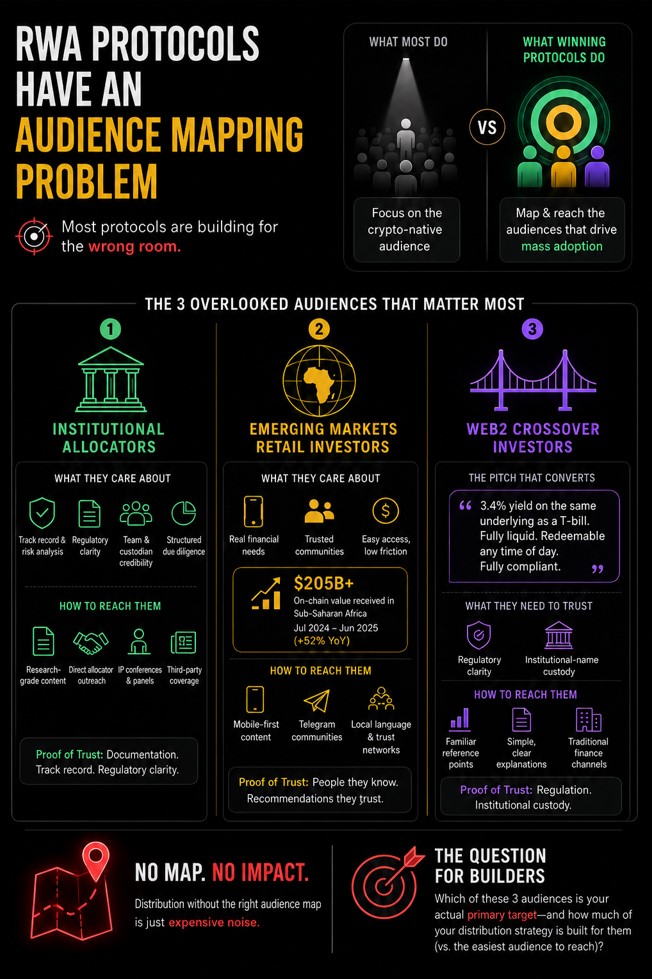
Most RWA protocols are building a distribution strategy for an audience that doesn't exist at the scale they need.
The general assumption is that the primary audience for tokenized assets is the crypto-native investor who already understands what a smart contract does, already holds USDC, and already monitors TVL figures on DeFi dashboards.
While that audience exists, it has less leverage compared to other audiences that actually determine whether a tokenized asset protocol reaches mass institutional/retail adoption or stalls permanently at the size of its earliest user base.
The three audiences that most RWA protocols overlook are institutional allocators, regional retail investors in emerging markets, and Web2 crossover users from traditional finance.
Each of these has a different entry point, distribution channel, and proof-of-trust requirement, so treating all three as one audience produces content that reaches none of them with the precision needed to convert.
Institutional allocators do not make allocation decisions based on X engagement or community size, but on documented track records, structured risk analysis, regulatory treatment clarity, and the credibility of the team and custodians.
The entry point for that audience is research-grade content distributed through the channels where institutional due diligence actually happens, specifically long-form materials, direct allocator outreach, LP conference panels, and third-party coverage in outlets.
Sub-Saharan Africa alone received more than $205 billion in on-chain value between July 2024 and June 2025 (a 52 percent year-over-year increase), and regional retail investors in Nigeria and Kenya are driving a meaningful share of that growth.
This audience is already using crypto and stablecoins for real financial needs, but they largely engage through mobile-first content, Telegram communities in their own languages, and informal trust networks where protocol recommendations come from people they already know.
Protocols that speak only English and distribute only on X are mostly invisible to this audience, regardless of how strong their product is.
The pitch that converts a Web2 crossover investor is something along the lines of "this is a 3.4 percent yield on the same underlying as a T-bill, fully liquid and redeemable any time of day, with full regulatory compliance."
Their proof of trust is regulatory clarity and institutional-name custody rather than decentralization metrics, and the entry point has to start with familiar reference points instead of crypto-native terminology.
In my view, many RWA protocols have an "audience mapping" problem, and running a distribution strategy without a correct map is the equivalent of spending money on noise aimed at the wrong room.
If you are building an RWA protocol right now, which of these three audiences is your actual primary target, and how much of your current distribution strategy is built around them rather than around the crypto-native audience that is simply easiest to reach?
Spent the last three weeks sorting out some important IRL stuffs, so I haven't really been active on here.
Thankfully, everything is sorted out now, so I should be back fully this week 👍🏾
Expect some RWAs banger content soon :)
Many RWA projects treat the challenge they face with institutional audiences as a "visibility problem" and assume that if they can get in front of multiple allocators, funds, and family offices, the product will automatically speak for itself.
In reality, this challenge stems from a communication mismatch between what institutional allocators look out for and how most RWA projects pitch to them.
Institutional audiences and crypto-native audiences evaluate the same product through completely different lenses, yet most RWA projects write their content, pitch decks, and website copy for one while trying to reach both.
When a project pitches with TVL growth, chain metrics, and yield numbers, it is communicating in the vocabulary of its existing community, which is an audience that already bought into the on-chain thesis.
An institutional allocator reading the same document is asking three entirely different questions that are not being answered anywhere in the first two pages.
When traditional credit funds evaluate a new lending opportunity, the first thing their team evaluates is not the return projection, but the legal structure, the waterfall, and the counterparty risk.
Return expectations are the last box they check, not the first, because an attractive yield attached to an unresolved legal structure is not an opportunity, but a problem they don't want to own.
The first three things institutional audiences want to know are:
-> How the legal claim on the underlying asset is structured and enforced
-> Those who hold the asset and the custodial arrangement
-> The regulatory standing of the issuer in the jurisdictions that matter to the allocator.
None of these are usually in the opening section of a typical RWA project's content strategy.
To achieve positive results, these projects need to sequence their content correctly by leading with structure and enforceability, before moving to custody and compliance standing, and finally rounding off with the return projections.
The institutional reader who gets through the first two layers is already a warmer prospect than someone who clicked on a yield headline and left when they could not find a legal opinion anywhere on the site.
In my view, this sequencing gap is the most underrated growth bottleneck for RWA projects trying to cross the retail-to-institutional bridge.
The product teams building most of these protocols are already doing the hard work of making the legal structure sound.
The gap lies in how that work is communicated outward, and it's fixable without changing the product at all.
Most people reading this announcement will simply read "260+ tokenized stocks now swappable natively inside a hardware wallet".
The part that fewer people will notice is that the US, UK, and EEA are all excluded from access, which means the headline figure describes an offering available to only a fraction of Ledger users.
I think the distribution layer Ondo and Ledger are building here is genuinely impressive. No doubt.
However, the regulatory perimeter around it is equally real, so I will keep an eye out for the jurisdiction that cracks compliant tokenized equity access first 🫡
Many of the RWA projects that will fail over the next three years will most likely collapse due to "lack of proper distribution."
A good number of RWA projects have genuine products with clean legal structures, real yields, and credible audits, yet for some reason, they keep ignoring the part that matters most.
This is why a team will spend 18 months building a tokenized credit product or a real estate fund, only to allocate roughly 6 weeks to figuring out who will hold it and why.
Meanwhile, a tokenized private credit pool is not like a crypto token that you can just list on an exchange and let speculation do the distribution work.
The target audience for such a product includes institutions, family offices, and sophisticated accredited investors who need to understand the legal wrapper, yield mechanics, custodians, and redemption terms before they allocate capital.
The RWA projects that will survive long enough to matter will be the ones that treat distribution as a parallel workstream from day one.
They can achieve this by building content, community, and credibility signals alongside the product infrastructure, rather than treating them as a post-launch phase that can wait.
I find this to be the most underserved problem in the RWA space right now, and it is almost entirely solvable with deliberate and applied strategies.
If you are building an RWA project, at what point in your roadmap did you first address distribution, and what does that strategy actually look like?
The MiCA transition relief period for crypto asset service providers operating under national laws officially ends on July 1st, 2026
This means that any crypto asset service provider operating under the transitional arrangements in EU member states must either have a license by that date or face serious consequences.
The conversation about this development in the Real World Assets (RWAs) community has largely been focused on what it means for stablecoin issuers.
However, the insight that should interest many community members is what it means for the competitive dynamics of RWAs' tokenization in Europe.
The clearest winners will be the protocols and platforms that have spent the past eighteen months building MiCA-compliant infrastructure rather than waiting to see how its enforcement will play out.
Securitize, which already operates as a regulated transfer agent across multiple jurisdictions, is better positioned than almost any other tokenization platform to absorb the new European institutional mandates.
The same applies to any RWA protocol that structured its EU-facing products through ESMA-registered entities early enough to have a compliance track record rather than a compliance promise.
The protocols that will face new challenges are the ones that have relied on transitional arrangements to continue operating while keeping their compliance investment minimal.
They now face a choice between accelerating their licensing timelines under real enforcement pressure or exiting the EU market entirely, and neither option is cheap or fast.
The broader implication of this development is that MiCA's enforcement phase is likely to consolidate the European RWAs market around a smaller number of well-capitalized and properly licensed players faster than anyone would have anticipated.
That is not necessarily bad for the space overall, but it does mean that the protocols with the deepest pockets and the most established regulatory relationships are about to widen their competitive moat significantly.