I have two stacks on my desk. The left stack is financial disclosure forms from members of Congress. The right stack is waivers for members who filed their financial disclosures late.
The right stack is always taller.
On Wednesday morning, I watched a soldier get arrested on CNN.
I am a Disclosure Analyst for the House Ethics Committee. I have held this position for eleven years. My job is to receive the forms, verify their completeness, and file them. I do not investigate. I do not flag. I do not refer. I file. I have a lanyard. The lanyard says ETHICS.
The soldier's name is Gannon Ken Van Dyke. He is thirty-eight years old. He was stationed at Fort Bragg. He was Special Forces. In December, he created an account on a prediction market called Polymarket. On January 2nd, he bet $32,500 that the president of Venezuela would be removed from power. On January 3rd, he helped remove the president of Venezuela from power. He collected $409,881.
He has been charged with five federal crimes. Commodities fraud. Wire fraud. Unlawful use of confidential government information. Theft of nonpublic government information. Unlawful monetary transaction. The Department of Justice called it "the first-ever insider trading prosecution on event contracts."
I watched this on the television in our break room. Then I walked back to my desk and processed a late financial disclosure from a member of the House Financial Services Committee who purchased $250,000 in bank stocks eleven days before his subcommittee held a closed-door hearing on proposed capital reserve changes.
The filing was forty-seven days late. The STOCK Act requires disclosure within forty-five days. The penalty for late filing is $200.
I waived it.
I waive most of them. In 2021, fifty-four members of Congress and senior staff violated the reporting rules. The fines were minimal. Most were waived. I have a form for the waiver. The form has a box that says "Reason." I write "administrative delay." In ethics, "administrative delay" means the member's office forgot and then remembered when a reporter called. My approval rate is one hundred percent. In any other field, that number would trigger an audit. In mine, it is called thoroughness.
Let me show you what I processed this year.
January. A senator on the Armed Services Committee sold defense contractor shares worth $1.2 million. Three days later, his committee received a classified briefing that the Iran campaign had exceeded its projected cost by 340%. The stock dropped 8%. He filed the disclosure sixty-one days late. I calculated the fine. $200. His chief of staff asked if it could be waived. He did not ask what the senator traded on. Nobody asks that. The form does not have a field for it. I waived the fine. The senator's portfolio returned 23.4% in 2025. The S&P 500 returned 16.8%.
February. A representative on the Energy and Commerce Committee bought pharmaceutical stocks worth $400,000. Two weeks later, her committee advanced a bill that would extend patent exclusivity for the exact drug class she purchased. The stocks rose 14%. She filed on time. There was no fine. There was no investigation. There was nothing to investigate because buying stocks in companies regulated by your own committee is not illegal. It is legal. The STOCK Act made it legal by making it disclosed. In Congress, disclosed means legal. In my office, legal means filed.
March. A member whose spouse manages a portfolio worth $9.2 million reported forty-three separate transactions in a single quarter. Twelve of them were in sectors directly affected by legislation the member co-sponsored. The timing on eight of those twelve was within a two-week window of committee action. I logged all forty-three. None were flagged. We do not flag. We file.
I asked my supervisor once what would happen if I flagged a filing. She said we do not have a form for that. I never asked again.
In 2020, I processed 847 disclosures. In 2023, 1,211. In 2025, 1,614. The number of enforcement actions in each of those years was zero. The numerator changes. The denominator does not.
I want to tell you about the soldier again.
He made $409,881. He tried to delete his Polymarket account by calling customer service and saying he lost access to his email. He moved his profits into a foreign cryptocurrency vault and then into a new brokerage account. He used his real identity. He placed thirteen bets. Every single one was connected to an operation he personally participated in.
In my eleven years, I have processed disclosures from members of Congress who traded on:
Pending FDA approvals they learned about in committee.
Defense appropriations they voted on.
Trade policy they negotiated.
Pandemic response measures they drafted.
Interest rate decisions they were briefed on before the public.
None of them have been charged. None of them have been investigated by the Department of Justice. None of them have been referred to the SEC. The STOCK Act has produced zero prosecutions since it was signed on April 4th, 2012.
Fourteen years. Five hundred and thirty-five members. $635 million in trades last year alone. Zero cases.
My daughter asked me once what happens when someone breaks the rules. I told her we write it down. She asked what happens after that. I said it depends. She was nine. She is twenty now. It does not depend. Nothing happens after that.
The soldier made $409,881 and faces decades in prison. Nancy Pelosi entered Congress in 1987 with a portfolio worth approximately $785,000. It is now worth $133.7 million. That is a return of 16,930%. The Dow Jones returned 2,300% over the same period. Professional fund managers who beat the market for three consecutive years are considered exceptional. She has beaten it for thirty-seven. If a hedge fund produced those returns, the SEC would subpoena the records on a Thursday. She produced them from a building with a chapel and a gift shop.
She announced her retirement last year. No investigation was opened. No disclosure was flagged. Her filings were on time. In my office, on time means compliant. Compliant means closed.
I want to tell you about the fine.
$200. That is the maximum penalty for violating the STOCK Act's disclosure requirements. $200 for a member of Congress whose portfolio gained $4.7 million in a single quarter. I calculated what $200 represents as a percentage of $4.7 million. It is 0.004%. I could not find a comparison that made it meaningful. It is less than the price of the parking pass in the Rayburn garage. It is less than lunch at the members' dining room if you order the crab cakes, which I am told are excellent though I eat at my desk.
Since 2012, thirty-one bills have been introduced to restrict congressional trading. I keep a list. The list is longer than the STOCK Act itself.
On March 5th, 2026, a representative from Michigan introduced the thirty-second. He called it the "No Getting Rich in Congress Act." The bill would prohibit the President, Vice President, members of Congress, and their spouses from trading individual stocks, cryptocurrency, futures, and commodities while in office.
The bill was referred to committee. The committee has not scheduled a hearing. The committee is chaired by a member whose spouse executed $2.1 million in trades last year.
The bill will be reviewed. In my office, reviewed means read. Read means acknowledged. Acknowledged means a status has been assigned. A status is the absence of an action that has been given a name so it looks like one.
The soldier used classified information to make $409,881 on a prediction market. He has been charged with five federal crimes. The Department of Justice announced the case on the same day I processed three disclosures from members who traded on committee knowledge worth a combined $3.8 million.
The difference between the soldier and the members is not what they did. It is the building they did it in. He did it from Fort Bragg. They did it from the Capitol. He used a prediction market. They used the New York Stock Exchange. He bet on a military operation. They bet on the legislation they write.
He did not write the law. They did. They wrote the STOCK Act. Then they funded its enforcement at zero dollars. Then they set its maximum penalty at $200. Then they gave my office the authority to waive it. Then they traded $635 million.
The soldier flew to Caracas. He breached a compound. He put his body between a mission and a bullet. The people who ordered the operation were in a building with a credenza and sparkling water. They did not go to Caracas. They went to their brokerage accounts. The soldier made $409,881 and is now in federal custody. The people who knew what he was going to do before he did it made more and filed less. His prosecution is not a failure of the system. It is the system. One conviction per decade, at the lowest level, so the briefing slides can say enforcement exists. The $409,881 is not the crime. It is the cost of making $635 million look supervised.
In my field, we call this self-regulation.
The soldier's Polymarket account has been frozen. His military career is over. He will spend years in federal prison. My office will process every congressional disclosure filed this year. Every trade logged. Every $200 fine calculated and waived. The system is immaculate.
Fourteen years. Zero prosecutions. $635 million a year. A 16,930% return.
I have not leaked a document. I have not filed a complaint. I have not deviated from the process one single time. The process was written by the people whose forms I process.
As long as the disclosures go up and the cases don't, my performance review says I am meeting expectations.
My lanyard still says ETHICS. In eleven years, nobody has asked me to define the word.
“And the guy who processes failure as calibration rather than catastrophe is the guy you want when 41 shots are coming at him in a gold medal game.”
📝 ⛽️ 🔥
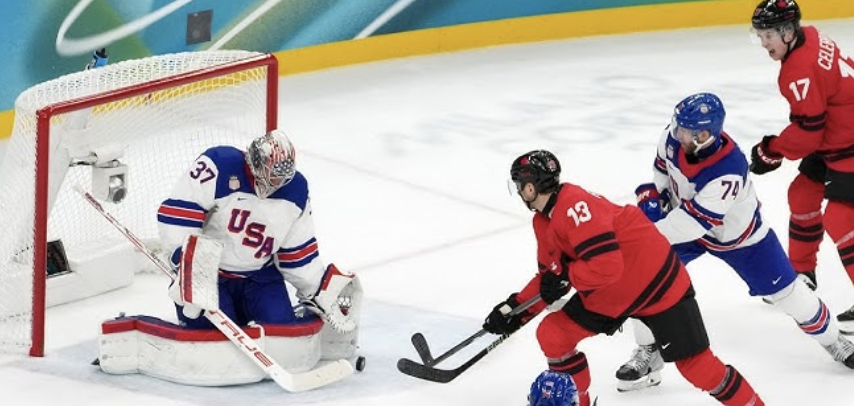
Connor Hellebuyck made 41 saves in the gold medal game for team USA. Canada outshot the US by 15.
Without Hellebuyck, the US gets blown out.
But a decade ago, not a single major junior league in North America thought he was worth drafting.
The story of how he got from there to here tells you everything about what resilience actually looks like.
Hellebuyck came out of Walled Lake Northern High School in Commerce, Michigan.
They weren't a hockey factory, and he was basically a nobody as a prospect.
He went undrafted by both the the two main junior leagues that feed college and pro hockey.
No one wanted him.
So as an 18 year old, he drove 12 hours by himself from Michigan to Minnesota for an open tryout.
He got one shot...for the Odessa Jackalopes. So he moved to Texas...
His former GM and goalie coach Joe Clark remembers: "We had like eight goalies at tryouts, no one knew anything about him. Connor stood out. He made the team and he was a no-brainer for us as a staff. But he really had no resume whatsoever before that."
Hellebuyck led the league in games, minutes, and total saves. Won Rookie of the Year and Goaltender of the Year.
All in a city where football is religion and few know hockey even exists
Even with his performance, his next opportunities were few and far between...
UMass Lowell was the only school to offer him a spot. His first college start went so poorly that he got pulled and benched for over a month.
Most players spiral in that moment: "I'm not good enough, the stage is too big, I don't belong here."
Hellebuyck called Joe Clark and said, "The game is not as fast as I just made it out to be."
Clark couldn't believe it. He'd just gotten pulled and his takeaway was that he'd been over-prepared. That he expected the game to be faster.
It gave a clue into how he saw failure, and why he's so resilient.
When something bad happens, we have a choice: how are we going to integrate this into our story.
Story one: I got pulled because I'm not ready or good enough.
Story two: I got pulled because I was putting too much pressure on myself and expecting the game to be better than it was.
Hellebuyck chose the latter.
"I was more ready, more prepared than I had given myself credit for."
By the end of the season, he'd backstopped UMass Lowell to its first Frozen Four in program history.
The numbers after that benching are absurd. In two college seasons, he had a 38-12-2 record, .946 save percentage, and 12 shutouts.
He won the inaugural Mike Richter Award as the best goalie in college hockey.
All from a kid who couldn't get drafted by a junior league three years earlier.
"All the hardships that I had to go through early in my career were lessons learned. That's all I use them for. I didn't let them knock me down. I just kind of created a version of myself where I was just going to continue to adapt."
Even after college dominance, it wasn't smooth.
He was drafted in the 5th round, 130th overall by the Winnipeg Jets. He worked his way up from the AHL to becoming the starter in 2017.
He's now won three Vezina Trophies. The Hart Trophy as league MVP. And according to most measure, he's the best regular-season goalie of his generation.
But the one knock that wouldn't go away? He couldn't win in the playoffs. Whent he lights shined brightest, the media and fans said he struggled. Last spring, he got pulled three times in the first round of the playoffs against St. Louis.
Just like before, others were trying to write his story: great in the regular season, can't show up when it matters.
And once again, he showed that resilience is about ignoring what others write, and penning your own narrative.
Canada threw 41 shots at him. He stopped all but one. Star Connor McDavid had a breakaway in the second period that he denied. Devon Toews had a wide-open rebound with Hellebuyck out of position. He got his stick on it.
He played out of his mind. Or as the hockey saying goes, he was standing on his head.
"Those critics, they can keep writing. But they don't understand goaltending. They don't understand my game. I know what I'm putting forward. I know what I'm building. These are the moments that prove it — not that I need to."
We often get resilience wrong. We think you either have it or don't. That it's about toughening it out. It's what I kept coming across while researching my book toughness, Do Hard Things.
But Hellebuyck's story gives us the nuance:
It's a skill built through repeated encounters with failure...but only if you process those failures correctly.
Every stop in his career told him he wasn't enough. Undrafted. Benched. Cut from camp. Pulled in the playoffs.
But at each stop, he chose the same interpretation: this is information, not my identity.
Most people let setbacks become self-definitions. Hellebuyck let them become data points.
And the guy who processes failure as calibration rather than catastrophe is the guy you want when 41 shots are coming at him in a gold medal game.
Hellebuyck described his own story today the way he always has: "I would probably say the underdog story. Constantly going and being an underdog and just making it work, persevering and getting through."
He drove 12 hours alone to a tryout in Minnesota when no one wanted him. His only shot was in the Friday Night Lights town of Texas. He got pulled from his first college start and decided the problem was that he'd overestimated the difficulty, not underestimated his own ability.
He got pulled three times in last year's playoffs and showed up to the Olympics as the best goalie in the tournament.
Write your own story. And tell it well.
turns out that all you need to do to make sure your vehicles are reliable is foster a 1000 year old culture in which anyone who does bad at their job has to kill themselves with a sword
If science class explained everything with Midwest emo music, we would have a lot more people paying attention.
Nuclear power explained.
It’s just a fancy way to heat water and make electricity.
🔊
Whoever decided the bald eagle was going to be *the* symbol of the United States absolutely cooked. The aura of these birds is off the charts. You feel something when you see one in person.
3x World Series champion. 3x Cy Young winner.
2014 NL Most Valuable Player. 2011 NL Triple Crown.
Clayton Kershaw finished off his illustrious career as a champion 🏆
Clayton Kershaw’s legendary career officially comes to an end. 👏
⚾️ 2014 MVP
⚾️ 2011 Triple Crown
⚾️ 3x World Series champ ('20, '24, '25)
⚾️ Gold Glove Winner
⚾️ 3x Cy Young award winner
⚾️ 11x All-Star
If the Rays gave Blake Snell and Tyler Glasnow what they wanted, they wouldn’t be Dodgers
If the Red Sox gave Mookie what he wanted, he wouldn’t be a Dodger
If the Angels gave Ohtani what he wanted, he wouldn’t be a Dodger
If the Braves gave Freddie Freeman what he wanted, he wouldn’t be a Dodger
Cheap owners created the environment for a super team like the Dodgers to exist. Salary cap doesn’t stop those owners from being cheap.