Chief Economist @krakenfx. 💰 Former L/S Special Sits Analyst @ Moore Capital. 📈 Amateur astronomer. 🔭 Thoughts are mine. Vires in Numeris. #Bitcoin#crypto
The Dow had its best day of 2026.
One day later, the Nasdaq-100 had its worst day since March 2020.
What’s driving the divergence?
@ThomasPerfumo breaks it down in this week’s Macro Minute. ↓
Theory on why bitcoin:native is handling the election outcome so well:
+ Democrats won enough seats such that their own party isn't held hostage by very small coalitions within their ranks. That would exacerbate disfunction.
+ Oil markets falling sharply, an immediate inflation relief.
+ Potential friction in AI CAPEX cycle points to deceleration, reducing tightness on near-term market liquidity. This is evident in hyperscalers with organic FCF vastly outperforming semiconductor CAPEX-driven stocks.
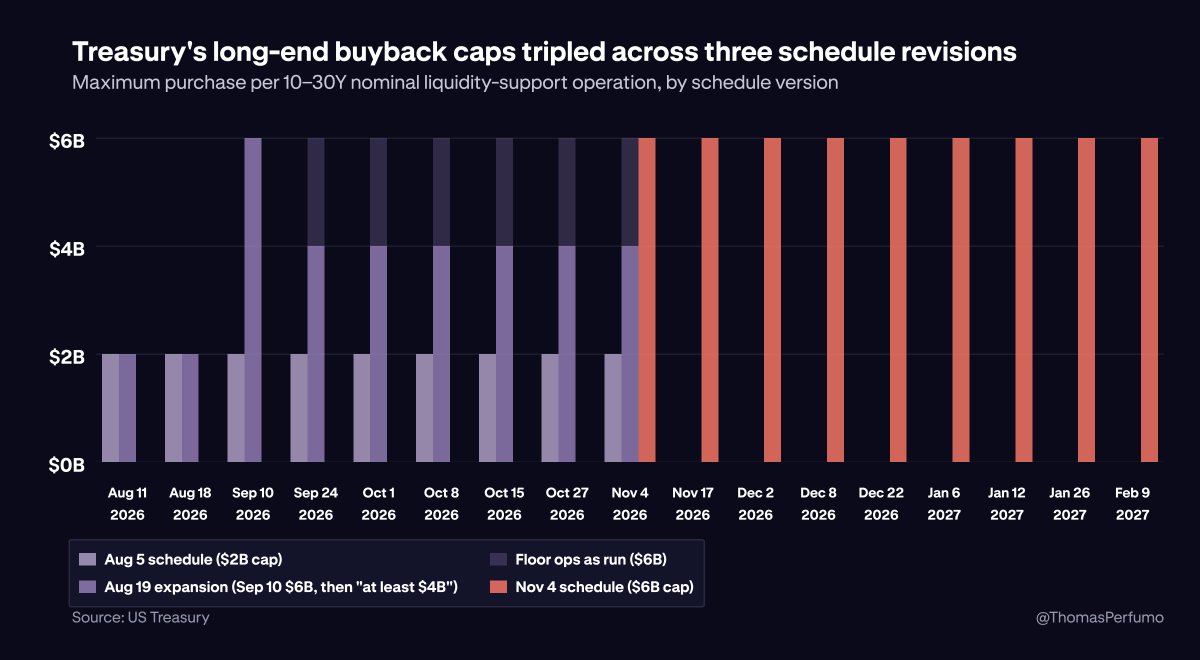
+ US Treasury maintains the 3x in long-end bond liquidity support program from August in today's quarterly refunding statement.
Not sure if this necessarily holds, but today signals some near-term relief in market liquidity, which crypto is very sensitive to.
That’s partly correct.
Fundraising-to-Bitcoin conversion fell during 3Q because they prioritized restoring balance sheet strength: the USD Reserve, primarily.
So far in 4Q, I’m observing what you’ve noted: relatively weaker NAV premium that holds them back from accretive fundraising opportunities to deploy into Bitcoin.
Unfortunately, there isn’t a particularly strong catalyst I can point you to that would drive higher NAV premiums outside of better Bitcoin price action, coupled with growth in options activity. The precursors for a healthier Bitcoin environment likely rest on normalization of energy markets (however that happens via US-Iran conflict) and line of sight to tamer inflation. These factors will improve liquidity conditions in the market by way of forecasting looser monetary conditions.
Buried in the election news today is the US Treasury Quarterly Refunding announcement.
In mid-August, the US Treasury surprised the market by more than doubling the cap for buyback operations for long-dated maturities (10Y to 30Y). This sent Bitcoin and gold on a durable rally.
This morning, the US Treasury released their tentative 4Q buyback schedule, a de facto continuation of the recent operating caps ($6B weekly).
This announcement confirms a tripling in the buyback program's size over the last 2-3 months.
The signal is the US Treasury continues to feel expanded intervention is necessary given how high yields are in the market.
Source: https://t.co/0uWS9FgTwn
.@MicroStrategy raised $4B last quarter.
Only 6% went into Bitcoin, down from over 90% earlier this year.
What’s changed?
@ThomasPerfumo breaks it down in this week’s Macro Minute. ↓
@tether seems to be freezing wallets with large amounts of $USDT that may be associated with the rumors of the Binance wallet drain.
This feels like the strongest confirmatory evidence. Be careful.
AI earnings are beating expectations. Stocks are falling.
Meanwhile, BTC volatility is near historic lows ahead of the Fed decision.
What’s the market pricing in?
@ThomasPerfumo breaks it down in this week’s Macro Minute. ↓
bitcoin:native is in the sweet spot of its four-year cycle but this one looks very different from prior cycles.
@ThomasPerfumo of @krakenfx tells @RemyBlaireNews the drawdown is only 35% versus 75-85% historically, and Bitcoin ETF flows remaining at 91% of their all-time high suggest the cycle pattern should change dramatically going forward.
$BTC is rewriting the cycle playbook
One year since its $125K ATH, Bitcoin’s drawdown remains shallower than in previous cycles
But macro correlations are shifting
@ThomasPerfumo connects the dots in this week’s Macro Minute ↓
$BTC gained 43% in Q3 while long-term yields climbed to generational highs
At the same time, Bitcoin volatility remains unusually muted
@ThomasPerfumo explains why that combination is worth watching
Macro Minute ↓