If anyone else needs to be able to set WebXR applications to kiosk mode on @PICOXR_Dev use this project to make your URL auto launch into WebXR on boot!
https://t.co/MHBplrdVX0
The greatest shift in software is happening 👇
Apps will become mere projections on the context of data and behavior it is put it.
Let me explain.
We are used to building data and interaction silos because that is how we inherently built software. When we wanted to remove silos it was necessary to either decide on standards or build custom integrations.
But with AI we have a universal language that glues together the data and interaction we need without developing standards for everything.
This changes everything. Suddenly the todo from one App could be shown in a note in another app. The mail from one person could be shown together with a WhatsApp from the same person.
When AI has access to all our context and apps data it will just offer user interfaces that dynamically stitch together the pieces we need.
This encompasses the context we are in, are we driving in a car, are we on a phone or in a VR headset?
We'll just generate UI based on the context of hardware, available modalities, user-preferences, accessibility level, available compute and so much more.
Want to have your own app for a vacation you are planning? The perfect UI will be right there for you with your flight tickets, messages from friends.
Every app, context and data, instantly sharable with anyone on the planet.
This future requires a new way of storing data and sharing access. Something we are building at xp0
Excited to share more on that along the way, so stick around 🚀
Our AI agent wrote a 95,000 character architecture document.
Next session, same agent, same document — it couldn't navigate what it wrote.
The document was there. The understanding wasn't.
Here's what actually went wrong — and it's not what you think.
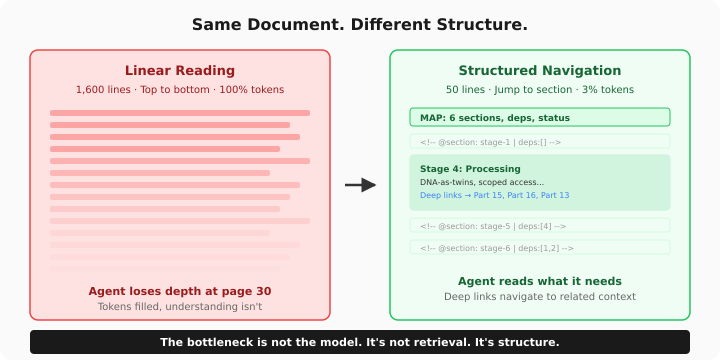
The agent read the document linearly. Top to bottom. Filled its context window. Proceeded to work. But somewhere around page 30 it had silently lost the decisions from page 4. It didn't flag this. It didn't know. It just kept going — building on an understanding that no longer matched ours.
We didn't notice either. Not immediately.
This is the pattern that kills agent productivity: silent divergence. You and your agent think you share the same context. You don't. Neither of you knows it. Every decision built on that invisible gap compounds the problem.
You only find out at harvest time — when the result doesn't match the intent. Then you trace back, realign, re-read, re-plan. And you do it again next session. And again. Until it's fully chaos.
The root cause is linearity. Linear reading fills the window — it doesn't build structure. An agent that read 1,600 lines has consumed tokens. It hasn't built a map.
We added 35 structural markers to the document. One line each. Invisible to the reader, navigable by the agent. Now it reads 50 lines to find what it needs instead of 1,600 to maybe find it.
Same document. 97% less tokens. But the real gain isn't efficiency — it's alignment. The agent can now verify what it knows instead of assuming.
Not RAG. Not search. Structure.
Three things we learned:
1. Long context ≠ deep context. 200K tokens in the window doesn't mean the agent understands page 30. It means it read past it.
2. An agent doesn't know its own blind spots. When context is lost, the agent doesn't raise a flag — it fills the gap with assumptions. So do humans. Neither notices until the result breaks.
3. If your agent can't find knowledge at the moment it needs it, that knowledge doesn't exist. Not "isn't accessible." Doesn't exist. For the agent, unfindable = nonexistent.
This applies to everything. Documents, databases, APIs, codebases. Anywhere two parties assume shared understanding without structural verification — silent divergence grows until it becomes chaos.
The bottleneck is not the model. It's not retrieval. It's structure.
Structure your knowledge so it can be found — not just read — and you stop building on assumptions.
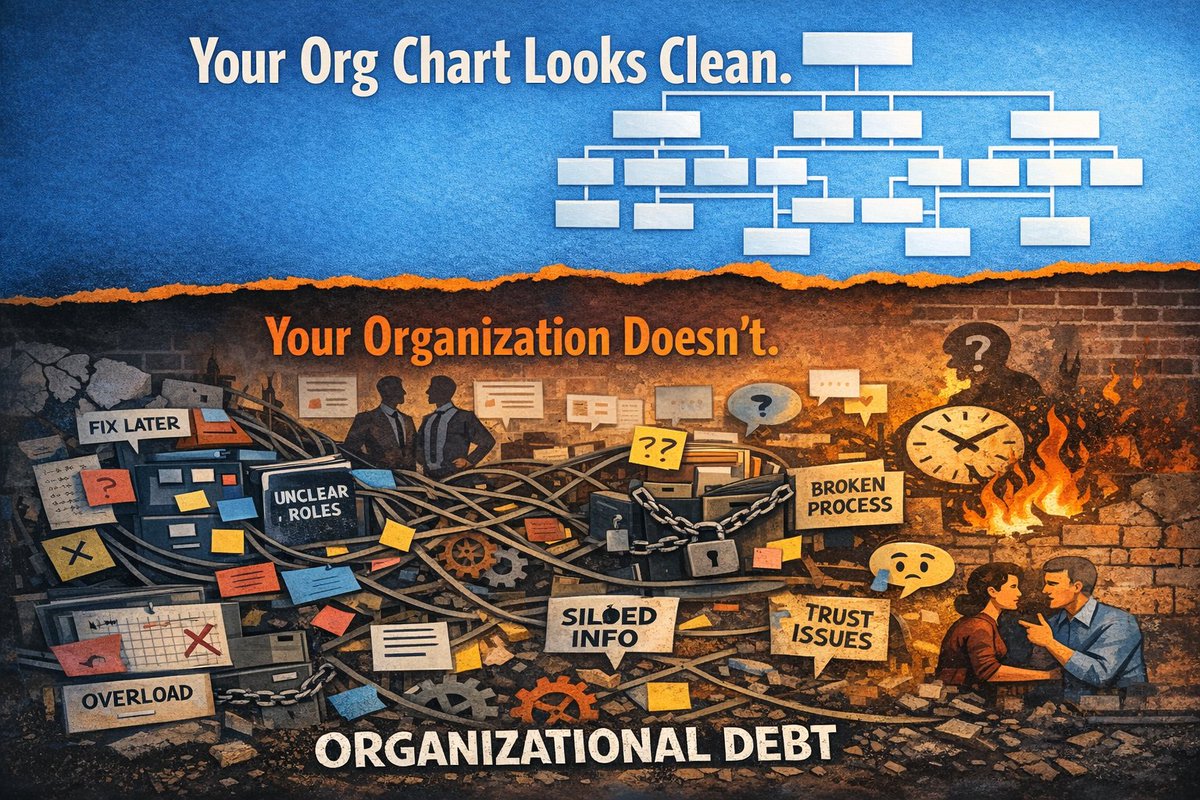
At 3 people, you don't need a process for how decisions get made.
At 15, you do — but the moment you need it is the moment you're too busy to build it.
At 50, the absence of that process is no longer a gap.
It's load-bearing.