Thrilled to be in Denver with 14 colleagues from @AstraZeneca’s Centre for Genomics Research, ready for 5 days of human genomics #ASHG24
The perfect chance to learn about how genomics is transforming drug discovery!
Here’s a thread of our presentations - see you there 😀
Excited to share our latest paper, where we describe ITSN1 as a novel risk gene for Parkinson's disease!
We found that rare loss-of-function variants are associated with a 10-fold increased odds of PD. As far as we know, this is the largest effect size reported for sporadic PD to date
https://t.co/QDXWVEHlGg
What is the probability of developing #ALS when you carry the #C9orf72 repeat expansion ('#penetrance')? For many years, this has been assumed to be ~90-100%. We tried to answer that question from a different angle, with surprisingly different results: https://t.co/AU1H6gQbop
We hope that this tool will help to accelerate research into the nature and breadth of SOD1-linked ALS.
Huge thanks to @opie_martin for her contributions and curating this dataset and to @kingsmnd, @AlfredoIacoange and @AmmarAlChalabi for their support.
https://t.co/SeyNaCpX1s
Excited to share an open-access manuscript describing our new tool for time-to-event (survival) analysis in amyotrophic lateral sclerosis: https://t.co/J6RULkq32y.
#ALS#MND#SOD1#rstats#shinyapp
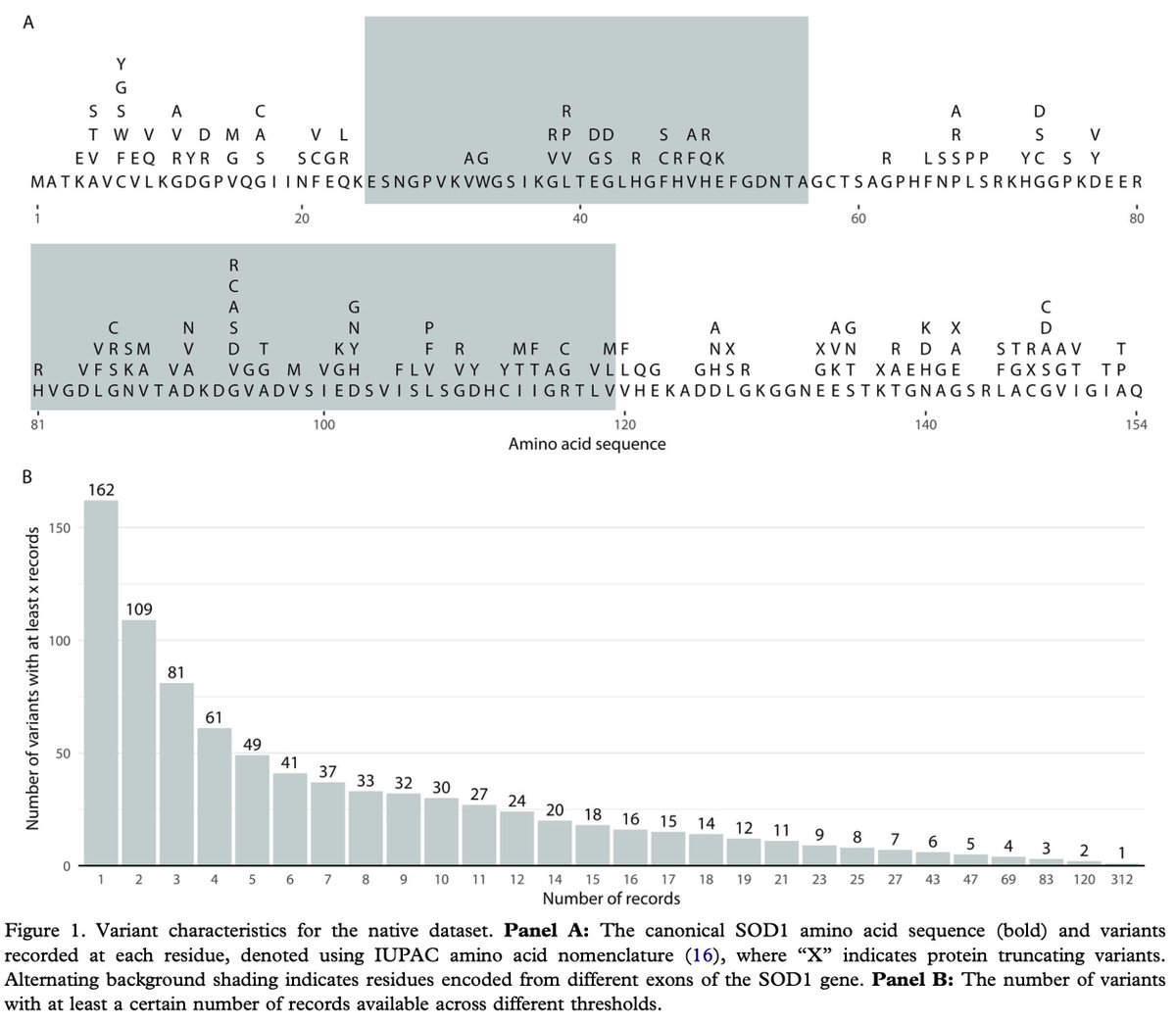
Users can perform bespoke analysis of age of ALS onset and disease duration from onset using the built-in dataset and any additional data they upload. Our built-in dataset represents 162 SOD1 protein variants from 1383 people with ALS and a large non-SOD1 ALS cohort is available.
A huge thank you to my supervisors @AmmarAlChalabi and @AlfredoIacoange for their support alongside the other lab members and external collaborators who contributed to this work over the years! 😊
So proud of @ThomasSpargo who passed his PhD with no corrections yesterday! 🥳🥂 Well done Tom and thanks to examiners Johnathan Cooper-Knock and Damien Medley.
@kingsmnd@KingsCollegeLon#ALS#MND
The survey is open until the end of January.
We are still looking for input from #ALS#MND community about the non motor symptoms such as pain, fatigue, quality of sleep and more.
For the survey follow this link 🔗: https://t.co/Th08CYVUAR
@AmmarAlChalabi@AliShojaie_KCL
It's great to see @ThomasSpargo's first paper published in @GenomeMedicine His method to estimate variant penetrance using disease family structure and population genetic data brings us a step closer to understanding how each variant affects our health https://t.co/oKtgn6Tk53
🚨 Our recent Preprint 🚨
The use of a placebo in clinical trials means that a proportion of people will be denied a potentially life-saving treatment. Therefore, we investigated the use of synthetic placebo populations in ALS clinical trials 🧵
https://t.co/RtOIozI2DL
Our new paper shows that for people with SOD1-mediated #ALS#MND, some mutations predict age of onset, some predict disease progression rate, and some predict both, meaning the cause of and the progression of ALS are distinct from each other biologically.
https://t.co/yphjLg2ged
New preprint: the role of NEFH variants in ALS has long been debated.Using genetic data of >18,500 people from @_Makeityours & other studies,@hev_marriott showed that mutations in the tail domain of NEFH increase the risk of ALS. https://t.co/vsGO3vX6nT @AmmarAlChalabi@kingsmnd
If you have #ALS#MND please consider taking part in our short survey on non-motor symptoms. These are symptoms unrelated to muscle weakness. For example, cold legs, bladder problems, etc. Put together by @AliShojaie_KCL and @AhmadAlKhleifat
https://t.co/mOP5ZqB73r
@mndassoc
Our latest effort to study the genetics of ALS. SCFD1 eQTLs influence disease risk, show distinct expression profiles in post-mortem ALS motor cortex, and act as disease modifiers. https://t.co/0kNQcU8Caq @AmmarAlChalabi@AhmadAlKhleifat @opie_martin and Dr Jones
@Jeanc9orf72 @opie_martin @cathrynlewis@AlfredoIacoange@AmmarAlChalabi Agreed! This is definitely something we would be interested in estimating, providing that the necessary data are available. Thanks for your interest in the paper!
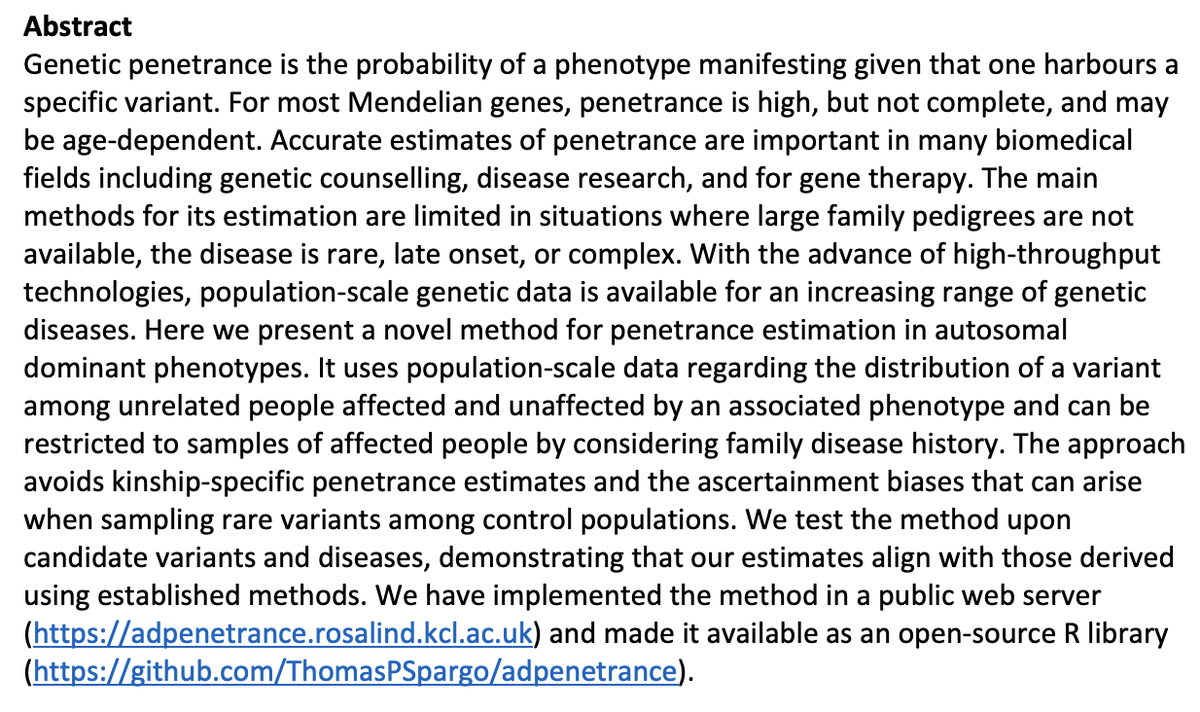
We have developed a new method to calculate genetic penetrance in autosomal dominant traits! The preprint is on medRxiv (https://t.co/yd3jQxAg8T) and the approach can be operated using our webserver (https://t.co/nb8R8O4QV8) or the R function on GitHub (https://t.co/AskvRo1nDL).
@Jeanc9orf72 @opie_martin @cathrynlewis@AlfredoIacoange@AmmarAlChalabi We argued that ALS and FTD arise roughly equally among people harbouring the C9 expansion and so the penetrance for ALS alone would reasonably be around 45%, aligning with our estimate
@Jeanc9orf72 @opie_martin @cathrynlewis@AlfredoIacoange@AmmarAlChalabi Hi Jean, thanks! We estimated C9 penetrance for ALS only as ~45% in European and ~28% in Asian populations.
The 90% estimate was from a previous paper, regarding C9 penetrance for either ALS and FTD (after attempting to account for likely ascertainment bias).