A small list you actually message beats a huge one you're sitting on.
People spend weeks building this giant list, get nervous, and send to almost none of it.
A hundred of the right people you reach out to today beats ten thousand you've saved for when you feel ready.
The list does nothing sitting in a spreadsheet.
Things worth paying for, and things that aren't:
→ A logo: no
→ A fancy website: no
→ Another tool: no
→ A bigger office: no
→ Getting your offer in front of more of the right people: every time
Most founders spend on the stuff that feels nice and skip the one thing that pays.
The first time a stranger paid me, something switched and never switched back.
Before that it's all in your head.
You think you might be able to sell.
The first time someone who owes you nothing hands you money, you find out you actually can.
Get that first one fast.
It's worth more than the money.
Reasons a good product still doesn't sell:
• You talk about what it does, not what they get
• You're telling the wrong people
• You're telling too few of them
• The thing you're offering is easy to say no to
• You went quiet after one message
The product is rarely the problem.
How you put it in front of people nearly always is.
A no-show isn't bad luck.
It's a review of how you booked it.
They said yes too easily, you never checked they actually had the problem, or three days went by and they cooled off.
People turn up to things they're sure about.
If they didn't turn up, they were never that sure.
Most outbound dies in the bit nobody watches.
Everyone fusses over the first message.
Nobody bothers with the follow-up.
Then they're confused why a list full of warm people went nowhere.
The first message starts it.
The second, third and fourth are where the meetings come from.
Most people send one and walk off.
What a thin pipeline really takes from you:
• You take work you'd normally turn down
• You drop your price when you shouldn't
• You can't see past the next 30 days
• Your best people start drifting
The lost deals are the small part.
The rest is the damage you don't see.
Screw it...
I wanna give back
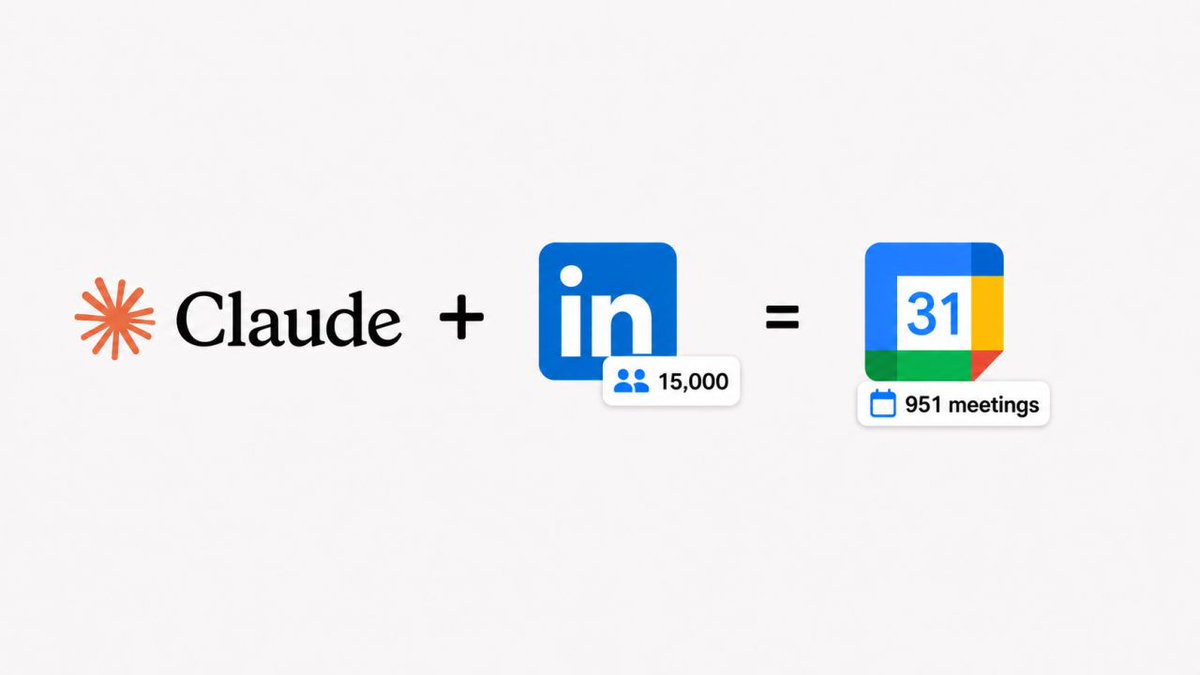
I'm giving away the FULL system we use to send 15,000+ LinkedIn connections a week and book meetings on autopilot
(One client booked 951 meetings in a single month with it)
All packed into one playbook
• Like this
• Comment "CLAUDE"
& I'll DM you the whole thing
*Must Follow*
Signs a meeting is never turning into money:
→ They only want to "pick your brain"
→ The person on the call can't actually say yes
→ It keeps sliding to next week
→ They've gone quiet every time but still won't say no
A polite maybe in your calendar is not a deal.
Screw it...
I wanna give back
I'm giving away the FULL system we use to send 15,000+ LinkedIn connections a week and book meetings on autopilot
(One client booked 951 meetings in a single month with it)
All packed into one playbook
• Like this
• Comment "CLAUDE"
& I'll DM you the whole thing
*Must Follow*
Say your price out loud and listen to yourself.
If you flinch when the number leaves your mouth, the prospect hears it before you've finished talking.
They don't doubt the price.
They doubt you.
Get comfortable with the number first.
It changes how they take it.
I just gave away the full system for winning back six hours a day on outbound admin.
Some founders are still doing by hand what a machine should've done while they slept:
> List building
> Account research
> ICP scoring
> Follow-up drafts
> Reply triage
Open your laptop to a ranked list, research done, follow-ups ready to send.
Spend your first hour making decisions, not gathering info.
Do yourself a favour and read the full breakdown:
Stuff that feels like work but moves nothing:
→ Tidying your CRM again
→ Fixing the slides one more time
→ Reading another book on selling
→ Answering every comment
→ "Looking into" a new channel for the third week
Being busy is the comfiest place to hide from the scary bit.
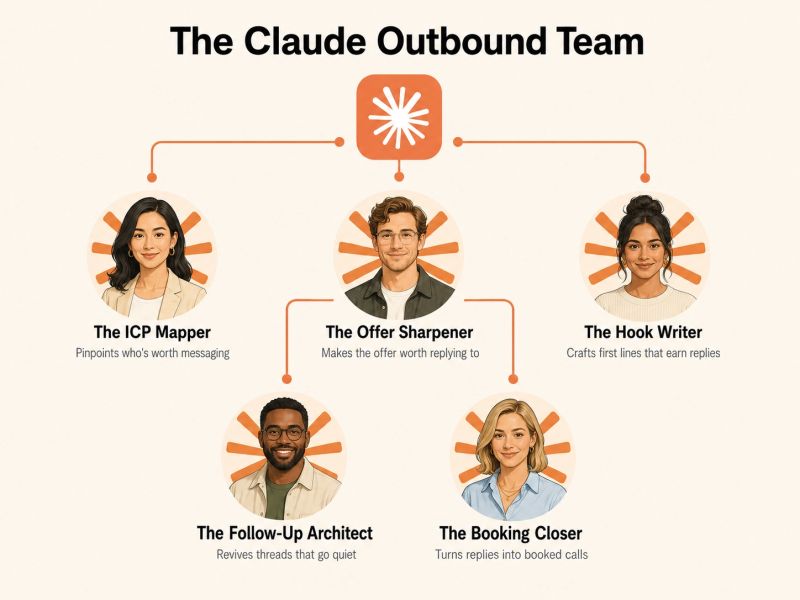
I built a Claude-powered outbound team for B2B founders.
And I'm giving it away free.
Most founders use AI to rewrite emails and clean up LinkedIn posts.
The smarter play: use it to build the meeting-booking system your sales process is missing.
What I built:
→ 7 specialized Claude prompts
→ 1 Master Meeting Engine prompt that ties them together
Not generic "act as an SDR" rubbish.
A full outbound stack covering:
→ ICP mapping (who's worth messaging, who's a waste of time)
→ Offer sharpening (so the outreach earns a reply)
→ Hooks and openers (the first line that gets a response)
→ Conversation starters that don't read like a pitch
→ Objection handling (turning "not now" into a call)
→ Follow-up sequencing (reviving threads that go quiet)
→ Booking conversion (moving replies onto the calendar)
Each prompt owns one job.
Give it your offer. Ask the question. Get the kind of answer most founders pay a consultant four figures for.
Will it book the meetings for you?
No. It can't run the outreach. It can't manage deliverability. It can't keep your calendar full while you're in client work.
But for the founders flying blind on LinkedIn, it hands you the strategy layer behind 1,500+ meetings booked a month.
You get the full kit. All 8 prompts. The questions to ask. The numbers to plug in. The order to run them in.
Use it this week.
Want it?
Like this + Comment "TEAM" & I'll DM it to you.
(Must Follow For DM)
The hardest thing in business isn't getting money.
It's turning the wrong money down.
You take a client who's a bad fit, and for the next six months they eat the time you needed for the good ones.
The invoice looks the same.
The cost isn't.
We booked hundreds of meetings for one client last month, and the messages that did it weren't written by a person.
Claude wrote them.
And they're out-replying anything my team used to write by hand.
I didn't expect that.
I spent years learning to write outbound.
Watching a model beat me at it stung a bit.
But once I looked at why, it made sense.
A human writes 40 cold messages and gets bored by number 12.
The quality drops.
You start reaching for the same three openers because thinking of a new one every time is exhausting.
Claude doesn't get bored.
Message 12 and message 400 get the same attention.
That's the whole thing.
Not that the AI is a better writer than a good copywriter.
It isn't, on any single message.
It's that outbound isn't a single-message game.
It's a 10,000-message game.
And consistency across ten thousand messages beats brilliance across ten.
The mistake people make is asking Claude to "write me a cold message."
You get generic slop and decide it doesn't work.
The job isn't writing the message.
It's feeding it the prospect's actual problem, your actual offer, and telling it exactly what a reply needs to sound like.
Give it the thinking, not the task.
Do that and every message reads like you wrote it for one person.
Because in a way, you did.
You just didn't sit there typing it 400 times.
The bit nobody wants to hear:
Your offer still has to be worth replying to.
Claude can't save a boring offer.
It'll just help more people ignore it faster.
Fix the offer first.
Then let the volume do what volume does.
If you're a B2B founder tired of your outbound depending on whoever's writing that day, this is the shift.
DM me and I'll talk you through how we run it.
Follow @ThomasVantage for more like this.
You'll spend more energy avoiding the hard call than the call would ever cost you.
The decision sits there for a month, taxing every other thought, when making it badly and fixing it would've taken a week.
I built a Claude-powered outbound team for B2B founders.
And I'm giving it away free.
Most founders use AI to rewrite emails and clean up LinkedIn posts.
The smarter play: use it to build the meeting-booking system your sales process is missing.
What I built:
→ 7 specialized Claude prompts
→ 1 Master Meeting Engine prompt that ties them together
Not generic "act as an SDR" rubbish.
A full outbound stack covering:
→ ICP mapping (who's worth messaging, who's a waste of time)
→ Offer sharpening (so the outreach earns a reply)
→ Hooks and openers (the first line that gets a response)
→ Conversation starters that don't read like a pitch
→ Objection handling (turning "not now" into a call)
→ Follow-up sequencing (reviving threads that go quiet)
→ Booking conversion (moving replies onto the calendar)
Each prompt owns one job.
Give it your offer. Ask the question. Get the kind of answer most founders pay a consultant four figures for.
Will it book the meetings for you?
No. It can't run the outreach. It can't manage deliverability. It can't keep your calendar full while you're in client work.
But for the founders flying blind on LinkedIn, it hands you the strategy layer behind 1,500+ meetings booked a month.
You get the full kit. All 8 prompts. The questions to ask. The numbers to plug in. The order to run them in.
Use it this week.
Want it?
Like this + Comment "TEAM" & I'll DM it to you.
(Must Follow For DM)