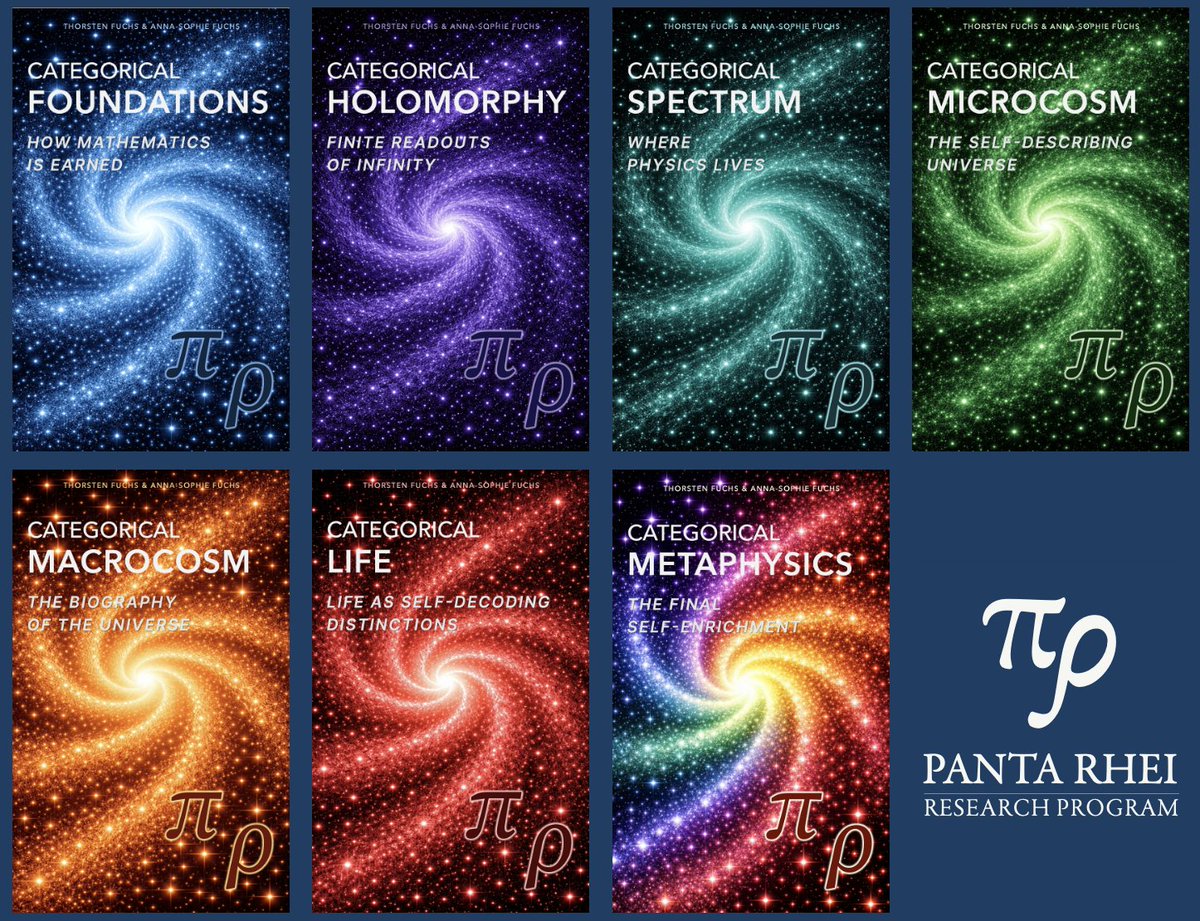
1/ Seven books. More than 3,000 pages. One construction body.
After the public observatory and the TauLib formalization layer, the third major surface of the Panta Rhei Research Program is the monograph series itself.
Lean 4.30.0 is live!
The release notes highlight four areas: a new 𝚜𝚢𝚖 => tactic, 𝚌𝚋𝚟 out of experimental, a completed LCNF compiler backend, and a full Lake cache overhaul.
On 𝚜𝚢𝚖 =>: "Unlike 𝚐𝚛𝚒𝚗𝚍 =>, which eagerly introduces hypotheses and applies proof by contradiction, 𝚜𝚢𝚖 => gives users explicit control over each step."
On the compiler: the expand reset/reuse port "results in a ~15% decrease in binary size and slight speedups across the board."
Full release notes: https://t.co/qSFWZVjK4x
A large theory should not first ask to be believed.
It should first expose its construction order.
The Panta Rhei Construction Spine is now live: a 10-step build route, with a 100-step routing ledger, from finite kernel to ontic-closure burden.
https://t.co/HQvBKqiJ4w
Standing in the Inquiry of Being - Lineages of Categorical Ontology (https://t.co/lNn3k8Yun5)
Not a proof.
Not a manifesto.
An orientation artifact.
Categorical ontology: Being through relation, transformation, articulation, context, and coherence.
Working note:
Thirty Open Problems as τ-Readout Surfaces
A structural answer-shape stress test of expressiveness, coherence, and translation capacity.
https://t.co/jWraGwmhp9
Can one construction framework face 30 open questions in physics without becoming ad hoc?
We used them as an expressiveness stress test — answer-shapes, not validation claims.
Which open question would you test first?
Mathlib is the community-driven mathematical library for Lean, now over 2 million lines of formalized mathematics, with contributions from 300+ mathematicians worldwide.
From undergraduate foundations to frontier research topics, it's one of the largest formal math libraries ever created.
🔗 https://t.co/Pr34P9PkmZ
🔗 https://t.co/OApCItDB1r
#LeanLang #LeanProver #Mathlib #FormalMathematics
3/ The website is the public observatory.
TauLib is the formalization layer.
The books are the full construction surface.
Research Monographs:
https://t.co/sArN1YuluP
Read · Inspect · Verify · Challenge · Engage.
#PantaRhei#OpenResearch
1/ Seven books. More than 3,000 pages. One construction body.
After the public observatory and the TauLib formalization layer, the third major surface of the Panta Rhei Research Program is the monograph series itself.
2/ The arc:
I Foundations
II Holomorphy
III Spectrum
IV Microcosm
V Macrocosm
VI Life
VII Metaphysics
From coherence kernel to earned mathematics, geometry, physics, life, and reflective structure.
NEW paper from Google DeepMind.
(bookmark it)
AI Co-Mathematician is an agentic research workbench for mathematicians, and it just hit 48% on FrontierMath Tier 4, a new high score among AI systems evaluated.
The system is an asynchronous, stateful environment that supports ideation, literature discovery, computational analysis, theorem verification, and knowledge development.
It manages uncertainty, clarifies intentions, records unsuccessful attempts, and emits formal mathematical outputs.
Early applications yielded solved open problems, fresh research angles, and recovered overlooked citations during active research sessions.
This is one of the cleanest demonstrations that agentic AI moves the frontier on genuinely hard mathematical research, not just problem-solving but discovery support. The asynchronous stateful workbench design is interesting to adopt if you are building agents for any expert workflow.
Paper: https://t.co/C1ro3mGPQi
Learn to build effective AI agents in our academy: https://t.co/LRnpZN7L4c
The @SAIRfoundation Science x AI Summit goes live at 9:30AM PDT today!
At 11:05AM: keynote by Lean FRO Chief Architect Leo de Moura on where Lean stands and what comes next as AI takes on a larger role in proof development.
📺Watch live: https://t.co/syHxptgwIc
#LeanLang #LeanProver #SAIR #Science #AI
3/ TauLib is not decoration for Panta Rhei.
It is one of the public inspection surfaces of the program.
WP003 includes a 10–15 minute fast route and the full technical inspection path.
https://t.co/ImmR6PFHLA
#Lean4#FormalVerification#PantaRhei
1/ We have released WP003:
TauLib — Technical Overview.
It explains the Lean 4 formalization layer of the Panta Rhei Research Program: release snapshot, architecture, trust budget, inspection routes, and reviewer protocols.
Not a theory synopsis. A formalization route.
2/ Current public TauLib snapshot:
512 Lean modules
142,406 Lean lines
4,863 theorem/lemma records
0 sorry assignments
3 disclosed custom axioms
Formal compilation is not empirical truth.
But it makes definitions, dependencies, assumptions, and proof obligations inspectable.
Most ML tutorials teach you how to call the machine.
This workshop is about understanding the shape of the machine.
Category Theory for Tiny ML in Rust
Tiny systems.
Rust types.
Typed transformations.
Composition.
Runnable examples.
No category theory background needed.
Executable structure, not AI magic.
🔗 Register: https://t.co/BIkU4O2voY
3/ It exposes Program, Agenda, Corpus, Results, Verify, Publications, Impact, and Engage.
The first story is not that Panta Rhei is proven.
It is that its burden, predictions, falsification paths, and correction routes are public.
https://t.co/hGoKAf7FQe
#Lean4#PantaRhei
1/ Yesterday, Anna-Sophie and I opened the Panta Rhei Research Program fully into public view.
This morning we shared WP000, the four-page At-a-Glance primer.
The next question is not yet:
Is the framework true?
2/ The better first question is:
What has been made inspectable before belief is requested?
That is why we built the public site not as a promotional landing page, but as a research observatory.