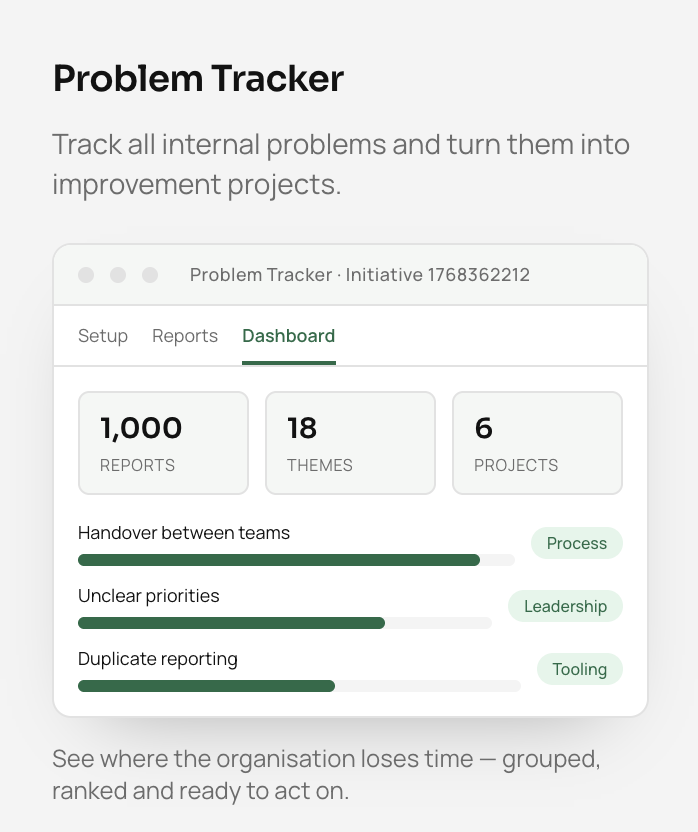
Track all internal problems and turn them into improvement projects.
Capture every internal problem in one structured place, cluster them by theme and impact.
Gather, analyse and act on organisation problems.
Get insights and actionable plans in days.
https://t.co/NXfv7Jflih
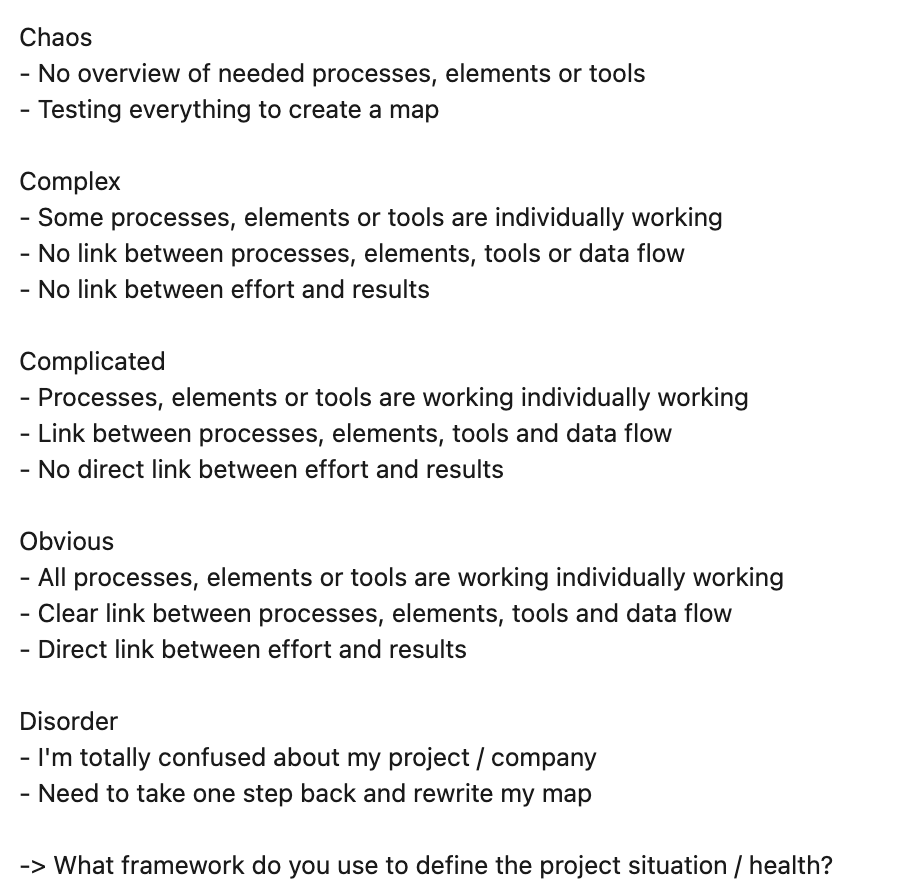
Defining the project phase is often quite easy. But what about the actual project situation / health?
Inspired by the #Cynefin framework, we can define the project situation / health into something high-level like this:
Analyst task: Collect problems reported across a company.
How https://t.co/NXfv7JeNsJ does the work: Gather reports in one structured place instead of scattered messages. Track all internal problems and analyse data quickly. Which tool: https://t.co/ugqCmtsFUq
#businessanalysis
Quite similar to how new business ideas and projects work, where we need to keep an eye on multiple interconnected elements to understand where things can blow up.
https://t.co/mL89B04NqR
#projectmanagement Credits to @numberphile
Business analysis is still manual, slow and impossible to scale - with organisations inventing its own way.
https://t.co/NXfv7Jflih is a AI-powered business intelligence platform that accelerate access to information and information-based decisions. For #businessanalyst and #PMO
What if business analysis wasn't a manual task?
What if business analyses where uniform, repeatable, easy documented and people would maintain interest until it was completed?
What if business analyses were easy?
https://t.co/xrR2XTSE5S
#businessanalysis
What if business analysis wasn't manual?
What happens if analyses are non-uniform, non-repeatable or if people lose interest and patience before the analysis is completed?
No more manual work. https://t.co/NXfv7JeNsJ does the hard work for you
#businessanalysis
The strongest presentation can win even when the foundations are weak.
Equally, a valuable idea can be dismissed because its evidence is scattered or its potential has not been explained clearly.
With the Chances tool we want to do better: https://t.co/fHCUvq3g1H
#startups
If we don’t understand the root causes and the real impact, we will never get the buy-in required to drive change in complex, technology-driven environments.
Uncover a project's real impact and secure a mandate: https://t.co/zDfq2vFL4X
#projectmanagement#businessanalysis
Rolling out an enterprise system in one business unit can be a challenge
Rolling it out across several business units is a completely different challenge
Read more: https://t.co/ns4HnKdeBQ
#digitaltransformation#CTO#CEO
Waiting for the “Perfect” moment holds us back (in corporate complex projects and when building new businesses).
Just a little more research.
Just one more meeting.
Just one more tweak.
Don't guess. Ask the organisation where the real trouble is: https://t.co/ugqCmtsFUq
We want to empower business analyst, business leaders and project managers to analyse, understand, rebuild and scale projects & companies faster.
This with tools targeted typical analyst tasks.
https://t.co/NXfv7JeNsJ does it for you
#projectmanagement#businessanalysis
In large-scale environments, it is easy to focus so hard on system-embedment and KPIs that we forget the human element.
What is we fail to simplify the operational processes for the person on the factory floor or at the frontdesk.
https://t.co/kBP4X5qtT6
When screening new initiatives: "What makes this project stand out?"
Often we talk about cutting-edge tech, innovation, business models, partnerships, smart integrations or AI-driven features.
In large-scale enterprise transformations, the "WOW Factor" can be quite different.
When migrating thousands of users or enterprise digital solutions, the real magic from a business perspective can be a unique opportunity for improvements, as we are often forced to review, document and align on:
1. Business process clarity and ownership
2. Operating models and ways-or-working
3. Application ownership and maintenance
4. Decision frameworks
5. Data flow and KPI tracking / reporting
6. Hierarchy
7. Where business-value is actually created
______
Hands-on experiences on why and how complex corporate projects fail, succeed & recover. For CxOs, PMOs, PMs & owners.
+70 articles about the topic.
Access for free on LinkedIn: https://t.co/zgRtMfWN7m
"This Cannot Be Done” — Maybe The Most Expensive Sentence (In The PMO)
“This cannot be done”
Let's pause for a minute.
That sentence is rarely about reality. It is about mindset.
In corporate programs or projects many elements can look like blockers;
Dependencies everywhere.
Stakeholders misaligned.
Processes broken.
No clear path forward.
Every changing priorities.
From the outside, it really looked like it cannot be done.
But when we start breaking things down and documenting things, something changes. Instead of asking “can we do this?”, we can for example ask:
- What is actually blocking us?
- What do we know for sure?
- What assumptions are we making?
- What is the smallest step forward?
Complexity has a way of overwhelming teams.
So they freeze or go into default “not possible"-mode.
-- Chaos is not the enemy --
It is often just unstructured information.
And our job - as business analysts and project managers - is to create structure, to help PMOs and leaders.
That means:
1. Thinking critically under pressure
2. Stripping problems down to the core (root-cause)
3. Documenting everything
4. Talking to stakeholders and facilitation workshops
5. Being honest about observations
6. Prioritizing what actually moves the needle
7. (Sometimes) making decisions without perfect information.
Is it uncomfortable to navigate in chaos?
No, not if you are aware that the program / project is in the chaos stage because.
Because every time a team pushes through what looked “impossible” confidence grows, clarity improves and execution becomes sharper.
Don't say:
“This cannot be done?”
Ask:
“Have we done the work to understand how it can be done?”
Business needs come first - Technology choices come later
Digital transformation is not (just) a technology project
It is easy to think that enterprise transformation and digital transformation is primarily about technology. It is not.
Technology is an enabler.
But transformation happens when the business actually changes how it operates.
Organizations can spend months selecting platforms, designing architectures and negotiating with vendors. Only to (too late) discover that the real transformation challenge starts after the technology is implemented.
Because installing a new system doesn't automatically create a better business. The business processes still need to change. The data still needs to be reliable. People still need to understand the new way of working. Leaders still need to make decisions. And someone still needs to own the business outcome.
It is fair to look at digital / business transformation through five layers:
1. Business - What are we actually trying to improve? What data confirms our theory that something doesn't work well?
2. Process - How should the organization work differently? What is AS-IS. What is TO-BE. What do good look like
3. Future data & KPIs - What information do we need to operate and make decisions?
4. Technology - What capabilities and systems enable the future state? Process needs, integrations needs, reporting needs, cost-saving needs, etc.
5. People - Who needs to change, and how do we make that change happen? How to communicate the message?
Technology is only one of the five. Yet it often receives most of the attention. That can easily be backwards.
A company can implement the world's best ERP, CRM or data platform and still fail to transform. Because technology does not create alignment. Technology does not clarify ownership. Technology does not resolve conflicting priorities. And technology certainly does not make people automatically change the way they work.
Successful transformations start with a business problem - not a technology solution.
The question should not be:
- “Which technology should we implement?”
It should be:
- “What do we need the business to do differently - and what role should technology, integrations and data / KPIs play in making that possible?”
That shift in perspective can fundamentally change the outcome of a transformation.
When a transformation starts going wrong, it is often worth going back to that same question. Because the technology may not be the problem. The missing transformation around it might be.
Projects never reach the delivery phase.
Startups never launch.
Great ideas collect dust.
Why?
Because just a little more research.
Just one more meeting.
Just one more tweak.
= Suddenly momentum is lost.
In complex business projects and building startups we must accept a level of uncertainty.
Don't seek "perfection" before getting started.
Complex business projects and startup companies have a build-in level of uncertainty.
Seeking perfection is an illusion that leads to overthinking that results in zero progress.
We should remember:
1. We cannot predict every future challenge.
So the best insights come from action.
2. It is about moving forward - even if it is imperfect.
This allows us to test, learns, iterate and refine.
Progress and iterations beats perfection every time.
3. Accept that there is a learning curve (both in terms of revenue and ways-of-working).
The managers and founders who remember this, will succeed.
Running a Company Is Not Just About Speed - It is About Structure Under Pressure
Running - or rebuilding - a company or large transformation project can look exciting from the outside, but be messy on the inside.
Unclear.
Full of pressure and competing priorities.
Success rarely comes from “just moving fast” alone.
It comes from building structure when things feel chaotic. And that usually starts not with the solutions, but with the analyses and the preparations.
-- It complex environments, it is essential to --
1. Before jumping into decisions, we need to understand what’s actually broken. Understand and map processes, data flows, stakeholder dynamics, user reality and more.
2. Set clear milestones, goals and KPIs. Not vague ambitions. But measurable signals that can tell us: “Are we moving in the right direction?”
3. Translate strategy into simple, actionable steps. Because complexity in execution kills momentum. We don’t need a perfect plan. We need a plan people can actually follow.
4. The team. Not just skilled individuals, but people who can operate in uncertainty, collaborate across silos and handle pressure when things don’t go as expected.
5. Progress must be monitored constantly. Not to control, but to learn. What’s working? What is not working? What needs to change now (and not in 3 months)?
-- Where it is easy to fail --
Don't stop when things get hard.
Rebuilding a company or delivering a transformation is not linear.
It requires persistence.
Adaptation.
Sometimes uncomfortable decisions.
The pattern I have seen?
The organizations that succeed are not the ones with the best starting point.
They are the ones that analyze deeper, adapt faster and stay consistent when complexity hits.
Do you treat a failed project as a failure?
The organizations that moves faster do something different.
They treat historical failed projects as vital data and sources of information.
- What assumption was wrong?
- Where did the process break?
- Which dependency did we miss?
- Which stakeholders did we not talk to?
- What did we document, but made "wrong" conclusions from?
Instead of hiding the problem, they investigate it.
Every failed attempt becomes an iteration.
Every iteration improves the next version.
#projectmanagement #PMO #digitaltransformation