@NWLRonline Pls I need an authority of a guarantor to sell off the a debtor's property in the event of default of a loan he guaranteed to offset the debt. Thanks.
@The_Ogundipe I am currently handling a matter that is centered on the advancement of a friendly loan and money lenders wahala... Fortunately, the Supreme Court came to my aid in the case of UZOUKWU V. IDIKA (2022) 3 @NWLRonline (part 1818) page 403.
Ratios 6 & 10 are very instructive!
Ordinarily you should lose the case. This is because it is illegal to give loan and take interest without being a licensed money lender. But there is an exception to this: it is not a defense for someone who has benefited from a contract to turn around and say the contract is void or illegal.
This position is reinforced by the decision of the court in Hydro Hotels Ltd & Anor v. AMCON" (2020) LPELR-50740(CA): The Court of Appeal held that- “No person shall, after reaping benefit from a transaction of which he is a party, be heard to say such a transaction is illegal or void or voidable when it comes to him to fulfill his obligation...”
So even if you are not a licensed money lender, you can still proceed to court to seek remedy for the unpaid 400k interest. You can even ask for damages, cost of legal action among other things.
To whom it may concern as copied from Taiwo Aromolarn on LinkedIn.
6 authorities every trial lawyer should cram (unless you enjoy being embarrassed in court)
1. 7UP Bottling Company v Abiola & Sons (1995); N.A.A v Orjiakor (1998)
When to use it:
Respondent’s Counsel tries to announce appearance in an ex-parte application.
Your objection:
“My Lord, this is an ex-parte application. Only the applicant can address the Court. There is no respondent before this Honourable Court. Even where the respondent is present, he can only be seen, not heard.”
Hint: This applies to lawyers “watching brief” too.
2. FRN v Bafarawa & Ors (2016)
When to use it:
Court refuses leave to amend your processes
Your response:
“My Lord, the object of the Court is to decide the rights of parties and not to punish for mistakes. We respectfully submit that this amendment is not a matter of favour or grace since it is neither fraudulent nor intended to overreach.”
3. Yunusa v Kano State (2022) (CA)
When to use it:
Opponent complains of irregularity after responding.
You respond:
“My Lord, the applicant seems to have lost sight of the fact that by filing a Reply on points of law to our so-called irregular counter-affidavit, he is deemed to have acquiesced and waived his right to argue against it. He cannot now approbate and reprobate.”
4. Dantile v APC & Ors (2020) (CA); Ekpoudom v APC & Anor (2020) (CA)
When to use it:
Opposing counsel argues that your exhibits are uncertified
You respond:
“My lord, it is trite law that documents attached or exhibited in the affidavit form part of the evidence adduced by the deponent. The issue of whether or not they are certified does not arise anymore.”
5. Nwankwo v Yar’Adua (2010)
When to use it:
An opponent fails to contest a fact that you adduced in evidence
You respond:
“My lord, it settled law that where a party neglects to contest an issue, it is deemed conceded. It is too late in the day for Counsel to raise it at this stage. It’s clearly an afterthought!”
6. Bode Thomas v FJSC (2016) SC; Maja v Samouris (2002) SC.
When to use it:
You cited the wrong law
OR
You mistakenly brought an application under the wrong section.
Your response:
“My noble lord, we apologize for the unfortunate oversight on our part. However, law is made for man and not man for the law. Your Lordship is clothed with extant powers to grant this order so long as there exists a rule of law which can back up our motion…
May we refer the court to [now, cite the appropriate law]”
Bonus tip: Get a book and start compiling your practice notes using these cases.
Lawyers, which of these stood out to you?
__
Save for later.
Repost to help other lawyers.
The Supreme Court in Igwenagu v. Min., F.C.T. (2025) 7 NWLR (Pt. 1988) 145 reaffirmed the settled position of law on whether a defendant can sue a co-defendant as a sole or co-defendant in a counterclaim.
The Court held that the law does not permit a defendant to institute a counterclaim against a co-defendant in the same action, whether as a sole defendant or jointly with others. This is because such a co-defendant has not made any claim against the counterclaimant in the main action, and therefore, no cross-action can validly arise between them within that proceeding.
PRESS RELEASE
OGUN POLICE ARREST TWO SUSPECTS, RECOVER LOCALLY MADE PISTOL, CARTRIDGE AND MASK
Operatives of the Quick Response Squad (QRS), Ogun State Police Command, have arrested two suspects (a father and his teenage son) for unlawful possession of a firearm. The suspects, identified as Joseph Kehinde ‘M’, aged 38, and John Joseph ‘M’, aged 13, were apprehended along the Shagamu/Ogijo Road axis.
On Sunday, 5th April 2026, at about 1100hrs, the operatives, while on stop-and-search duty at the Lafarge area along Shagamu/Ogijo Road, intercepted a tricycle conveying the younger suspect. A search conducted on him led to the recovery of one locally made pistol, one live cartridge, and a mask, the ownership of which he could not satisfactorily explain. The suspect, however, claimed that the firearm belonged to his father.
Following this disclosure, operatives intensified efforts, leading to the arrest of the father, Joseph Kehinde ‘M’, aged 38. Both suspects, along with the recovered exhibits, have been transferred to the State Criminal Investigation Department (SCID) for thorough investigation. Investigation is ongoing to unravel the circumstances surrounding the case. The suspects will be charged to court upon conclusion of the investigation.
The Commissioner of Police, Ogun State Command, CP Bode Ojajuni, psc, FCSS, MNIPR, commends the vigilance and professionalism of the operatives. He reiterates the Command’s zero-tolerance stance on illegal possession of firearms and other criminal activities, assuring residents of sustained efforts to ensure safety and security across the State. He further urges members of the public to continue providing timely and credible information to the Police.
Members of the public are encouraged to report suspicious activities or security concerns through the Ogun State Police Command emergency lines: Gateway Shield (Toll-Free): 0800 000 9111; Emergency numbers: 0906 283 7609, 0912 014 1706, 0915 102 7369, and 0708 497 2994.
DSP OLUSEYI B. BABASEYI, anipr
POLICE PUBLIC RELATIONS OFFICER
OGUN STATE COMMAND
ELEWERAN, ABEOKUTA, OGUN STATE
6TH APRIL, 2026
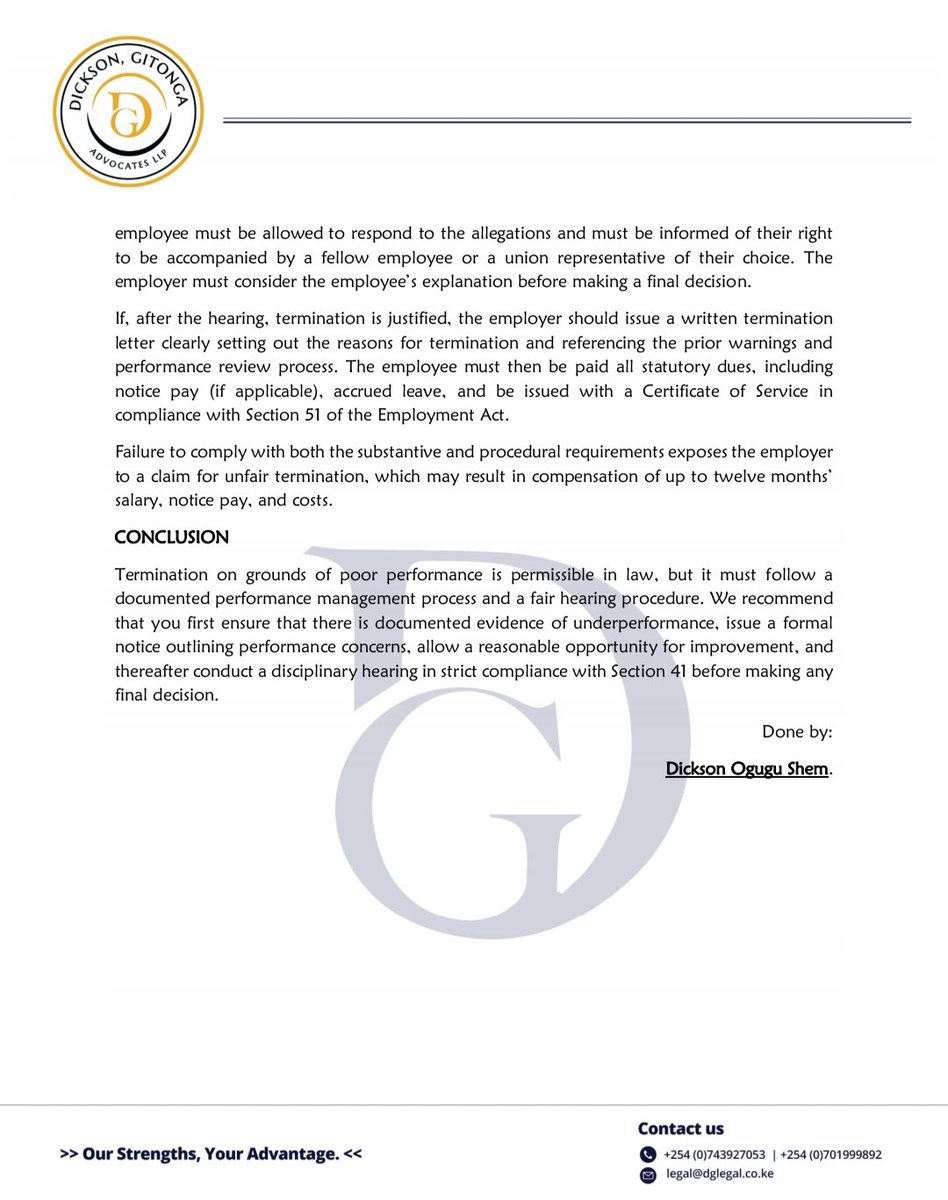
If you’re looking to terminate an employee lawfully, or you’re interested in employment law, have a look at this brief draft I developed to jog your thinking on this area of law.
Order IX Rule 1 of FREP rules says that failure to comply with time, manner, place or form shall be deemed as irregularity which may not affect the proceeding unless it relates to mode of commencement of the application or the subject matter does not falls under chapter IV of the
@ataweweattorney Order 3 of the Fundamental Rights (Enforcement Procedure) Rules, 2009 provides that: "An application for the enforcement of Fundamental Rights shall not be affected by any limitation statute whatsoever." - Moore A. A.
Adumein, J.C.A. El-rufai v. Senate of the Natl Assembly 2014
If the law is against you, argue the facts.
If the facts are against you, argue the law.
If both the facts and the law are against you, argue procedure.
If procedure, law, and facts are all against you — settle.
A reminder that good advocacy is about strategy, not noise.
Millar v State (2005) 8 NWLR (Pt. 927) 236
Suspicion cannot take the place of proof.
It is improper to convict an accused merely because he was present when a crime was committed.
Evidence must be cogent, direct, unbroken, create causal link and leave no doubt as to guilt.
🧵
But it’s a simple logic backed by Section 393(4) of CAMA 2020 and the case of Mr. Kelvin Ihesiaba & Ors v. Chief Mathew Ochepa (2015)
Once a company goes into receivership, the board’s powers are suspended in respect of the charged assets and that affects who can represent the company and even instruct lawyers.
Directors cannot exercise powers that interfere with the receiver’s mandate.
In Ihesiaba v Ochepa, the court held that once a receiver is appointed, only the receiver can institute or defend actions on behalf of the company.
🙂↔️
“The law is settled that where a Director enters into a contract in the name of the company, it is the company that is liable on it and not the Director. HOWEVER, where the Director is shown to have guaranteed performance of the contract by the company, he will be liable together with the company. “ Major concept Ltd v Eze (2025).
A lot of all these online CEOs go see shege this 2026 😁
How I discovered my business partner secretly relocated to Canada — one half of comedy duo “Still Ringing” reveals
One half of the popular OAP and comedy duo “Still Ringing” has shared how he unexpectedly found out that his partner had relocated abroad without informing him. Speaking in a recent interview, he explained that he first sensed something was wrong while hosting a live radio show.
According to him, listeners kept asking, “Where is Coach now? Where is your interpreter?” He said he tried to cover up by assuring the audience that his partner was on the way before quickly switching to a commercial break. He recounted that during the break, he called his partner to ask about his whereabouts, telling him that fans were asking for him.
To his surprise, his partner replied, “Let me not lie, I’m currently in Canada.” Thinking it was a joke, he pressed further, but was told clearly that the relocation was real. The OAP admitted he felt deeply disappointed, especially because they lived in the same compound.
“If he wanted to leave, he should have informed me,” he said. “You can’t leave me hanging like this. I have a wife and children, and this is how we survive.” He described the experience as shocking and hurtful, stressing that proper communication would have made the situation easier to handle.
When company directors can’t hide behind incorporation
Dilly Motors Ltd v. Nujuum Ventures Ltd & Ors (2025) LPELR-81603 (CA)
Question: Can directors be held personally liable when a company uses its corporate status to commit fraud?
Short answer: Yes. The Court of Appeal held that when a company’s separate personality is used to perpetuate fraud, the veil of incorporation will be lifted and the individuals behind it personally liable.
Legal background:
Ordinarily, a company is a distinct legal person, separate from its directors and shareholders. However, this protection is not absolute. Under Nigerian law, particularly guided by judicial precedent, courts will “lift” or “pierce” the veil of incorporation where justice demands it, especially in cases involving fraud or illegality
Core holding:
The Court of Appeal allowed the appeal and held that:
* Once fraud is established, directors cannot rely on the company’s separate legal personality as a defence.
* The veil of incorporation must be lifted to hold the real actors accountable.
The facts:
1. Nujuum Ventures (the 1st Respondent) bought vehicles worth ₦107.5 million from Dilly Motors using post-dated cheques and a credit bond insurance.
2. The cheques later bounced, and the insurance bond turned out to have expired before the payment date.
3. The High Court found fraud but refused to hold the company’s directors personally liable.
4. On appeal, Dilly Motors argued that once fraud was proven, the court ought to lift the veil of incorporation and make the directors jointly liable.
5. The Court of Appeal agreed, finding that the directors used the company as a cover for fraudulent conduct.
Competing arguments:
* Appellant: Fraud had been proved, so the veil must be lifted to hold the directors personally responsible.
* Respondents: Liability should remain with the company, not its directors.
Court’s ruling:
The Court of Appeal sided with Dilly Motors. It held that fraud nullifies the protective shield of incorporation. A company cannot be used as an engine of fraud, and courts will look beyond its façade to hold the individuals behind the misconduct personally accountable.
What to learn from this:
1. Incorporation protects honest business, not fraudulent conduct.
2. Directors who use their company to cheat or deceive others risk personal liability.
3. The courts will not let incorporation become a hiding place for fraud.