Loved discussing with @DanielaAmodei that humans, not just machines, can recursively self-improve. So how can we keep helping humans, and not just machines, become more and more capable? Bringing AI and humanity together is like a dance or a marriage. It won't work if one partner keeps getting better and better and the other partner, in this case humans, stagnates.
Science makes it clear that health is also about what happens between doctor visits: how we sleep, what we eat, how we move, how we manage stress, how we connect with ourselves and others. I asked @DanielaAmodei, president of @AnthropicAI, how AI’s powers of hyper-personalization can be used to offer the right nudges and recommendations to help us improve these essential daily habits.
@AnthropicAI's value of holding light and shade is not just true about AI, it's true about all of us. We’re all a mixture of better angels and lesser angels. @DaneielaAmodei and I discussed why this moment isn’t just about how AI can constantly improve, but also what we can do to nurture our better angels.
What does @DanielaAmodei’s 5-year-old think she does all day? Hint: not running one of the biggest AI companies in the world, @AnthropicAI. Would you guess taking care of an alligator named Claude at @calacademy?
Also:
• why her 5-year-old thinks her job is taking care of an alligator named Claude
• why Leaves of Grass and Yesteryear are both on her nightstand
• why there should never be an AI czar
Watch our interview here: https://t.co/WcFjX0cVVQ
In my conversation with Daniela, we explore:
• why the discussion about recursive self-improvement has to include humans, not just the machines
• the dance between humans and AI, and what happens when one partner keeps growing and the other stagnates
• letting AI own intelligence and letting humans own wisdom, and why “@ClaudeAI can never be your manager, or your therapist, or your partner, or your kids”
• how AI’s power of hyper-personalization can transform health, because health is also about what happens between doctor visits when we improve our daily habits around food, movement, sleep, stress management and connection
• whether AI, unlike social media, can nurture our better angels instead of activating our lesser ones and strengthening the worst in us
With everyone at the company reporting to her, she is not only a key AI leader, but the most prominent woman leader at a time when the AI conversation is dominated by men. She’s at the forefront of frontier models, but she also studied literature, she played the flute, she’s a mother. She doesn’t just speak tech, she speaks about nature, community, friendship, and self-reflection.
Right now, 75% of Americans are anxious and afraid about AI. People are even bringing their concerns into their therapy sessions, sorting through everything from how AI impacts their jobs to more existential fears about humanity’s future. These concerns are real. But they’re only part of the story. To go deeper, I sat down with @DanielaAmodei. As president of @AnthropicAI, she is a unique figure in AI.
You might open a door they didn't know existed.
For more on how therapy can support people living with cancer, read the full article on @pfizer's This Is Living With Cancer: https://t.co/fsIqxlepGC
After a cancer diagnosis, most people focus on the physical — the treatment plan, the appointments, the next steps. But the emotional toll deserves just as much attention.
This World Mental Health Day, if someone you love is living with cancer, consider sharing what's available.
Most of us already know what supports better health, but the challenge is making those behaviors part of daily life.
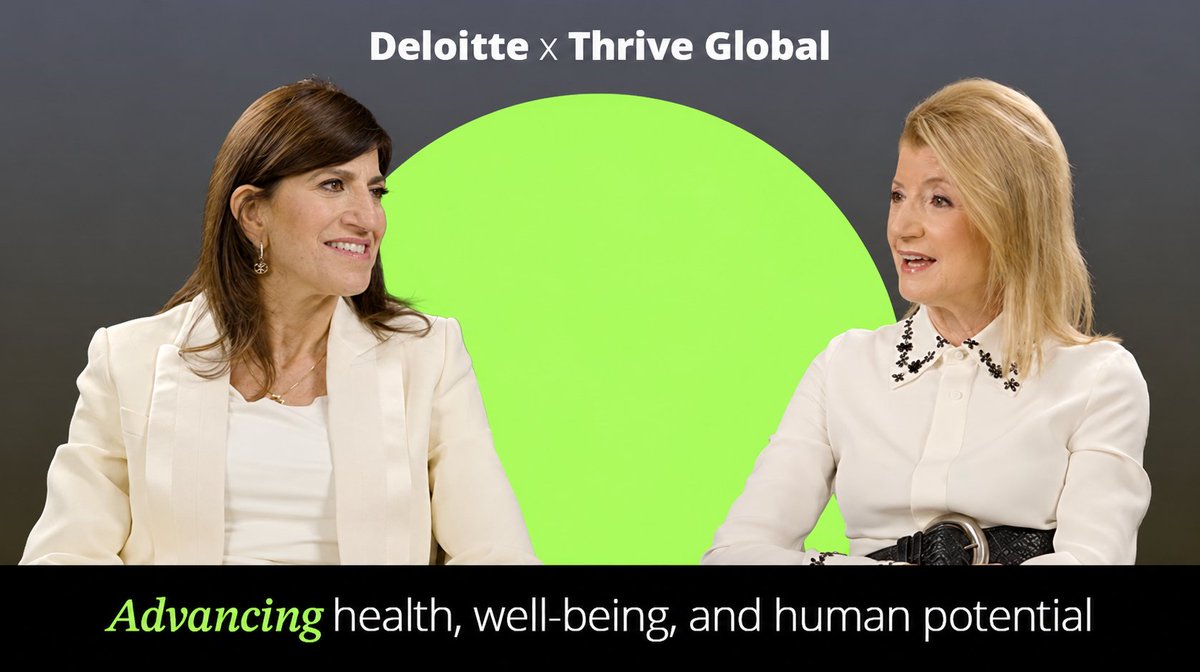
And today @Thrive Global and @Deloitte are launching a strategic relationship that makes it easier for people to move from awareness to action so they can build healthier habits and improve their health — one Microstep at a time.
Currently, most U.S. healthcare spending is reactive, focused on treating illnesses and conditions after they occur. But Deloitte estimates that proactive “well-care” could save the country up to $2.2 trillion a year in medical and pharmacy costs. This number captures the enormous opportunity we have to move the needle.
By bringing together Thrive’s AI-powered behavior change platform and Deloitte’s experience in health care transformation, data and analytics, digital innovation and large-scale implementation, we’ll help organizations harness the science-backed power of our daily behaviors — food, movement, sleep, stress management and connection — and scale behavior change to help people build healthier habits and routines. And starting in October, Deloitte will incorporate Thrive content across key areas of health into the wellbeing resources available to its U.S. workforce.
Learn more about how Thrive Global and Deloitte are helping organizations support health and wellbeing through behavior change here: https://t.co/ya1rVkdYCI
Positive affirmations can help you reframe the limiting beliefs you hold around sleep. They've also been shown to reduce stress and negative thinking, which can help you get to sleep faster.
Gratitude is one of the most powerful emotions, with benefits that extend inward and outward. You can also ask: Who is one person I’m grateful to have in my life?
For additional tips on supporting your mental health while caring for someone with cancer, read more on @pfizer's This Is Living With Cancer: https://t.co/dEPdoLwTtV
When you're caring for a child with cancer, it's easy to put your own needs last. But tending to your own wellbeing — even in small ways — isn't selfish, it's essential.
This Childhood Cancer Awareness Month and beyond, remember to pour back into your own cup.
Tonight, say no to one thing that gets in the way of your sleep, like doom-scrolling the news, binge-watching a show, or losing yourself in social media. Your morning self will thank you.
This Blood Cancer Awareness Month, we’re reminded that life with cancer happens between doctor’s visits. That’s why Thrive Global has partnered with @bmsnews to launch a free wellbeing resource library for people living with multiple myeloma and the caregivers that support them.
The library offers science-backed support across five key daily behaviors: food, movement, sleep, stress management, and connection.
Whether you’re living with cancer or caring for someone who is, prioritizing your wellbeing can begin with one small step.