@Nightlizard1564@CarnyNews I personally think MV peaked at KOTM so far. GvK was stupidly fun. GxK could’ve been way better. Skar King was so mid but I think the point was that he’s just a tyrant that didn’t have anyone stronger than him show him up. I’m trying to have high hopes for supernova
@Pyroraptor717@DaJezziee@OmegaAshura I love that in the English dub, he sounds like the dopiest fucker imaginable, but in the Japanese one it sounds like a child talking through a ham radio across the planet
According to the official Wakaliwood instagram, the actor that played Captain Alex in Who Killed Captain Alex died. Rest in peace to a man who played a very unsung role in action movie history, who helped prove that no matter the hardship, filmmaking can be for everyone.
I like this. A few airshows are icons: Paris, Farnborough, the RAF Tattoo. Boeing & Airbus announce sales here & they demo jets in a way you’ll never see anywhere else.
Americans have OshKosh. Some others, too, & they are epic, but it’s not the same thing.
My impression is that we’ll do the airshow & demos that make icons, and we’re going to add space. Why not have a Falcon launch, do an orbit & return as part of your show? Maybe the Blue Angels can do their show in between.
I’d buy tickets.
Built to play. Not to pet. Enter for a chance win!
Follow and repost with #XbiteSweepstakes for a chance to win the one-of-a-kind playable XBOX Series X-BITE.
No Purchase Necessary. US/DC/PR 18+. Ends on 11/10/26. Rules: https://t.co/tngcGpYvRR
Let’s do a primer on in-flight ice accumulation, or “icing” for those not familiar.
As you go up in altitude, the temperature & pressure decrease. It’s about 2°C per 1,000’, called the “standard lapse rate”. It varies locally, but we use this as our standard.
So, even on a hot day on the surface at 90°F (32°C), you theoretically only need to climb 16,000’ to get to 32°F (0°C).
Because of the way air flows over the surfaces of an airplane at speed, the outside air temperature is not equal to the temperature of the air as it hits the wing & such. Friction & compression heats the air as it hits the airplane; we measure this & call it the “Total Air Temperature” (TAT). The faster you go, the higher the TAT.
Still, most jets can’t go fast enough at altitude to get the TAT above freezing. In fact, on the 737 at near max speed & a cruise altitude of 35,000’ or so, the TAT is still going to be around -40°C (it varies a lot, that’s just a guess).
Now, clouds are just visible moisture. We all know what happens to water at those temperatures. An airplane passing through a bunch of frozen water is going to collect ice on it.
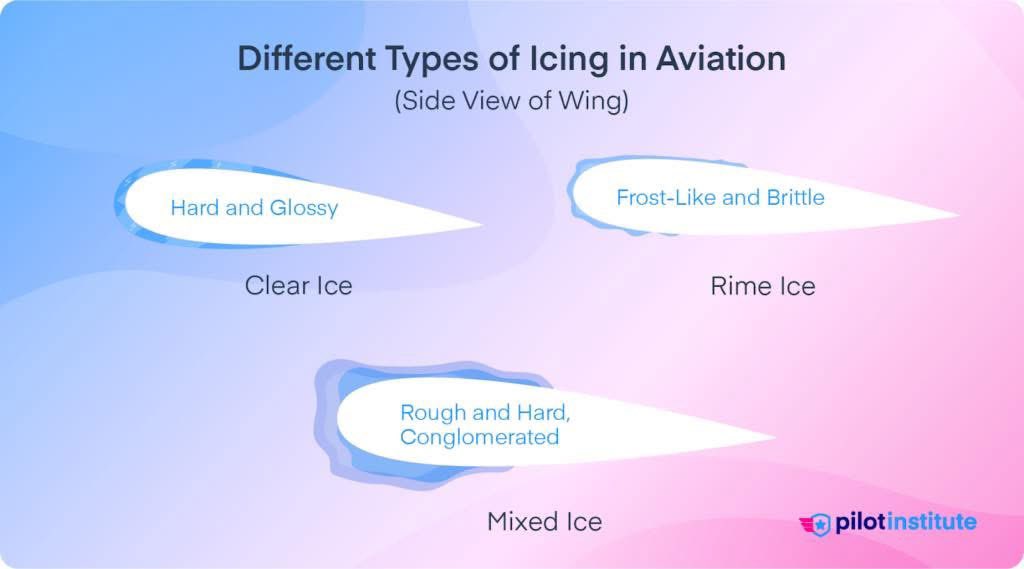
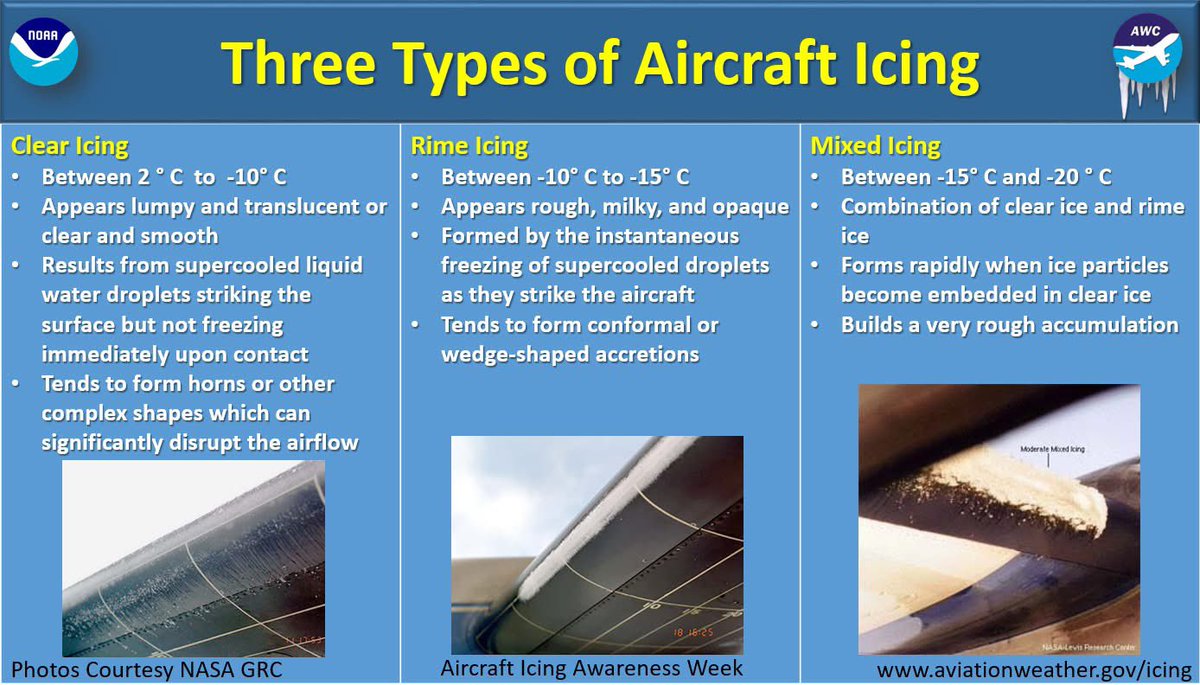
There are different categories, types & intensities of icing. Structural icing is just the airplane flying through cold clouds; the ice collects on the airplane. It can be Rime icing, which is kind of milky in color & looks bubbly, Clear icing, which can be tough to see or a mix. In some rare scenarios, very large drops of water are supercooled & remain liquid until they contact the jet, then instantly freeze. While the other types of ice generally only collect on the leading edges of surfaces, supercooled drops may run back over more of the jet during the freeze.
That’s a big problem; usually only the leading edges of the surfaces like the wings & engines are protected from ice. The shiny parts on the front of airliner wings & around the engine intake are where hot air from the engines gets diverted to heat up that area & melt any ice…but if ice goes beyond that, there isn’t much you can do. Some airplanes have systems to prevent ice formation on the tail, too, but that’s usually electric pads & usually only shows up on T-tail jets.
Anyway, regardless of the type, you may get various intensities: trace, light, moderate or severe ice.
Induction icing occurs in the engines, as it sucks air in & changes the pressure. You can get induction icing without structural icing, but again, the area around the engine inlet is heated to prevent large chunks of ice from forming, breaking off & going through the engine.
We treat icing as a possibility anytime there is visible moisture (rain, snow, fog, clouds) and the temperature is 10°C or below. Yeah, you won’t get structural icing at 10°C, but you might get induction icing. In these conditions, the engine anti-ice is turned on, sending hot air around the leading edge of the engines.
The wing anti-ice is used a bit differently & the philosophy here varies widely by airline. I’ve always used it not as an anti-ice, preventing ice from forming like on engines, but as a de-ice…it’s not turned on until I see ice forming. Other airlines have different philosophies.
I turn it on, melt the ice, then turn it off. Now, we can’t see the wings well, so on the 737 we use the windscreen wipers as a proxy for the wings. If the large nut on the wiper arm has collected ice, I assume the wings have, too (the windscreens are electrically heated, but it’s not unusual to go through moderate or severe icing & collect some ice around the edges of the windscreen).
If you recall, I said the tail often doesn’t have an ice system, and that’s true of the 737. That may sound scary, but it’s not something I’m worried about. If we turn on the wing anti-ice during a flight, the computer assumes the tail may have ice on it & it bumps our approach speed up to give the tail extra air to manipulate. It’s basically an ICE additive to our final approach speed.
I hope that helps, I’m out of space.
This is a bit sudden, but Uni is having surgery today.
Recently, we discovered some small stones in Uni’s bladder, even though he’s already on a special prescription diet designed to dissolve certain types of stones.
Uni had been getting regular checkups after recovering from cystitis, so even our vet was puzzled by how suddenly the stones appeared.
Our vet determined that the stones are a type that can’t be dissolved through diet, so they need to be surgically removed and analyzed.
Thankfully, Uni is doing well and acting like his usual self. But if the stones block his urinary tract, it could become life-threatening. That’s why we decided to have surgery as soon as possible.
He’ll likely be hospitalized for 3–7 days, which is a bit of a long stay. The surgery itself isn’t considered particularly complicated, but we're still very worried.
Please keep Uni in your thoughts and prayers