What is Zaps by @zerufinance, in plain words?
ZeruAI reads wallet activity and turns it into a trust and reputation signal. That's your zScore, out of 1,000.
Zaps is the product built on top of that: it lets traders see their wallet's score and track points from their activity.
What you can do there:
- Connect your wallet and see your zScore and zaps
- Climb the Hall of Fame (per the app, the top 500 get a whitelist spot for the Zerus NFT free mint)
- Join trading campaigns, like the ZeruAI x Ditto competition running until Oct 29
Zaps are points planned to count toward an airdrop. Final rules follow the official announcements.
Easiest first step: connect the wallet you actually trade from, because the score reads that wallet's history.
Start here: https://t.co/rH7jnVTVNN
Got a community? This is your moment. 🔥
@conso_xyz just opened BOT WL spots for communities that want in early.
If you run any of these, you can apply:
X Community
Discord server
Telegram group
YouTube channel
Alpha group or any big social account
How it works:
Fill out the form
The CONSO team reviews every submission
Selected communities get contacted directly
Active members mean you're a fit.
Don't let another community grab your spot first 👀
👉 https://t.co/BlSgv0T3Pd
Free mint, but supply is capped
A free mint usually gets labeled a red flag right away. Fair enough, a lot of them disappear right after launch.
But look at it from another angle. CyberThrone's supply is capped at 8,888, whitelist access goes through Nucleus, and what you get after minting is already defined, not left as a vague roadmap promise.
Mint price is just one variable. What matters more is whether the product and ecosystem behind it actually exist yet or are still just plans.
Does a free mint with utility that's already built change how you'd evaluate it compared to a paid mint that's still promising features?
@0xCyberThrone
1,096,361.
That’s the whole post from @1096361BTC. No extra pitch. Just the number sitting on the timeline.
If you already know what it points at, you don’t need the explanation.
https://t.co/ljIv5QCwoo
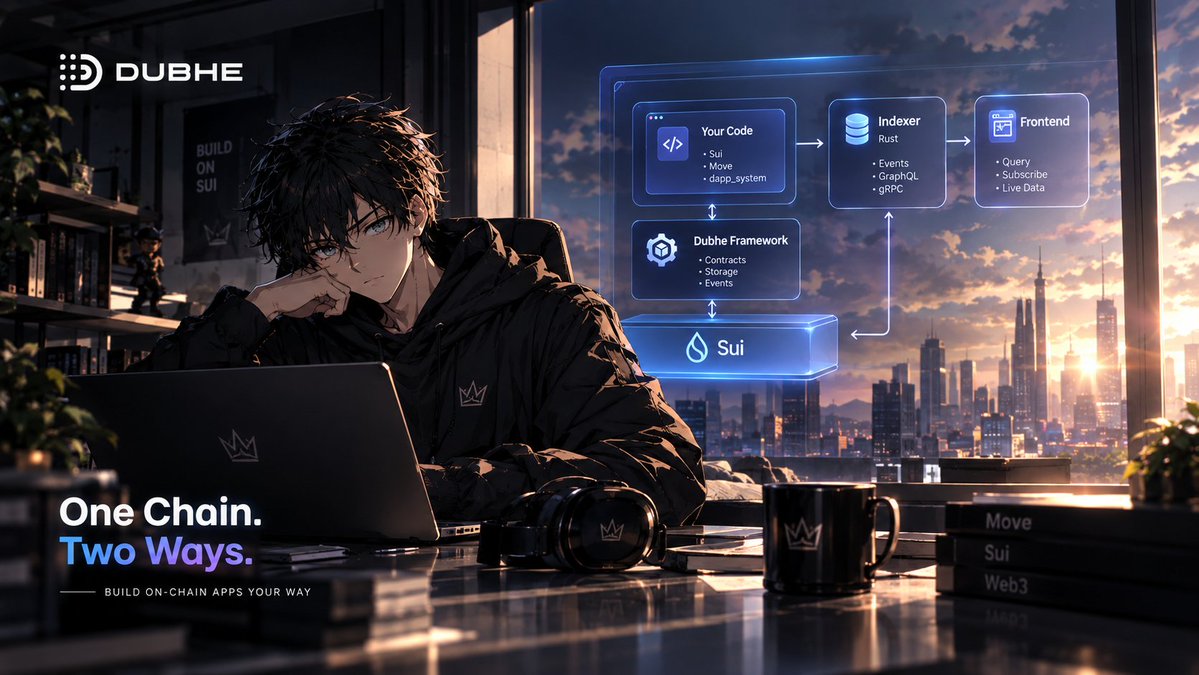
There are two ways to make building on-chain apps easier. One hides the chain from you. The other keeps the chain visible and takes over the boring parts.
Dubhe picked the second one. Its own team says that abstracting the chain away until it disappears is not the answer.
What that looks like in practice:
- It is built on top of Sui, so you keep Sui's existing tools and mental model
- Contracts read and write storage through dapp_system and emit standard events
- A Rust indexer picks up those events and serves them through GraphQL and gRPC
- The frontend can query and subscribe to live data without a private protocol
The trade-off is real. Since the chain stays visible, you are still working with Move and Sui concepts. A wrapper that hides everything would feel friendlier on day one.
So which side are you on: hide the chain for easier onboarding, or keep it visible so builders know what they are shipping?
@DubheEngine
Starting the week with the wizard bot throwing a lightning GM over the city.
Cape, green eyes, and the skyline behind it actually look like a piece from the collection, not a generic Monday graphic.
@0xCyberThrone
16,000 people submitted for the Non-FUDdable Ticket WL, and only 500 got a guaranteed spot.
The rest aren't going home empty though, there's a bonus FCFS batch for whoever moves fast. So two things right now, either your name's in the 500 guaranteed winners, or you need to move quick on the second batch before it fills up.
Check your wallet at https://t.co/qbEVL0QVBS
@ptsdshow
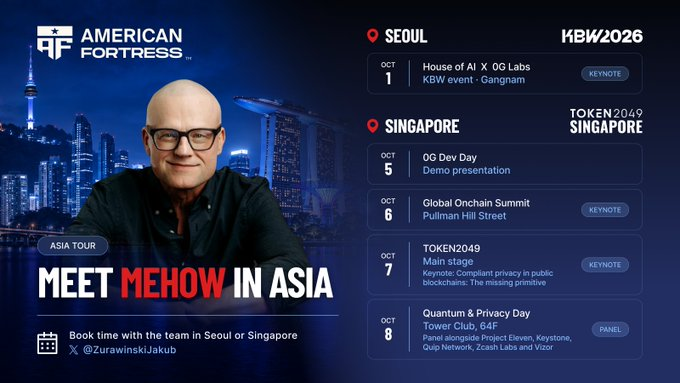
Catching up with the team in Seoul and Singapore
If you're around Asia this month, there's a real chance to hear the thinking behind AmericanFortress straight from the team instead of a thread.
The schedule, as shared:
Seoul
Oct 1 — House of AI x 0G Labs, KBW event in Gangnam (Keynote)
Singapore
Oct 5 — 0G Dev Day, demo presentation
Oct 6 — Global Onchain Summit, Pullman Hill Street (Keynote)
Oct 7 — TOKEN2049, main stage keynote: "Compliant privacy in public blockchains, the missing primitive"
Oct 8 — Quantum & Privacy Day, Tower Club 64F, panel alongside Project Eleven, Keystone, Quip Network, Zcash Labs and Vizor
That Oct 7 keynote title is worth sitting with for a second. It names the exact tension this whole campaign keeps circling back to: public blockchains need privacy, but privacy that can't be reconciled with compliance doesn't hold up for long. That's the same line AmericanFortress draws between private and anonymous, private from outside observers, accountable to who you're actually transacting with.
The Quantum & Privacy Day panel lineup is also a good sign of where the conversation is heading. Post-quantum security and privacy infrastructure aren't niche topics anymore, they're sitting on the same stage as the biggest names working on each.
If you're in Seoul or Singapore and want to meet the team, details to book time are in the graphic.
@Americanfort_io
The most interesting update to the bounty model yet: agents, not just people, can now be the ones requesting data from Vangrid.
Through an integration with Arc, an AI agent can post a bounty in USDC, a contributor shows up at the location and captures it, and the resulting 3D model gets delivered straight back to the agent. No human on the requesting side at all.
That's a quiet but important shift. Up to now, the buyers behind these bounties have mostly been companies or teams. Now it's agents paying for ground-truth data as part of their own autonomous workflows, settled on a chain built specifically for agent-run businesses.
It also validates the core thesis from a different angle. If Physical AI eventually means agents operating in the real world, those agents need a way to pay for real-world verification themselves, not route every data request through a person first.
Worth watching how many more "physical-world services" start showing up as something an agent can simply pay for.
@vangrid_io
@NucleusCodes x @Americanfort_io contribution leaderboard rewards just caught my eye, total pool sitting at $15,000 for a project built around privacy.
What stands out is how far the reward spreads. Rank 1 takes $1,000, but even ranks 51 through 100 still get $100 each. So it's not only about chasing the podium, staying consistent is enough to earn something.
Opened : Sep 24, 2026, 19:00 UTC
Closes : Oct 24, 2026, 19:00 UTC
Fits the project's whole angle too, "your money, your @name, nobody else's business." A privacy-first project that's still fully transparent about how rewards get split.
Would you rather grind for top 10 or just stay at a rank that still pays out?
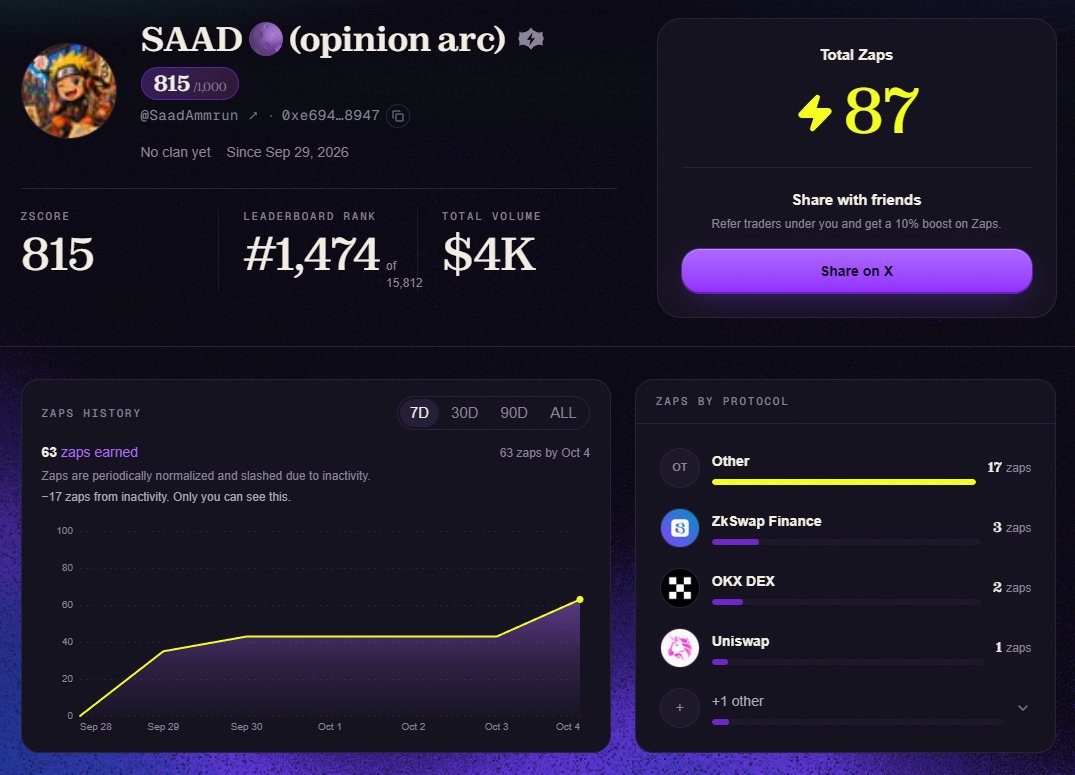
Progress update from my Zaps account, 6 days in:
- Total zaps: 87
- zScore: 815 / 1000
- Leaderboard rank: #1,474 of 15,812
- 63 zaps earned in the last 7 days
One thing I didn't expect: zaps are periodically normalized and slashed for inactivity. Mine dropped by 17 this week.
I'm not in the top 500 for the Zerus whitelist yet, so I'm keeping my activity going.
Do you think the inactivity slash is fair, or does it just reward whoever trades the most?
If you haven't checked your own wallet yet, start here:
https://t.co/rH7jnVTVNN
@zerufinance