💡Can a WAM remember long-horizon history while staying efficient?
🔥 Introducing MemoryWAM: Efficient World Action Modeling with Persistent Memory
🔗 https://t.co/Ao9I4OHtY2
🌶️🤖𝐖𝐞 𝐜𝐨𝐨𝐤𝐞𝐝 𝐭𝐡𝐞 𝐫𝐨𝐛𝐨𝐭𝐢𝐜𝐬 𝐰𝐨𝐫𝐥𝐝’𝐬 𝐟𝐢𝐫𝐬𝐭 𝐩𝐥𝐚𝐭𝐞 𝐨𝐟 𝐌𝐚𝐩𝐨 𝐓𝐨𝐟𝐮.🤖🌶️
This was not just a cooking demo. It was a 30-minute, long-horizon robotics challenge packed with delicate, continuous, high-dexterity actions.
With only a small number of demonstrations, our model learned to perform complex manipulation over an extended sequence. At the same time, we pushed hard on motion control and system-level optimization, making the robot move smoothly while keeping the high success rate.
For us, this plate of Mapo Tofu is more than a dish. It is a small but meaningful step toward home robots that can handle real everyday tasks with the dexterity, consistency, and reliability people expect.
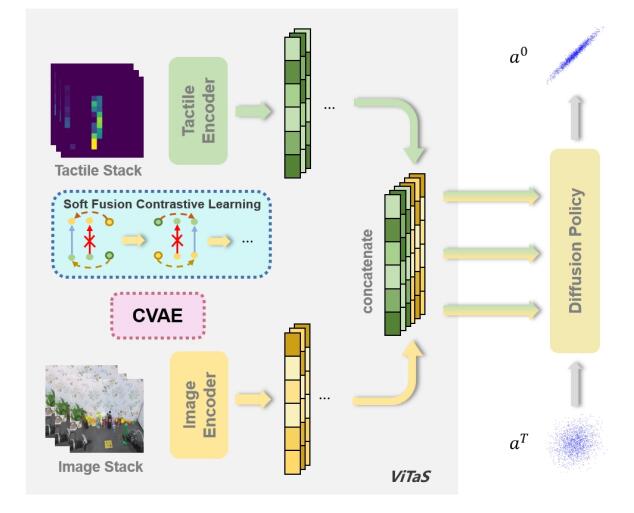
Eyes see. Hands feel. Many visuotactile methods rely only on concatenation, leaving room to better exploit alignment and complementarity for manipulation.
Excited to share our #ICRA2026 paper: "ViTaS: Visual Tactile Soft Fusion Contrastive Learning for Visuomotor Learning".
Results: For RL, ViTaS shows significant improvement in 12 tasks. For IL, ViTaS still wins across 3 simulation IL tasks, showing that touch compensates for reduced vision.
2/N ViTaS in RL and IL.
In RL we use ViTaS as the feature extractor with PPO. In IL we plug ViTaS into DP, replacing its default encoders with our visuo-tactile pipeline.
Fair comparison: DP gets 3 cameras, while ViTaS uses only 1 head camera + tactile sensors.
Real-world deployment is crucial for robotics.
I wrote about a recipe: strong base model + RL post-training (offline & online) → toward human-level capability.
https://t.co/DGlxVjSduH
Introducing RL-100: Performant Robotic Manipulation with Real-World Reinforcement Learning. https://t.co/FUqEQ26mzi
7 real robot tasks, 900/900 successes. Up to 250 consecutive trials in one task, running 2 hours nonstop without failure.
High success rate against physical disturbances, zero-shot, and few-shot adaptation
Our first step toward a deployable robot learning system.