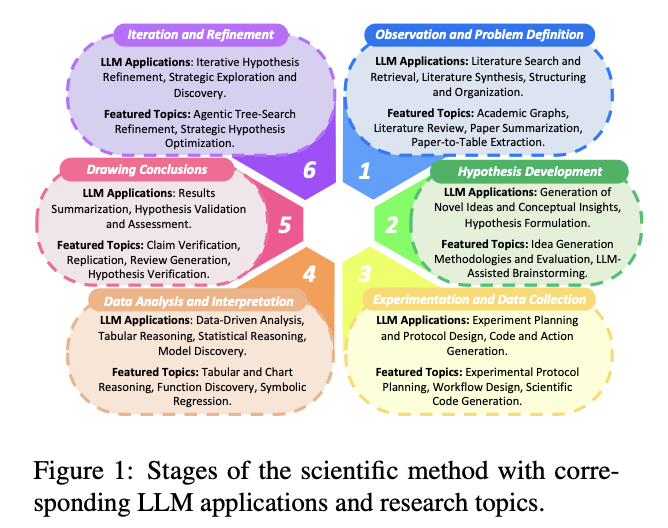
New arXiv: SciResearcher, an agent for frontier scientific reasoning by @Tianshi_0218
The key point: science is not generic web QA. It requires academic evidence, domain-specific entities, tool use, and computational reasoning. Curate data for SFT and RL https://t.co/CmrSEpNYej
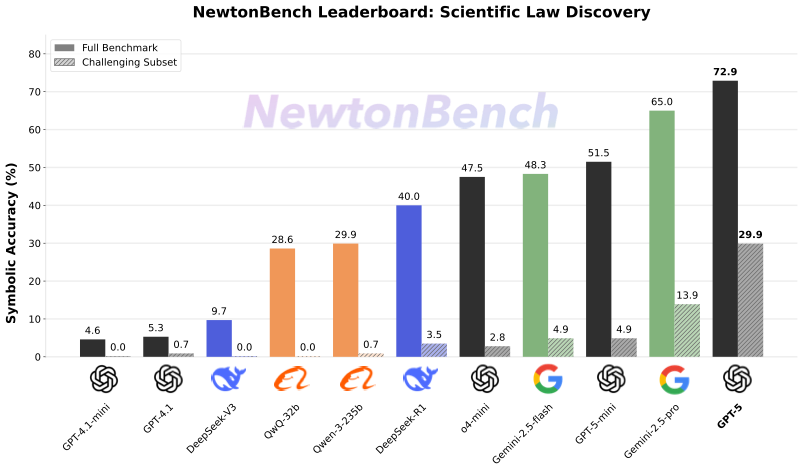
🤯 Can LLM rediscover Newton’s laws?
Imagine an LLM agent perched in the apple tree in 1666. Could it independently uncover the law of gravitation?
✨ Introducing NewtonBench: a benchmark for genuine scientific discovery—by launching “parallel universes” for LLMs to explore👇
Paper: https://t.co/gtlG9dUTuc
Code: https://t.co/zgAUjpLc5b
(1/7)
The Takeaway? 🚀
While LLMs are developing foundational scientific skills, robust, generalizable discovery remains a core challenge.
Tool use isn't a simple fix; it introduces complex agentic trade-offs. NewtonBench provides a crucial testbed to measure real progress toward AI capable of genuine scientific discovery.
Explore the 'parallel universes' yourself!
#AI #LLM #AIforScience #ScientificDiscovery #Agent #Reasoning #DeepLearning #Benchmark #HKUST #NLP
Work done in @HKUSTKnowComp with collab from @nvidia. Thanks for all contributors!
Paper: https://t.co/gtlG9dUTuc
Code: https://t.co/zgAUjpLc5b
(7/7)
Thrilled to share a major milestone: the culmination of a 15-month project, ATLAS—a new benchmark in event graphs and conceptualization! This journey began with Probase in 2012, evolved through ASER (2019), AbstractATOMIC (2022), and AbsPyramid (2023), and now realizes a decade-long dream of building a web-scale knowledge graph integrating entities, events, and a conceptualization framework. It’s also a tribute to Marvin Minsky’s K-Lines Theory.
I still vividly recall 2012 when I worked with Haixun, including intern Fangting Xia, spent months exploring event semantic primitives and conceptualization, only to pivot due to limitations. Fast forward to the era of large language models, and we’ve finally brought this vision to life!
Someone argued that knowledge graphs are obsolete in the age of large models. We disagree—it’s about having high-quality graphs that scale with these models. That’s why we invested HK$1.5M to process Wikipedia, academic abstracts, and 3% of web data from Dolma, creating a 1B-node graph—the best we could achieve.
While entities cover 70% of factual queries, adding event semantic primitives boosts coverage to 90%. This is why text decomposition is gaining traction. Our extracted knowledge graph excels on complex factual queries like HotpotQA, MMLU, and FELM, making it the largest open-source GraphRAG dataset available.
This work is the result of 10+ students and nearly 10 collaborators pouring their hearts into it. I’m deeply grateful for their contributions to this meaningful milestone, and I hope they’ve gained as much from the journey as I have.
Big shoutout to anyone curious about pushing this further! Parsing the entire web’s data would cost ~HK$40M, and I’d love to collaborate with bold thinkers to make it happen.
Paper: https://t.co/anSipOlyVJ
Code & Resources: https://t.co/1Mc2w4zs93
Project: https://t.co/T90c1kSkLP
Feedback and critiques are welcome! Let’s keep advancing the field together. #KnowledgeGraphs #ATLAS #GraphRAG
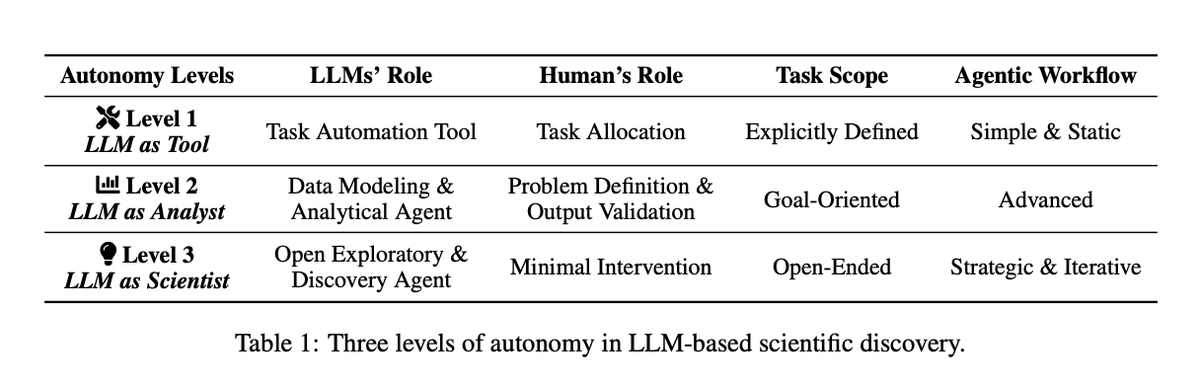
@HKUSTKnowComp@hkustNLP We chart the paradigm shift as LLMs evolve from tools to autonomous agents in science. Introducing a foundational 3-level taxonomy (Tool, Analyst, Scientist) to map their escalating autonomy & capabilities. 🤖🔬
I have just got my abductive knowledge graph reasoning paper accept by acl24, and I really have some sights to share.
In this paper, we try to explain observations by using a complex logical expression formed by the knowledge inside a knowledge graph. Seems very abstract? Here is an example: suppose someone follows five people, Grant Heslov, Jason Segel, Robert Towne, Ronald Bass,
Rashida Jones, in social networks, and we have a kg about these people, then we want to explain like: they are the Screenwriters and Actors that are born in California.
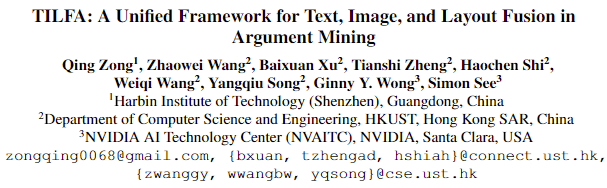
🚀Our work "TILFA: A Unified Framework for Text, Image, and Layout Fusion in Argument Mining" has been accepted to the 10th Workshop on Argument Mining, co-located with EMNLP 2023
✨We rank 1st in subtask A
Arxiv: https://t.co/L7H1BGJgxd
#EMNLP2023#EMNLP2023NLP#NLProc
(1/5)👇🏻