Federal contract intelligence for public-market research.
New awards on public companies. Materiality signals.
Independent research. *Not investment advice*
TIDINGS RESEARCH IS LIVE!
As of this past week our website is fully live and here is what that means.
- Research library is publishing free research
- Our screener is running during market hours for anyone to watch
- Membership is available to those who want timely alerts
A $131B federal contract headline can be $343K of real money.
An IDIQ announces a ceiling — the maximum the government may order. The cash actually obligated at award is a separate, much smaller number.
Read the obligation, not the headline.
Sometimes the work is ordered before the price is agreed.
An undefinitized contract action starts performance against a funding ceiling. The final value is negotiated later, and can settle well below the announced number.
Work has begun. The price has not.
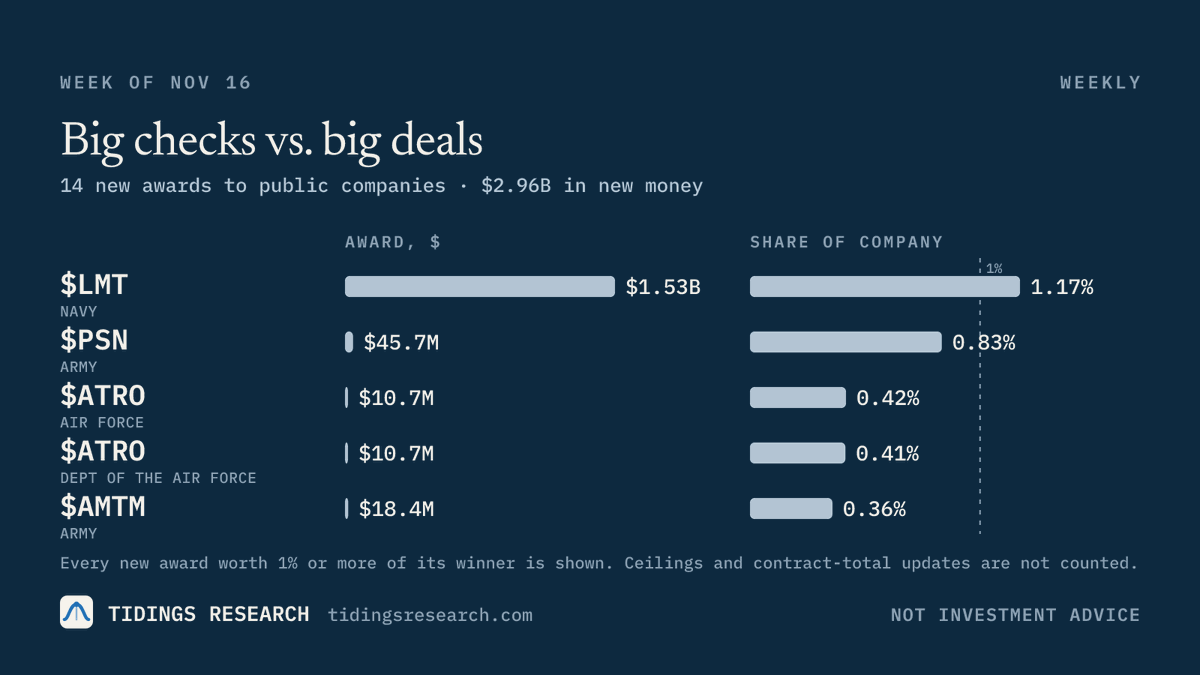
This week: 14 new federal awards to public companies, $2.96B in new money.
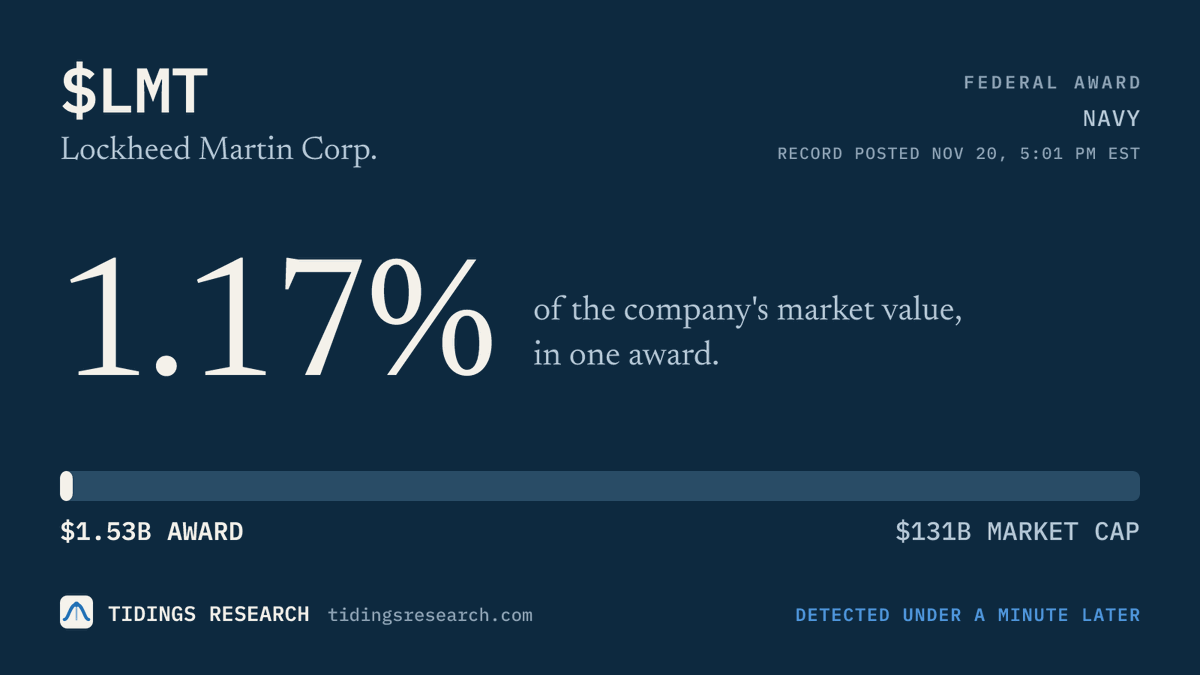
The biggest check was also the biggest deal: $LMT, $1.53B, 1.17% of the company.
8 ceiling increases and contract-total updates not counted: not new money.
31 more not yet classified, so not counted.
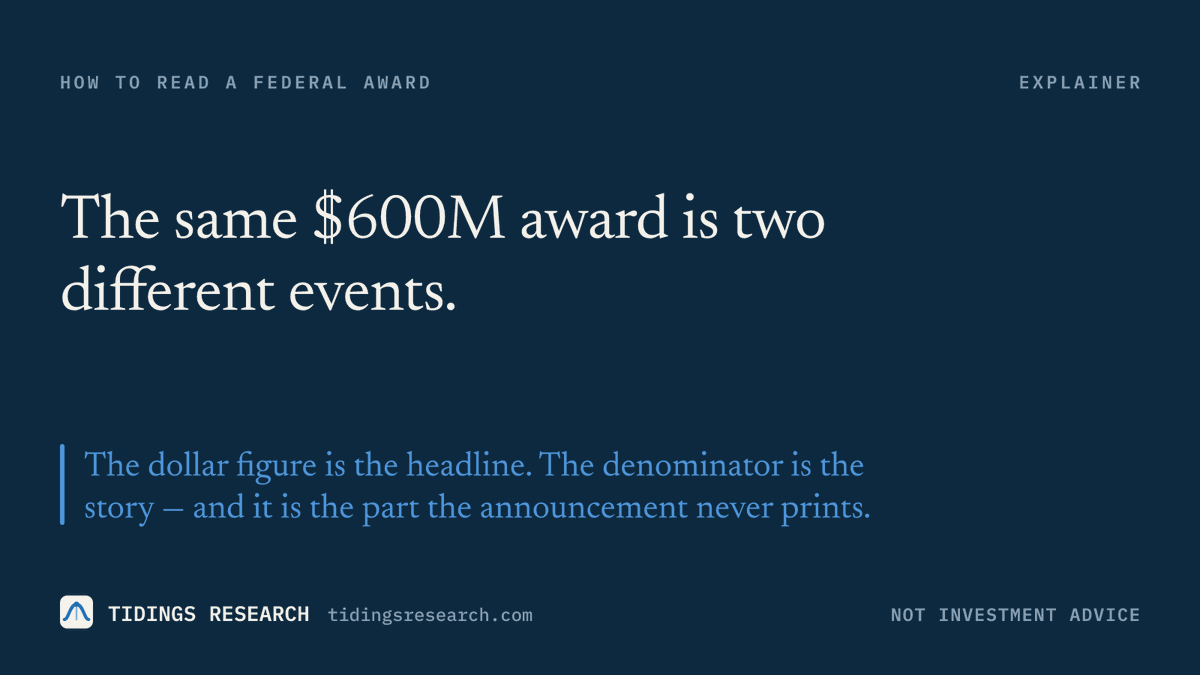
The same $600M award is two different events.
To a $100B prime it is 0.6% of market cap and a Tuesday. To a $2B supplier it is 30% and a repricing.
The dollar figure is the headline. The denominator is the story — and it is the part the announcement never prints.
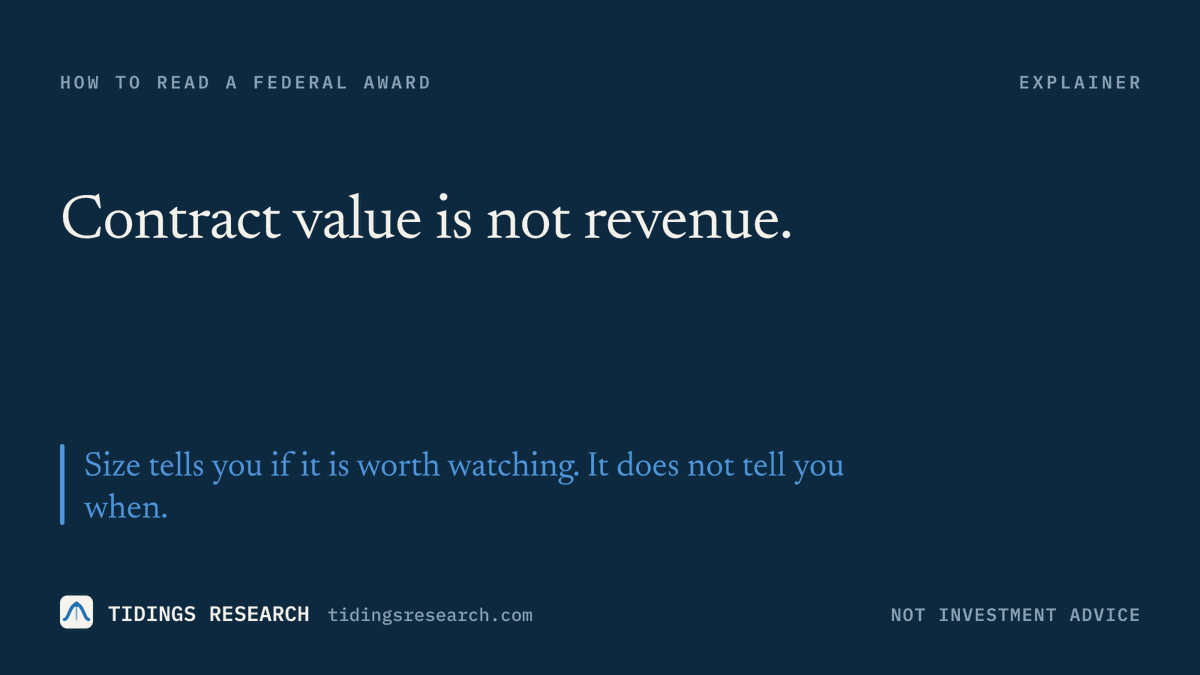
Contract value is not revenue.
A multi-year award is recognised as the work is performed, across the life of the contract. A $600M award to a company with $2B of annual revenue does not add 30% to next quarter.
Size tells you if it is worth watching. It does not tell you when.
The company on a federal award is usually not the company on the ticker.
Awards go to operating subsidiaries, and the parent's name often appears nowhere. Mapping the awardee to the listed parent is most of the work — and where most contract screens go wrong.
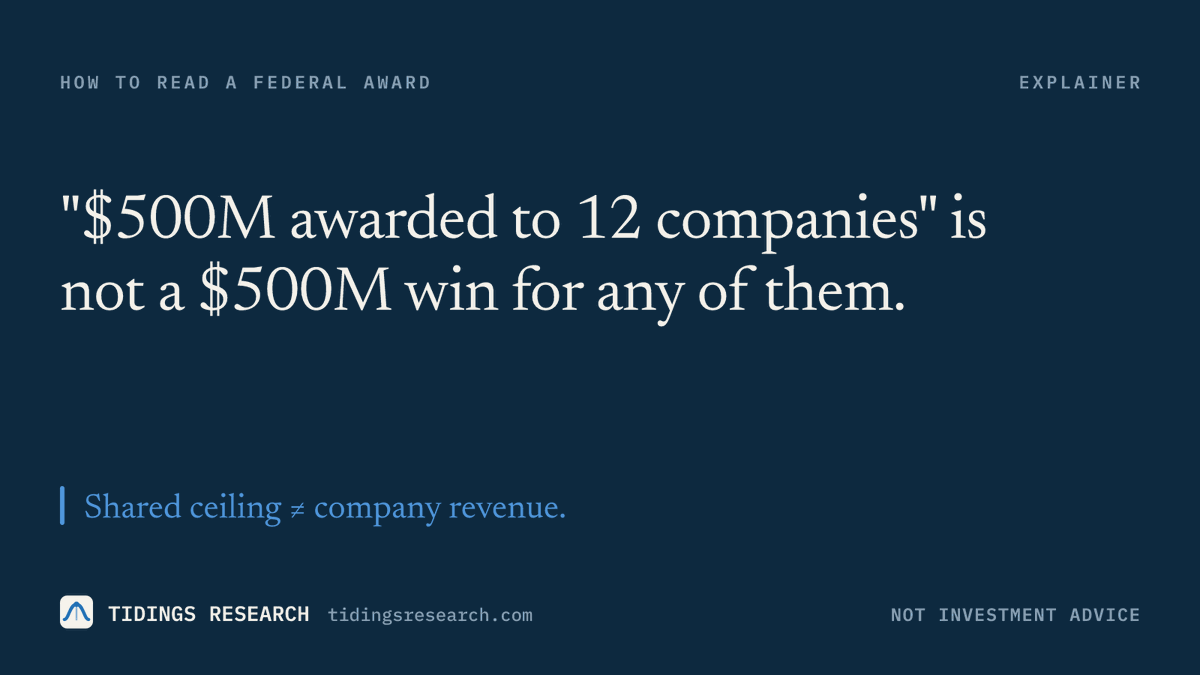
"$500M awarded to 12 companies" is not a $500M win for any of them.
On a multi-award vehicle the companies compete for individual task orders. Until a specific order is placed, no dollar figure is attributable to any single awardee.
Shared ceiling ≠ company revenue.
Most large federal award announcements are not new money.
A modification adds funds to a contract that already exists, and the release leads with the new cumulative total — making a routine option exercise read like a fresh win.
New value is the increase, not the total.
Most large federal award announcements are not new money.
A modification adds funds to a contract that already exists, and the release leads with the new cumulative total — making a routine option exercise read like a fresh win.
New value is the increase, not the total.
Finding federal awards is easy. Knowing who won is not.
Awardee names are legal entities, abbreviated and often shared across unrelated firms. A confident match on a near-identical name attaches a real award to the wrong ticker.
We would rather report that we cannot resolve it.
This week: 3 new federal awards to public companies, $55.8M in new money.
The biggest check: $HON, $23.2M.
None was worth 1% of the company that won it. We read them anyway.
5 ceiling increases and contract-total updates not counted: not new money.
40 more not yet classified,…
The federal record is the primary source. The press release is a summary of it.
Award notices post on the government's schedule — often before a company says anything, sometimes when it never will.
We read the record. Coverage arrives later, if at all.
Sometimes the work is ordered before the price is agreed.
An undefinitized contract action starts performance against a funding ceiling. The final value is negotiated later, and can settle well below the announced number.
Work has begun. The price has not.
The same $600M award is two different events.
To a $100B prime it is 0.6% of market cap and a Tuesday. To a $2B supplier it is 30% and a repricing.
The dollar figure is the headline. The denominator is the story — and it is the part the announcement never prints.
Contract value is not revenue.
A multi-year award is recognised as the work is performed, across the life of the contract. A $600M award to a company with $2B of annual revenue does not add 30% to next quarter.
Size tells you if it is worth watching. It does not tell you when.
The company on a federal award is usually not the company on the ticker.
Awards go to operating subsidiaries, and the parent's name often appears nowhere. Mapping the awardee to the listed parent is most of the work — and where most contract screens go wrong.
"$500M awarded to 12 companies" is not a $500M win for any of them.
On a multi-award vehicle the companies compete for individual task orders. Until a specific order is placed, no dollar figure is attributable to any single awardee.
Shared ceiling ≠ company revenue.
"$500M awarded to 12 companies" is not a $500M win for any of them.
On a multi-award vehicle the companies compete for individual task orders. Until a specific order is placed, no dollar figure is attributable to any single awardee.
Shared ceiling ≠ company revenue.
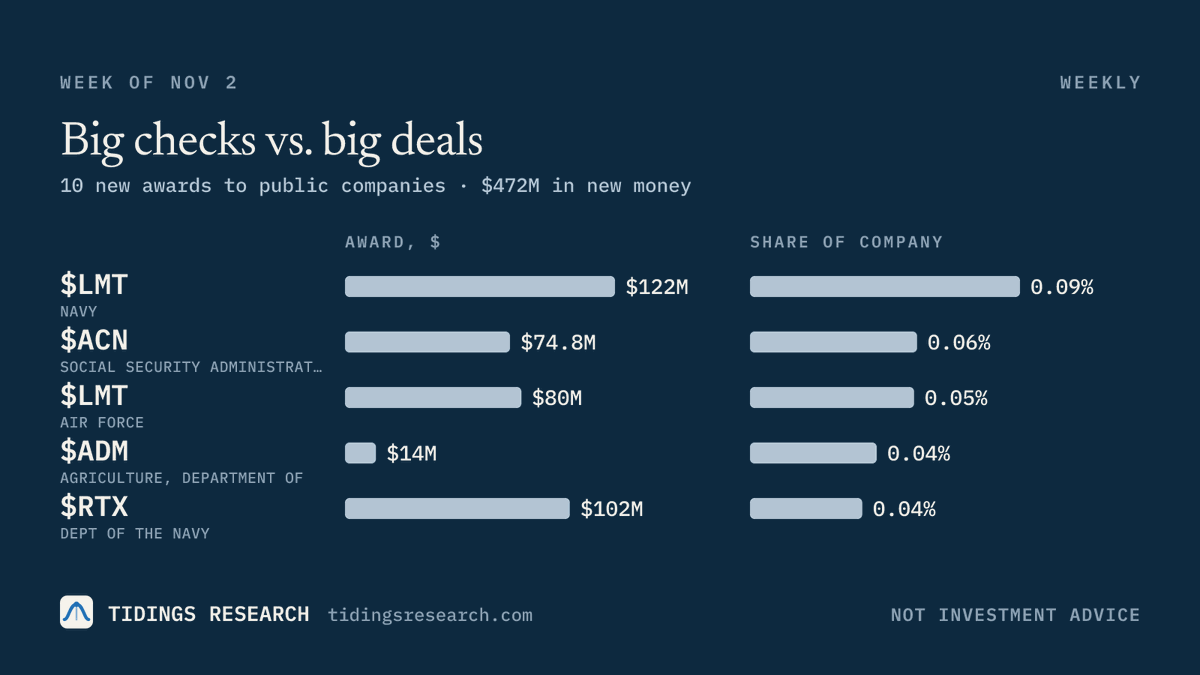
This week: 10 new federal awards to public companies, $472M in new money.
The biggest check: $LMT, $122M.
None was worth 1% of the company that won it. We read them anyway.
5 ceiling increases and contract-total updates not counted: not new money.
41 more not yet classified,…