My friend went to an indie hacker meetup this week and said this:
"i went to indie hacker meetup
so what’s really interesting is that almost everyone is super focused on development.
they build these whole spaceships that generate code, review it, make all kinds of reports, analytics, and so on.
one guy built an entire factory: he has a list of ideas, and agents generate the landing page, the saas, the analytics, and pull everything into one dashboard. straight-up sci-fi.
and they focused optimize all of it like crazy.
and you can really see how comfortable that is for them.
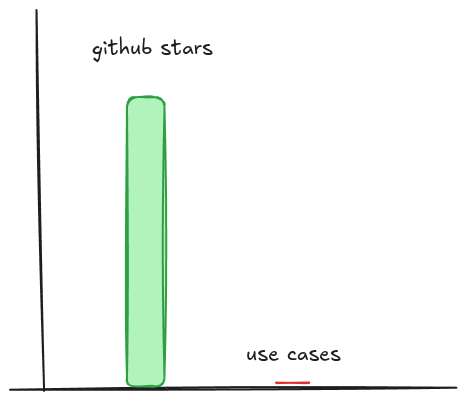
but the most interesting part is that almost none of them have money or traffic.
and nobody knows where to get either one.
you often hear something like, yeah, i should probably do on marketing, but first i’ll finish my super system and then i’ll start.
or in best i would need to make agent that will post to instaram automatically
before, the classic programmer would spend a year writing code, tests, preparing for scale in the basement, and not show anything to anyone.
now it’s even worse: the amount of useless aislop nobody needs has grown massively."
5/ The expectations are rigged. The "I built a tiny app and it makes $10k a month" posts are survivorship bias. They quietly leave out the audience the person already had, or the ten things that flopped first
1/ "Small and easy to build" gets pitched as the advantage. It's actually the problem. Three reasons why
Easy to build means everyone can build it. AI made building nearly free, so the supply of little tools exploded.
4/ So you don't just need a thing. You need a thing some group already hurts enough to pay for. Finding that group means talking to them. Which is distribution again.
3/ Willingness to pay is rare. People will happily use almost anything for free. The set of things they'll actually pay for is small and specific: business pain, time saved, or money made.
2/ Once the artifact is commoditized, the only edge left is distribution and a narrow niche. Those are the exact parts you can't code your way through.
The token cost to build a production feature is now lower than the meeting cost to discuss building that feature.
Let me rephrase.
It is literally cheaper to build the thing and see if it works than to have a 30 minute planning meeting about whether you should build it.
It’s wild when you think about it.
This completely inverts how you should run a software organization. The planning layer becomes the bottleneck because the building layer is essentially free. The cost of code has dropped to essentially 0.
The rational response is to eliminate planning for anything that can be tested empirically. Don’t debate whether a feature will work.
Just build it in 2 hours, measure it with a group of customers, and then decide to kill or keep it.
I saw a startup operating this way and their build velocity is up 20x. Decision quality is up because every decision is informed by a real prototype, not a slide deck and an expensive meeting.
We went from “move fast and break things” to “move fast and build everything.”
The planning industrial complex is dead.
Thank god.
I don’t think there’s anything especially groundbreaking about OpenClaw itself. It’s going viral because it integrates 200 plus tools into one system
Give an agent real agency and the ability to act and it quickly becomes extremely powerful. That’s why it starts to feel like AGI
i think programming might be done but human verification is still a big need.
we won't need programmers as much anymore but we will still hire people to run the code and make sure it works as intended
I believe this new model in Claude Code is a glimpse of the future we're hurtling towards, maybe as soon as the first half of next year: software engineering is done.
Soon, we won't bother to check generated code, for the same reasons we don't check compiler output.
@JustCallMeMaxy1@chibidoki a lot of Spanish youtube videos are too hard for beginners. listening to something that's just a bit above your level is the key.
boorix is the app for that
https://t.co/wCJwdRCe64
@DuskofRa@chibidoki learning via comprehensible input is also very effective as it's been proven by many people
Boorix is an app that can help you
https://t.co/wCJwdRCe64