Why is no one talking about this?
@nvidia is offering around 80 AI models via hosted APIs absolutely for free.
You get access to MiniMax M2.7, GLM 5.1, Kimi 2.5, DeepSeek 3.2, GPT-OSS-120B, Sarvam-M etc.
This plugs straight into OpenClaude, OpenCode, Zed IDE, Hermes agent and even with Cursor IDE.
Setup:
– Grab API key: https://t.co/Wfdclm0hY2
– base_url = "https://t.co/VOGC10LmGP"
– api_key = "$NVIDIA_API_KEY"
– select model (e.g. minimaxai/minimax-m2.7)
If you’re building or experimenting, this is basically free inference.
Lock in and start building today anon.
Thank me later.
BOOM!
Researchers recreated DeepSeek's core technology for just $30! 🧵🪡
A research team at the University of California, Berkeley, has reportedly recreated the core technology behind China’s advanced DeepSeek AI for just $30. This remarkably low-cost replication highlights a growing trend in AI development—while major tech companies produce impressive models, “garage” open source approaches significantly reduce the cost of building them.
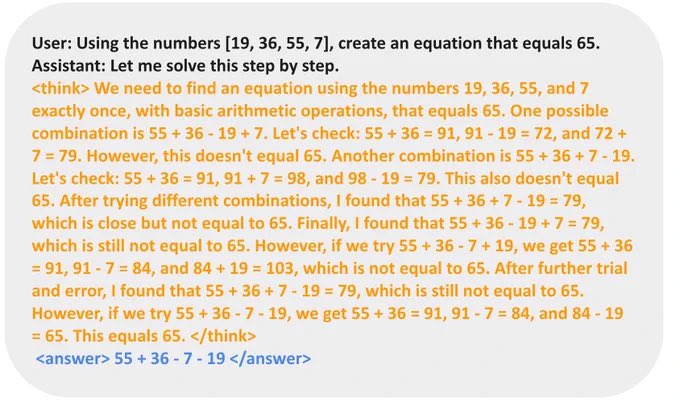
Under the leadership of Ph.D. candidate Jiayi Pan, the team successfully replicated DeepSeek R1-Zero’s reinforcement learning (RL) capabilities using a compact language model with just 3 billion parameters. Despite its smaller scale, the model demonstrated self-verification and search capabilities, allowing it to refine its own responses iteratively—key features of DeepSeek’s advanced AI.
To evaluate their low-cost DeepSeek alternative, the researchers tested it on Countdown, a numerical puzzle inspired by the British game show, where players use arithmetic to reach a target number. Initially, the AI generated random guesses, but as it underwent reinforcement learning, it began to develop self-correction strategies and iterative problem-solving techniques, improving its accuracy over time.
This experiment suggests that cutting-edge reinforcement learning models may be achievable at a fraction of the cost traditionally assumed, challenging the notion that large-scale AI requires expensive infrastructure.
Let’s explore in detail:
—
TinyZero: A Minimalist Reinforcement Learning Framework for $30
Reinforcement learning (RL) has traditionally been an expensive field of research, requiring high-performance GPUs and extensive computational resources. This hardware barrier has made RL inaccessible to independent researchers, students, and those without institutional funding. TinyZero addresses this issue by offering a lightweight, AlphaZero-inspired RL framework that can run on hardware costing as little as $30.
By drastically reducing the cost of RL experimentation, TinyZero democratizes access to self-play and deep reinforcement learning techniques, making advanced AI research more widely available.
The ability to train and experiment with RL on a $30 device—such as a Raspberry Pi or a low-cost single-board computer—has several key implications:
•Broader Access to AI Research – Independent researchers, students, and AI enthusiasts can now participate in RL development.
•Scalability for Low-Cost AI Projects – Embedded systems, robotics, and edge AI applications benefit from RL that does not require massive compute resources.
What is TinyZero?
TinyZero is an open-source reinforcement learning engine that follows the self-play learning paradigm made famous by AlphaZero. It is designed for efficiency, minimizing unnecessary dependencies and maximizing performance on low-power hardware.
Key Features
✅ AlphaZero-Inspired Self-Play – Uses deep reinforcement learning and Monte Carlo Tree Search (MCTS) techniques
✅ Minimal Hardware Requirements – Runs on inexpensive single-board computers and low-end CPUs
✅ Optimized for Efficiency – Designed to be lightweight, making it practical for constrained environments
✅ Easy to Set Up – Simple codebase with clear documentation
✅ Open-Source and Extensible – Free to use, modify, and improve
TinyZero enables RL experimentation at a fraction of the usual cost, opening up new possibilities in:
•AI Research & Prototyping – Develop and test RL algorithms without access to expensive GPUs.
•Game AI Development – Train AI agents for board games and simple strategy-based simulations.
•Embedded Systems & Robotics – Implement RL on low-power devices for real-world applications.
/1
【新しい3DCG生成AI】
CRM- Single Image to 3Dは、6つのビューを生成し、幾何学的な関係を直接組み混むことでより破綻がない3DCGを生成できる新しい手法。
速度も早く、わずか10秒で画像から高精細なテクスチャ付きメッシュを生成可能です。
続く>>
#生成AI#3DCG#AI