The EU reset deal will cost businesses like mine a small fortune.
We are an artisan food producer who produces small quantities of a wide variety of products.
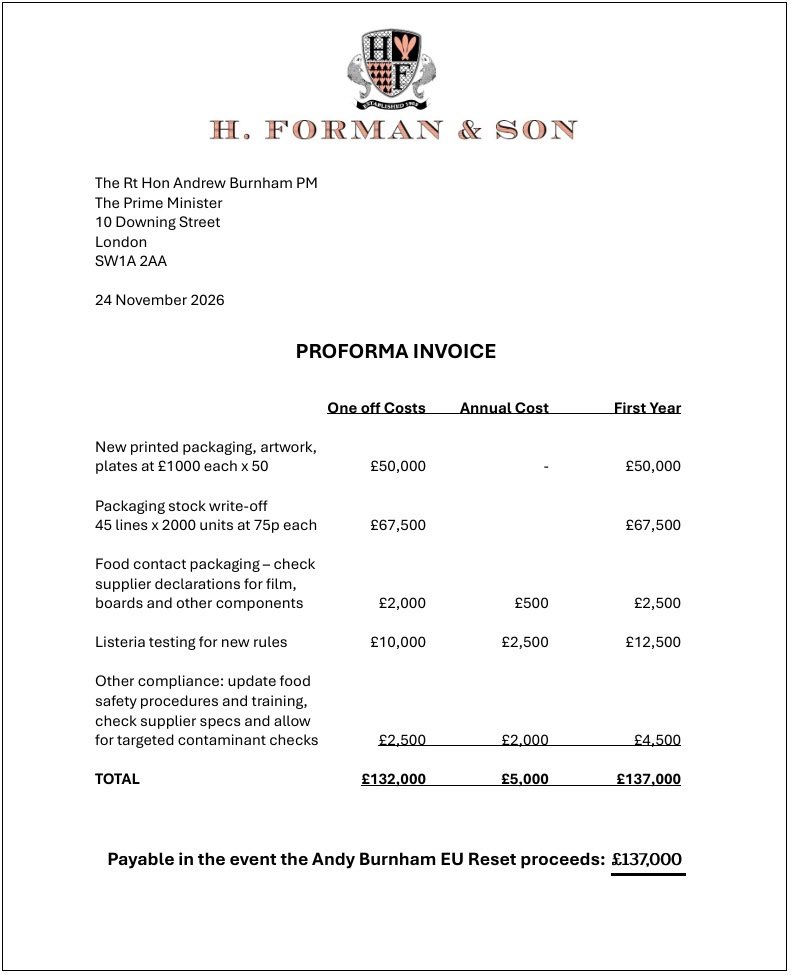
We have approx 50 different types of printed packaging which can last us for at least five years on the smaller volume lines. So not only will we have costs associated with new printing plates and designs, we will also have to write-off a huge volume of packaging stock.
The new EU rules on testing for listeria will also come into force, adding additional one-off and annual costs.
Other compliance costs and updates for annual audits will also add to our costs.
Given this unnecessary burden, I have decided to send Andy Burnham an invoice should the reset proceed.
For four long years we fought for Britain to be allowed to use precision breeding to reduce the cost of food, improve nutritional quality, cut dependence on chemicals etc.
With one stroke of his pen, @andyburnham has killed the whole project.
Great news from Emma Reynolds who says employers aren't working people, "they are companies".
So as a company, I've decided to stop working !
Should have done it years ago. I'll be at home from now on, or on holiday, doing whatever it is unemployed people do with their time. Maybe I might even be eligible for some benefit payments now @EmmaforWycombe ?
Good luck to my staff, who'll turn up this morning with nobody to tell them what needs doing, no diesel, no fertiliser and no wages on Friday.
HMRC might notice eventually. I just haven't got round to the PAYE. Or the VAT return. Or the corporation tax. I'm sure they'll understand, I'm not a person, And such tasks just seem a little bit like hard work to me !
If anybody calls chasing invoices they want paying, tell them to speak to the company.
We'll see how that goes........
For the first time, a golden eagle has fledged from a new nest on managed grouse moor in southern Scotland.
The gamekeepers on that moor have named him Beaky Junior.
The charity Restoring Upland Nature (RUN) asked them to choose the name in recognition of their part in helping golden eagles thrive in the area. They have kept their identities private to protect the nest.
His parents, Beaky and Skan, were both moved south from the Highlands by the South of Scotland Golden Eagle Project, Beaky in 2018 and Skan in 2019.
RUN's chief executive, Dr Cat Barlow, says the support of landowners and gamekeepers has been "absolutely vital" to the recovery. That support runs from the Highland estates where young eagles were collected to the gamekeepers who monitor and protect nests in the south.
Golden eagles now hold 18 active ranges across southern Scotland. When the project began there were three nesting pairs.
READ MORE: https://t.co/THVUwufGlr
I don’t know about any other small business owner but my business plan is literally to survive a labour gov, if they get in for a second term? That’s it, we’re done, toast
Maybe its just me, but running a small business has never - certainly not in my lifetime - been as difficult as it is right now and I'm struggling to find reasons to carry it on.
Its certainly not for the work life balance, or for the money. Its not for an easy life, or to relieve avoid stress.
So what is it for? To keep other people employed? To keep paying ever more tax?
Its been 25 years, and I think I'm done.
This Budget offered the Chancellor the opportunity to reset its relationship with the countryside. Today, however, he showed little interest in seizing that chance.
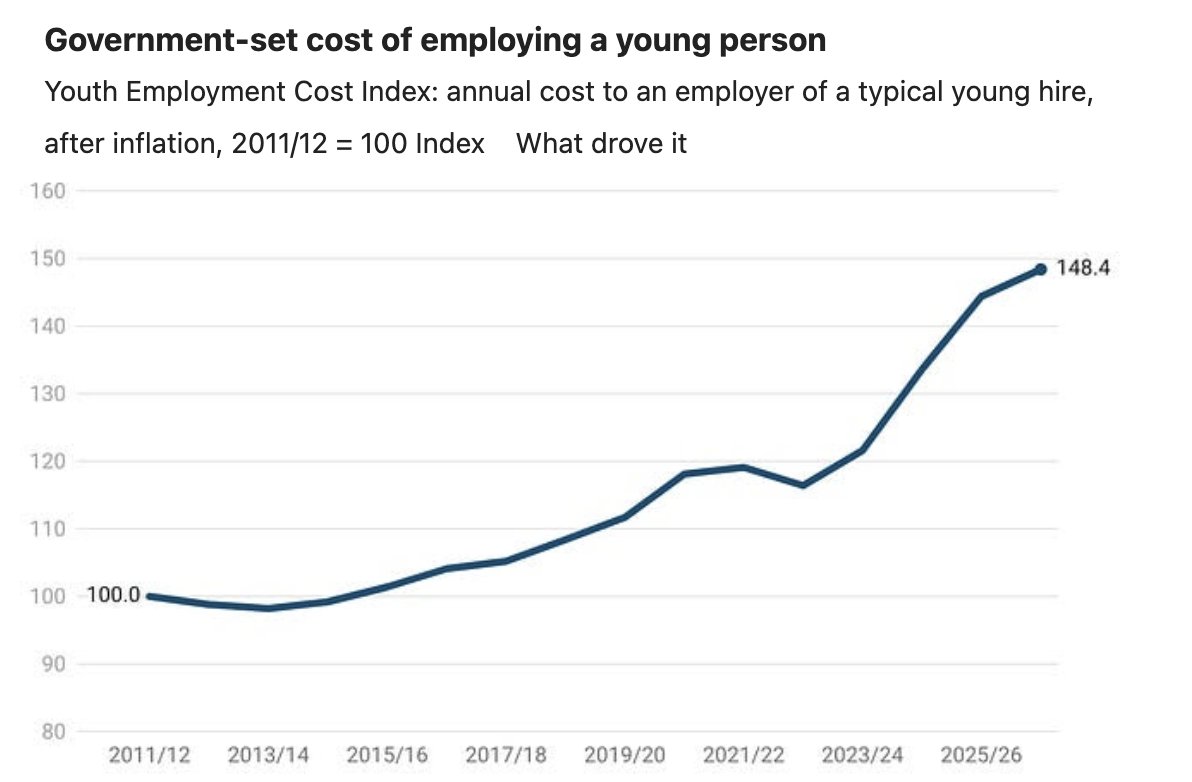
Extending small business rates relief could help rural businesses, but coupled with hikes in employment costs it remains to be seen whether hardworking rural business owners will see any real benefit. Additionally, while temporarily extending the red diesel duty cut and suspending tariffs on kerosene heating oil and fertiliser are welcome moves, it will come as little solace to farmers still facing enormous threats to their livelihoods.
Before becoming Prime Minister, Andy Burnham pledged to revisit the hated Family Farm Tax. He has failed to do so. This tax continues to tarnish the government’s rural record. It is preventing farmers from making important decisions about their livelihoods, hampering the government’s own mission of creating good growth in every postcode. Working with the custodians of our countryside, we will continue to vocally oppose this tax and call for its abolition.
Additionally, farmers have been encouraged for years to diversify their businesses by creating holiday lets, among other measures; but anyone who has done so is now being punished by yet another increase to the property income tax paid on such lets, further threatening the viability of their business.
At a time when the government should be increasing support for farmers and in the wake of last month’s Sustainable Farming Incentive fiasco, it has slashed DEFRA's funding for 2027-28 by £100m.
This Budget does little to give “breathing space” or fresh hope for the countryside. If this government is serious about growth in every postcode, including in the countryside, it must urgently address the plethora of problems facing rural businesses. Scrapping the Family Farm Tax is the only way to turn a new leaf.
@CAupdates
This Budget tells us something v important about the government’s direction for rural Britain.
No reversal of the farm tax.
The lifetime limit for Business Asset Disposal Relief is HALVED from £1m to £500,000, making retirement and succession potentially more expensive.
Taxes on property income rise again.
And the OBR itself now says the expected revenue from the APR/BPR changes is “particularly uncertain” because of the behavioural response.
We can already see that behaviour.
The CLA says 9 out of 10 of its members are cancelling investment.
You cannot tax the transfer of productive businesses, make their disposal more expensive and then announce that you want “growth in every postcode”.
British farms are productive capital. Food production is national infrastructure.
This is a still a recipe for disinvestment.
Chancellor John Healey could have reversed the financial punishment inflicted by his predecessor Rachel Reeves with the family farm tax. He failed to do so. Meanwhile, over 6,000 farming related businesses have closed since the IHT announcement in the 2024 Budget.
#Budget2026
This tidiness trope needs to stop, @BenGoldsmith because it distracts from the real reasons why hedgehogs are disappearing.
Weather extremes are affecting their food supply (this year no slugs and worms gone deep due to drought). More on this later..1/9 https://t.co/9x51InS6iS
Winter wheat emerging - drilled speculatively as current price means a loss. Absolute madness.
Almost nobody in Parliament understands the deep shit British farmers are in, through no fault of our own. It is all apocalyptically difficult right now.
The decline of the hedgehog is mainly caused by the huge recent expansion of the badger population. In both time and place there is a strong negative correlation between badger numbers and hedgehog numbers.
The scientific evidence that an increase in Mr Brock may well be the chief cause of Mrs Tiggywinkle’s demise is overwhelming.
There’s the direct evidence – the hollowed-out prickle-bearing skins left behind after a badger eats a hedgehog. Only badgers can open a hedgehog after it rolls up in defence with prickles on the outside. Foxes and dogs cannot. Badger predation is often found to be the main cause of hedgehog death in studies in this country.
There’s the timing evidence. The decline in hedgehogs coincided with the rise in badgers since the latter’s protection began in the 1970s and was strengthened in the 1990s. Anecdotally, there are clear-cut cases to show this is likely to be cause and effect, not coincidence. Kew Gardens had a thriving hedgehog population until the mid 1980s when badgers first arrived there. Today, says the Royal Botanic Gardens’ website, “Kew is teeming with badgers”. There are now more than 20 badger setts and hedgehogs are hardly ever seen, and if they are don’t last long. Habitat change and development cannot be the cause in Kew, because there has not been any.
There’s the spatial evidence. Throughout England hedgehogs (great worm eaters) have vanished from worm-rich pastureland, where badgers thrive, and cling on only in suburban gardens and amenity grassland, where badgers so far have not penetrated much. Even here, as one study put it: “the probability of hedgehog occurrence in suburban habitats declined towards zero in areas of high badger density.” As a general rule, wherever badgers are present at a density higher than about one main sett every four square kilometres, hedgehogs are absent. In most of rural England, sett density is two or three times higher.
There’s the behavioural evidence. Back in the 1990s, ecologists discovered that the smell of badgers alone is enough to deter hedgehogs from entering an area. And hedgehogs released into areas of excellent habitat high-tailed it out of there if they smelt badger. They do not wait to be eaten.
There’s the international evidence. Sweden has also blamed its decline in hedgehogs on rising badger numbers. In the Netherlands, scientists reported this yearthat hedgehogs are now confined mostly to urban areas, despite roads and development, because of the spread of badgers in rural areas.
There’s the experimental evidence, which is the clincher. The randomized badger control trials, carried out between 1998 and 2006 in 30 different parts of the country, provided an opportunity to see what happened to hedgehog numbers if badger numbers were reduced.
In pasture land, where hedgehogs are mostly extinct, there was of course little effect. But in “amenity grassland” – parks, lawns, gardens, playing fields etc – there was a dramatic explosion in hedgehog numbers in those areas where badgers were culled: hedgehog density almost trebledfrom an average of 0.9 per hectare to 2.4 per hectare in just five years. By contrast in the control areas where no badgers were culled, the hedgehog density remained unchanged at 0.3 per hectare over the same period.
So we know one way to increase hedgehog numbers: reduce badger numbers. No other approach has been demonstrated to have such an effect. Given that badgers are highly effective predators of bumble bees (those who try to study bumble bees complain that most of the nests they find get dug out and eaten by badgers) as well as of ground nesting birds, and that they carry bovine tuberculosis, there is little doubt that lower badger densities would be good for the ecology of the British countryside as well as for farming.
There is nothing natural about the density at which badgers and foxes live in Britain today.
“The effects of the family farm tax means we will lose the farm. We are the smallest farm locally. But we have an inheritance tax liability of £600,000. That’s unsustainable for us.”