New paper alert 🚨
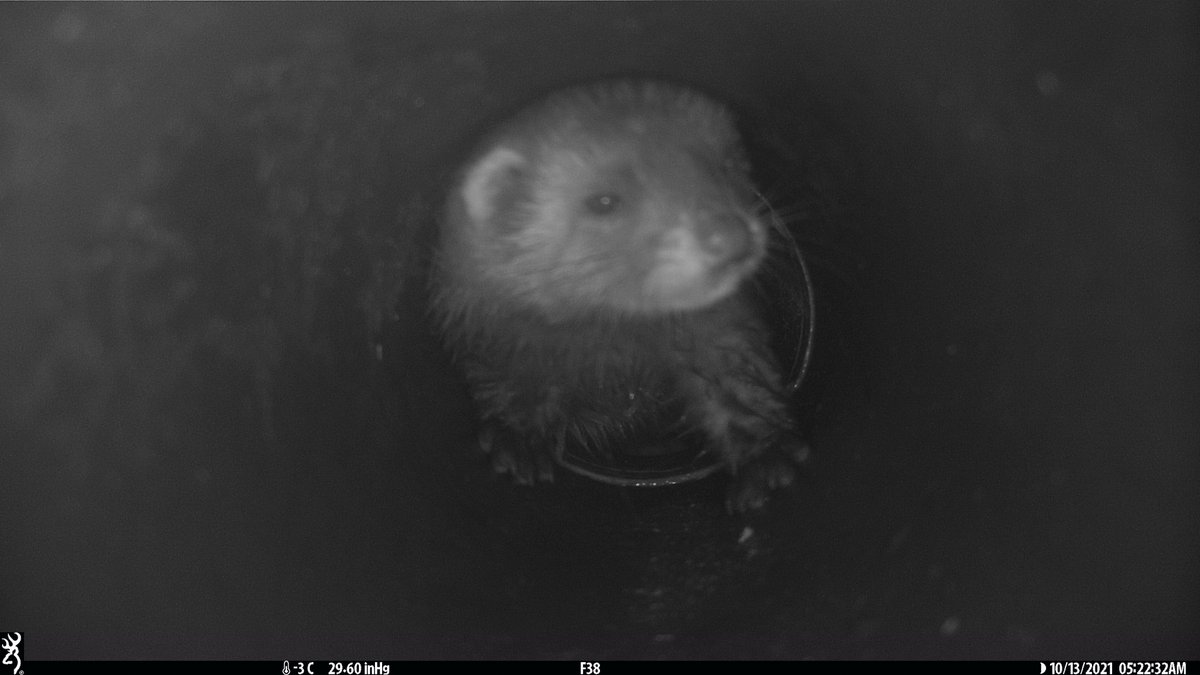
Mustelid mugshots: photographing facial masks of European polecats (Mustela putorius) for individual recognition and density estimation using camera traps @MammRes
With Nadine Erath, Jeroen Mos and Henrik Thurfjell
1/7
https://t.co/3yCXbk6ApO
Just wanted to highlight there are still a few days left to apply to this two year postdoc position combining satellite remote sensing, camera trapping and AI.
🚨Job alert🚨
Our Conservation Technology group is growing!
We are currently hiring a fully funded doctoral student (4 yrs) with a large focus on passive acoustic monitoring of birds and bats, and a 2 yr postdoc focussing on camera trapping, satellite remote sensing and AI.
A few more days to apply. In case you are doubting if you should apply: We are a growing department working on wildlife conservation and sustainable wildlife management. There are great funding opportunities to work on wildlife in Sweden and Umeå is a great city to be based at.
We are growing our team working on quantitative methods to study wildlife/game populations and are now recruiting a researcher for a permanent! position in Umeå. Anyone with a PhD can apply, but some postdoc experience will likely be beneficial.
https://t.co/1ax4eSlnaA
📢I am recruiting a PhD student in applied quantitative ecology .@FCFCMontana .@umontana to work on large mammal monitoring. More information: https://t.co/i9VGQnWuVV
We are looking for someone with experience with Bayesian hierarchical models and Integrated Population Models.
The position will entail grant writing and leading projects, but as a start, we have two projects on which the successful candidate will work, one involving me.
We are growing our team working on quantitative methods to study wildlife/game populations and are now recruiting a researcher for a permanent! position in Umeå. Anyone with a PhD can apply, but some postdoc experience will likely be beneficial.
https://t.co/1ax4eSlnaA
Marco Granata presents excellent work from the Italian Alps, shedding light on under studied small mustelids, with aims to start long term monitoring #35EMC
@BenCAugustine@MammRes We actually don't know how large the individual variation in facial patterns is so there very well might be some individuals that cannot be IDed even on good images. I guess we'll need more images/individuals combined with other ID methods to be sure 😅
New paper alert 🚨
Mustelid mugshots: photographing facial masks of European polecats (Mustela putorius) for individual recognition and density estimation using camera traps @MammRes
With Nadine Erath, Jeroen Mos and Henrik Thurfjell
1/7
https://t.co/3yCXbk6ApO
@cameratraps1@MammRes The only tubes that got destroyed were destroyed by cows. The majority of placements were under vegetation and in stone piles so not very visible.
@BenCAugustine@MammRes I think it is mostly random (gut feeling) but can imagine more shy individuals not looking into the tube/camera more often than bolder individuals.
As all EU member states need to report the status of their polecat population as one of the species on the Annex V of the EU Council’s Directive on the conservation of natural habitats and of wild fauna and flora, we hope this method will be picked up in other countries 7/7
We think the Polecam shows promise but larger field tests in different sites with known polecat occurrence would be good to see if a larger effort can increase precision in the estimates. As we observed multiple species, it could also be used to look at species interactions. 6/7