It's 8:39 p.m. and I'm hungry. I'm trying to cut, so I definitely don't need late-night Chick-fil-A or snacks, but there is this full feeling that I desire.
So I tell myself now that what I'll do is go home and have two scoops of casein protein powder. Typically, that is important because it gets my protein count up to retain muscle mass, and it also makes me full. I'm going to trust that this can work: just follow the protocol. It's hard to do, but feelings don't dictate behavior. I'm going to have the two scoops of protein powder, and after that, if I'm still hungry, then I'll go eat whatever.
Really, I'm going to turn the battle of "this or that" into a battle of sequencing. The trick is that once the first, healthy activity is completed, a lot of times the desire for the second activity no longer exists.
It's an interesting principle when it comes to behavior change: tell yourself you're just making choices about sequencing, and that you can still do whatever you want after.
Running on fumes the last three to four weeks, just working really long hours. I started to break my own rules: started to consume more than I created, and started to bring my phone inside the house instead of leaving it in the garage. Food poisoning, fever, and incredible workloads definitely did not help.
But that's all part of the process, too. It's okay to lose calibration. The fact that there is a voice inside means you can still detect True North. So even when you're off-bearing, at least you know you're off-bearing.
Grace is the applicable concept here. Maybe this post is the reset. Let's give it a shot.
@greptile doesn’t work well, if it catches something it’s great, but it often misses a lot of issues and does not help with architectural mistakes codex makes. It’s just marketing once again
Here’s my fell for it again award 🥇
My friend yesterday pointed out that there are parallels between the physical training of professional athletes and the "hustle and grind" patterns of high-level CEOs and founders.
It is truly fascinating to compare and contrast the two different cultures. Within the world of professional sports, the concepts of a rest day, zone 2 training, and deload weeks are firmly established as scientific. There are no myths regarding pushing through, not resting, and training hard. You would be laughed out of any professional sports team, and all winning professional athletes respect the insights of science into physical limits.
What's interesting is that within the Silicon Valley scene and American business culture, there is often a complete lack of tension and paradox. Instead, you get a single, flattened narrative around maximum pain and maximum sacrifice. But physiologically, our mental systems are firmly seated within a physical system, and there are physical limits.
I suppose the difference is that in business, sometimes it can be life or death. Sometimes we override because the timing matters. This is a little bit different from sports. In sports, there is no concept of a crisis; the only crisis would be game-day decisions to keep pushing even if it makes sense to rest due to a minor injury. So, even there, you can see some comparisons.
I guess the next obvious observation is that within business, sometimes there can be endless sets of crises. While it is admirable to push past your limits for the sake of a temporary crisis, what happens when a professional builder or CEO loses their ability to discern what is a crisis and what is not?
These are just some thoughts on my mind. I really find it much easier to surrender my control patterns and workaholism by connecting to a physiological metaphor. I'm learning to treat myself like a professional athlete with physical and cognitive limits, versus a simple, one-dimensional myth.
Perhaps there may be some pushback from those who have succeeded through war and grind, and that's totally okay, too. To each their own; our society needs different types of men and women in order to create a better society. What matters is that we listen to what has been called out of each of us.
But ultimately, one thing I stand firm on is if you lose your family, you have gone too far. Or perhaps it is a matter of really understanding your deepest motivations, the purity of your convictions, and your heart. If the sacrifice is truly for your loved ones and they understand it, I think you can work massive hours without hurting them. But more often than not, I think there is a lack of purity in that motivation.
But at the same time, I think our society often forgets that some individuals are given big visions because that is how they're wired. For them, it is important to compete, to achieve, and to build—and the entirety of society benefits from this.
And so, there are no simple answers here.
Just some thoughts to ponder.I share these thoughts because I have been struggling. I find myself working 60 to 70 hours and sleeping only six to six and a half hours. I feel the old and familiar slight depression fall over me. In the past, I powered through this with fear, cortisol, coffee, and desire.
But today, I realize I need more creativity, for sure. I need a better way of doing things. So for me, I feel a constant paradox. I have zero intention of pulling back. I love building, I love pushing, and I love dreaming.
At the same time, I have to be careful:
• I must rest.
• I must not try to seek ultimate and perfect control.
• I must be more creative and smart, versus just putting more hours in.
It's a paradox, and I embrace it wholeheartedly.
What I'm trying to point out here is that there is a deep paradox, and no one should try to removeit. It is up to each and every one of us to wrestle daily. We lie to ourselves when we pick an easy, convenient answer. We must wrestle with it daily.
Discomfort is not danger.
This sentence has been ablaze in my mind the last couple of days. I heard it while at Celebrate Recovery's Regional West Conference. Celebrate Recovery is a Christian 12-step program located in every major city in the country. The speaker's name is Donald, and he is one of the directors.
Donald pointed out that all humans develop coping mechanisms of three types. Each coping mechanism is a nuanced strategy that provides relief from different kinds of pain:
1. Addiction: provides escape.
2. Control: provides safety.
3. Isolation: prevents the pain of rejection.
I chuckled to myself as I realized I was world class at all three skills. What I love about that first sentence—about the idea that discomfort is not danger—is that the recovery process requires you to lean into the pain of rejection, lean into the lack of control, and lean into feeling pain and having nowhere to escape to and simply having to grieve.
As I woke up this morning and laid in the dark with six-eight different thoughts rolling through my mind, I realized I'm in a good place. There are many situations that make me very uncomfortable, but I'm in no danger. Particularly as I change my life and grow, it makes myself and a lot of other people around me uncomfortable. But discomfort is the way. It's going to be okay.
I also interestingly note the connection between discomfort and surrender. The first step of the 12-step program is admitting one is powerless. The next step is believing that something higher—God, the community, others—can help. These two steps are not just for recovering addicts; they are required to live a good life and to be a wise person.
Discomfort is not danger. I think to surrender is to be in and embrace discomfort, and to trust that you are in no danger.
As an entrepreneur, it's important to remember that I'm not trying to find customers or sell products to owners and operators. I'm not looking for prospects; I'm looking for people who are suffering. I'm looking for owners and operators who are struggling—those who don't get home on time to see their kids, and who have less energy to contribute to their communities and friends.
I'm not looking for monthly recurring revenue. I'm looking for real human beings who are waiting for me, who have been longing for my product. I'm not trying to sell to clients; I'm trying to deliver a gift to people who have been waiting for my product for a very long time.
I'm not scared that calling them is interrupting their day. When I call them, I'm making their dream come true. They didn't know that the call they were waiting for is coming today.
This is the correct mindset. This is the true, deeper phenomenon of capitalism.
But you do have a lot of people who probably seek status and achievement without understanding that all achievement requires great service, and all great service requires great compassion.
This is not something I particularly excel at, but it is something I must focus on and aim to return to constantly.
So I'm a little bit bored by this hot take on whether SaaS is dead.
I get it: this CEO replaced a $600,000 Salesforce contract with a homegrown solution. But obviously, the benefit of a SaaS product is that the SaaS company can hire 500 engineers who are all super good at vibe coding, giving you a product that is making quantum leaps right now, all while charging a low price for it.
Long story short, if you have a company vibe coding a single piece of software just for their own personal use versus a company purchasing a vibe-coded product that services 4,000 other companies, the company that bought the SaaS solution will ofttimes have the more advanced solution and a better market edge. Now, obviously, when cost-value dynamics are incredibly broken, this no longer holds true.
I guess what I'm trying to say is, before we say SaaS is dead, how about we just say: in areas of the software market where cost-value dynamics have gone astray, SaaS is dead. That simple qualifier makes the opinion coherent and at least remotely interesting. As it is right now, these blanket statements make me fall asleep.
https://t.co/KZn8F5RZcp
My co-founder Jonathan has the most hot and funny takes. I feel lucky because we're building a company, but literally every day he says something that makes me laugh. I think that's just great luck, to find someone on your team like that.
We have no followers for the most part, but we are excited to be on this journey and participate in the conversation that others have cultivated.
Sharing this funny one.
I am learning the hard way, if you want to make an actual, reliable app used by many people, you must keep Codex 5.6 Sol xhigh on a leash like this.
I just caught this high iq autist having my app poll things every 75ms, and polled 2 others things every 250ms and 30s.
Not to mention 2 weeks earlier it spammed a bunch of tables for no good reason and had the frontend reconstruct pages 100s of times per second.
I never let it make decisions on its own anymore, I must tell it what to do before implementing.
Rule 1:
In order to open Instagram and check my feed, I must first open X and make a post. Before one consumes one must create.
These are principles for living in the modern age of the smartphone.More to come.
Hey everyone! I'm looking to hire a software intern $40/hr if in undergrad, $30/hr if in highschool, must be in person LA/OC area.
We already have a working product running at our first customer who does $70 million per year employing 50 people. So it's a legit operation and there's lots of interest from more customers, we're just bottlenecked by people so that's why we're hiring!
The company sells and implements software to medium sized businesses, not tech companies, but real businesses selling physical goods.
Please don't refer a strong test-taker, I'm looking for someone who enjoys building things in the real world, can talk to people, and can just GO.
& no, there is no god forsaken VC involved.
DMs are open!
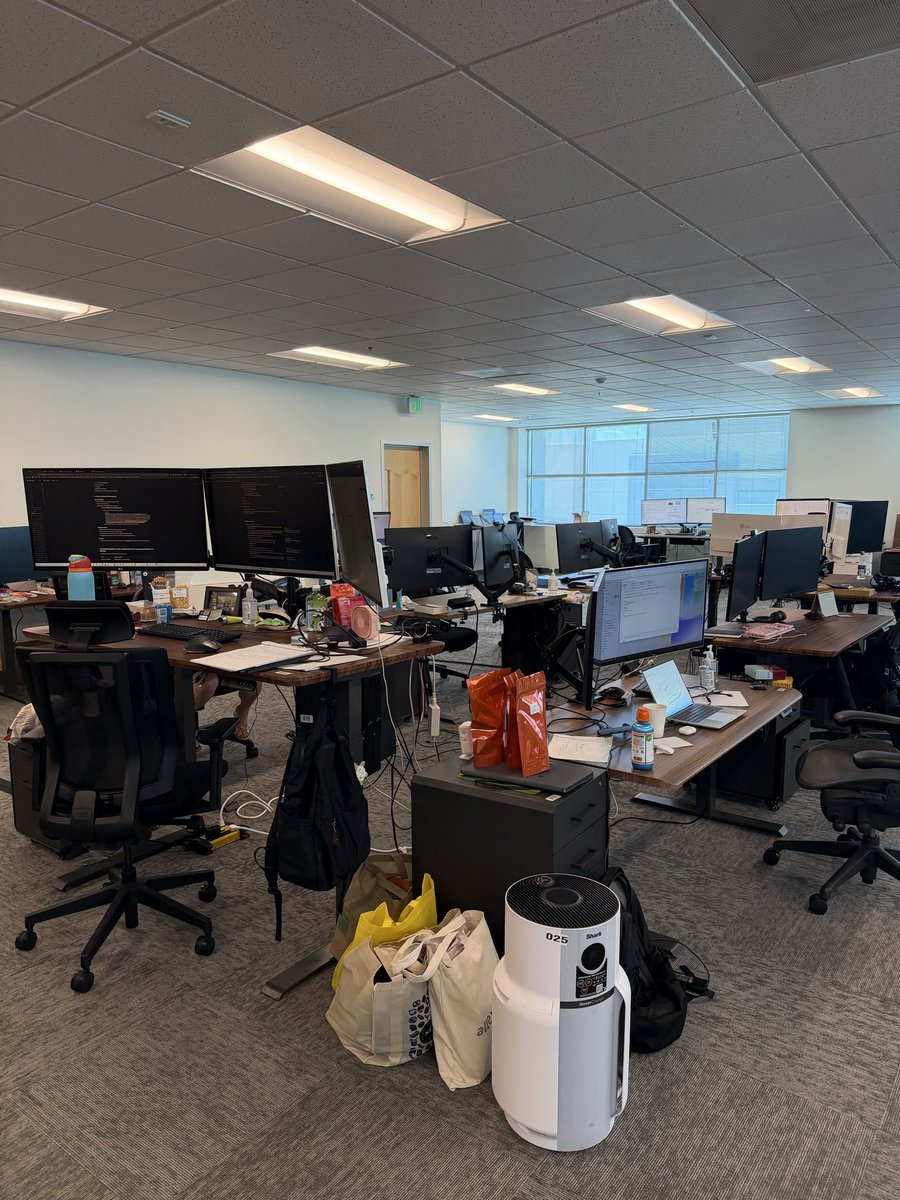
Photos of our office:
My coach J, during a very, very hard season in my personal and professional life, shared with me a story with a smile. The story was so beautiful and lifted my spirits and helped me to focus.
The story was about a man who was very good at fishing. He had an incredible boat and knew the waters which contained incredible stocks of fish that only he could navigate. He would fish during the day, just enough. In the evening, he would sit on his boat, moored off the shore under the moonlight and stars, play his guitar, and sing.
An investor met him and realized how much potential his fishing company had. They talked, and he sketched out a plan for how to grow his boat to a fleet of 20 fishing boats over seven years and how they would be able to become a major regional supplier. The investor then excitedly asked him, "Hey, once you make millions, what are you going do once you become this incredibly wealthy owner? What are you going do with all that money?" He said this with a smile and excitement.
The fisherman looked at him, paused, thought about it, and then he replied, "I would be out here playing my guitar at night in the open air, enjoying my boat."
I won't kill the story by trying to explain it, but it was a moving story. Yesterday, as I was running after my bike ride, I remember thinking: regardless of how much wealth I have, how much more pleasure can there be than running in a beautiful Southern California summer this morning? And as I had a bowl of rice and hainan chicken and hot soup with freshly cracked black pepper, the thought crossed my mind that, regardless of how much money I have, these experiences don't change, and these are the experiences that make up life.
I ran a bad meeting this week, and I felt terrible because I felt like I let down my team. I could instinctively feel it was a net negative for everyone involved in the meeting. I went on an long run to just process, and over the last couple of days, it really occurred to me what's needed.
What's needed is to send Negative Nancy home and only bring Positive Pete. I know it sounds so simple and basic, but I think as leaders, sometimes when we're tired and not drawing refreshment and new energy from a place of solitude regularly, that fatigue starts bringing a different person out. One of our greatest strengths as leaders is to bring a positive attitude and a way of looking at things.
This reminds me of what one of my coaches also shared with me, which was: when you're giving feedback, it's a lot simpler to simply point out what needs to be done firmly and clearly. There really is no purpose to pointing out what was deficient. Simply state the standard, point it out, move on. I know these things sound simple, but in terms of the day-to-day lived reality, I think it's easy to mess up.