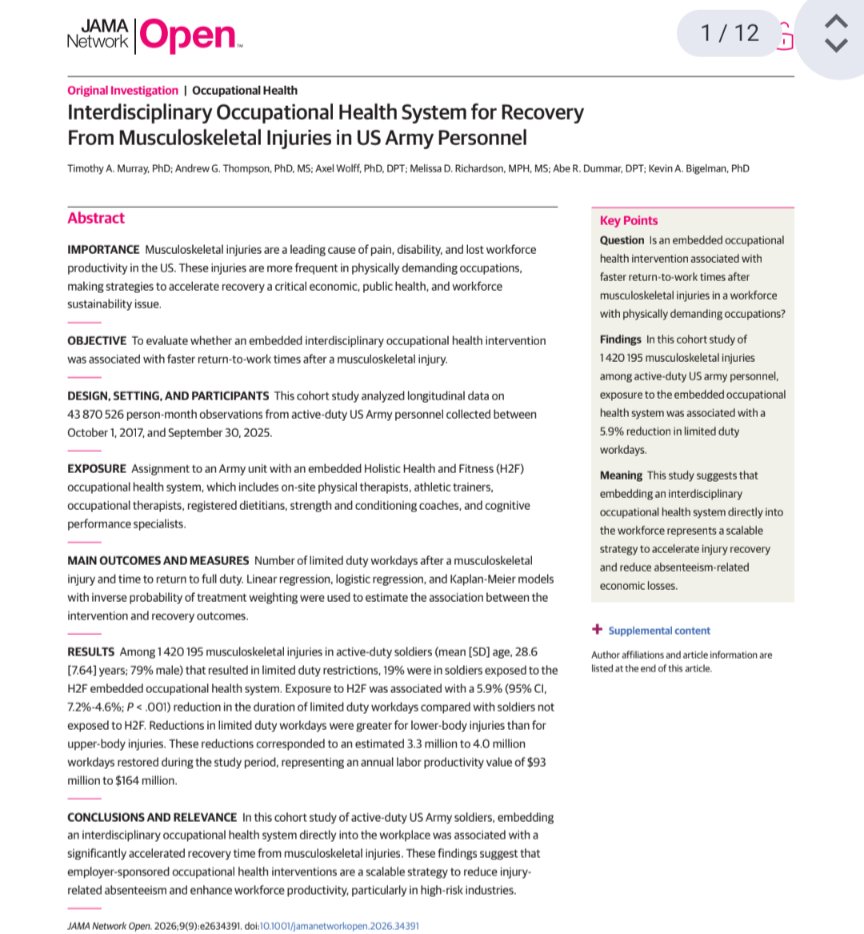
🚨 Our new paper showing how the Army's H2F system accelerates recovery from musculoskeletal injuries was just published in @JAMANetworkOpen.
Musculoskeletal injuries (MSKI) are the Army's top cause for medical encounters and the leading cause of temporary limited duty, medical discharge, and long-term disability. This study utilized 43,870,526 person-month records to evaluate the impact the Army's Holistic Health and Fitness (H2F) system on recovery from MSKI.
Key findings include:
➡️ H2F reduced the number of days Soldiers spent on limited duty from MSKI by ~6%, returning as much as 6 duty days back to their units.
➡️ The impact is greater for lower body injuries (~7%) than lower body injuries (~4%).
➡️ Fully resourcing the Army with H2F could have saved 660,000-800,000 days annually that were lost due to MSKI
➡️ This translates to a $93 million - $164 million in annual economic labor productivity restored to the Army
➡️ The reduction in limited duty days increases the number of Soldiers that are available for unit training and deployment.
Embedded human performace teams in operational Army units can address modifiable determinants of MSKI and reduce barriers to evaluation and treatment. As the military services continue to focus on Human Performance Optimization, these results provide quantifiable evidence of their impact on physical readiness. This type of system may also be beneficial to other physically demanding occupational settings to reduce MSKI related absenteeism in the workplace, which account for 30% of all lost days in the US labor market.
🔗 Link to the open access article can be found in the reply
#HumanPerformance #H2F #Army #HealthEconomics #OccupationalHealth #Healthcare #JAMAnetworkOpen
Happy Veterans Day to all who have served, especially those in my family, friends, and colleagues I have the privilege of working alongside each day 🇺🇸
Most of my work uses military healthcare data and military AI systems available are not authorized to handle PHI. Additionally, we are not authorized to have AI agents on our computers as they have not met the necessary cyber security requirements.
However, AI has increased my productivity by more quickly troubleshooting coding, cleaning really complex data, and the litterature review process, though 80% of my output is not for public release and doesn't get published.
Someone has to score on bad teams because of the shot clock. You can look at every bad team every year and there's a guy that puts up numbers but team loses. If they ever get a shot on a good team they underperform. The issue with LaVine is he's a good player who's just way overpaid. So his play isn't with the cap hit under the current CBA
🚨 Public good alert: I put together a list of 100+ free datasets for social science research, spanning a large number of topics.
I hope it's useful for students, researchers, and anyone looking for interesting data to explore.
Contributions are welcome! https://t.co/DyoS8IsW4U
🚨 Our new paper showing how the Army's H2F system accelerates recovery from musculoskeletal injuries was just published in @JAMANetworkOpen.
Musculoskeletal injuries (MSKI) are the Army's top cause for medical encounters and the leading cause of temporary limited duty, medical discharge, and long-term disability. This study utilized 43,870,526 person-month records to evaluate the impact the Army's Holistic Health and Fitness (H2F) system on recovery from MSKI.
Key findings include:
➡️ H2F reduced the number of days Soldiers spent on limited duty from MSKI by ~6%, returning as much as 6 duty days back to their units.
➡️ The impact is greater for lower body injuries (~7%) than lower body injuries (~4%).
➡️ Fully resourcing the Army with H2F could have saved 660,000-800,000 days annually that were lost due to MSKI
➡️ This translates to a $93 million - $164 million in annual economic labor productivity restored to the Army
➡️ The reduction in limited duty days increases the number of Soldiers that are available for unit training and deployment.
Embedded human performace teams in operational Army units can address modifiable determinants of MSKI and reduce barriers to evaluation and treatment. As the military services continue to focus on Human Performance Optimization, these results provide quantifiable evidence of their impact on physical readiness. This type of system may also be beneficial to other physically demanding occupational settings to reduce MSKI related absenteeism in the workplace, which account for 30% of all lost days in the US labor market.
🔗 Link to the open access article can be found in the reply
#HumanPerformance #H2F #Army #HealthEconomics #OccupationalHealth #Healthcare #JAMAnetworkOpen
@JAMANetworkOpen 🔗 Interdisciplinary Occupational Health System for Recovery From Musculoskeletal Injuries in US Army Personnel
https://t.co/VYOOkPpOqb
🚨 Our new paper showing how the Army's H2F system accelerates recovery from musculoskeletal injuries was just published in @JAMANetworkOpen.
Musculoskeletal injuries (MSKI) are the Army's top cause for medical encounters and the leading cause of temporary limited duty, medical discharge, and long-term disability. This study utilized 43,870,526 person-month records to evaluate the impact the Army's Holistic Health and Fitness (H2F) system on recovery from MSKI.
Key findings include:
➡️ H2F reduced the number of days Soldiers spent on limited duty from MSKI by ~6%, returning as much as 6 duty days back to their units.
➡️ The impact is greater for lower body injuries (~7%) than lower body injuries (~4%).
➡️ Fully resourcing the Army with H2F could have saved 660,000-800,000 days annually that were lost due to MSKI
➡️ This translates to a $93 million - $164 million in annual economic labor productivity restored to the Army
➡️ The reduction in limited duty days increases the number of Soldiers that are available for unit training and deployment.
Embedded human performace teams in operational Army units can address modifiable determinants of MSKI and reduce barriers to evaluation and treatment. As the military services continue to focus on Human Performance Optimization, these results provide quantifiable evidence of their impact on physical readiness. This type of system may also be beneficial to other physically demanding occupational settings to reduce MSKI related absenteeism in the workplace, which account for 30% of all lost days in the US labor market.
🔗 Link to the open access article can be found in the reply
#HumanPerformance #H2F #Army #HealthEconomics #OccupationalHealth #Healthcare #JAMAnetworkOpen
🚨NEW PUBLICATION
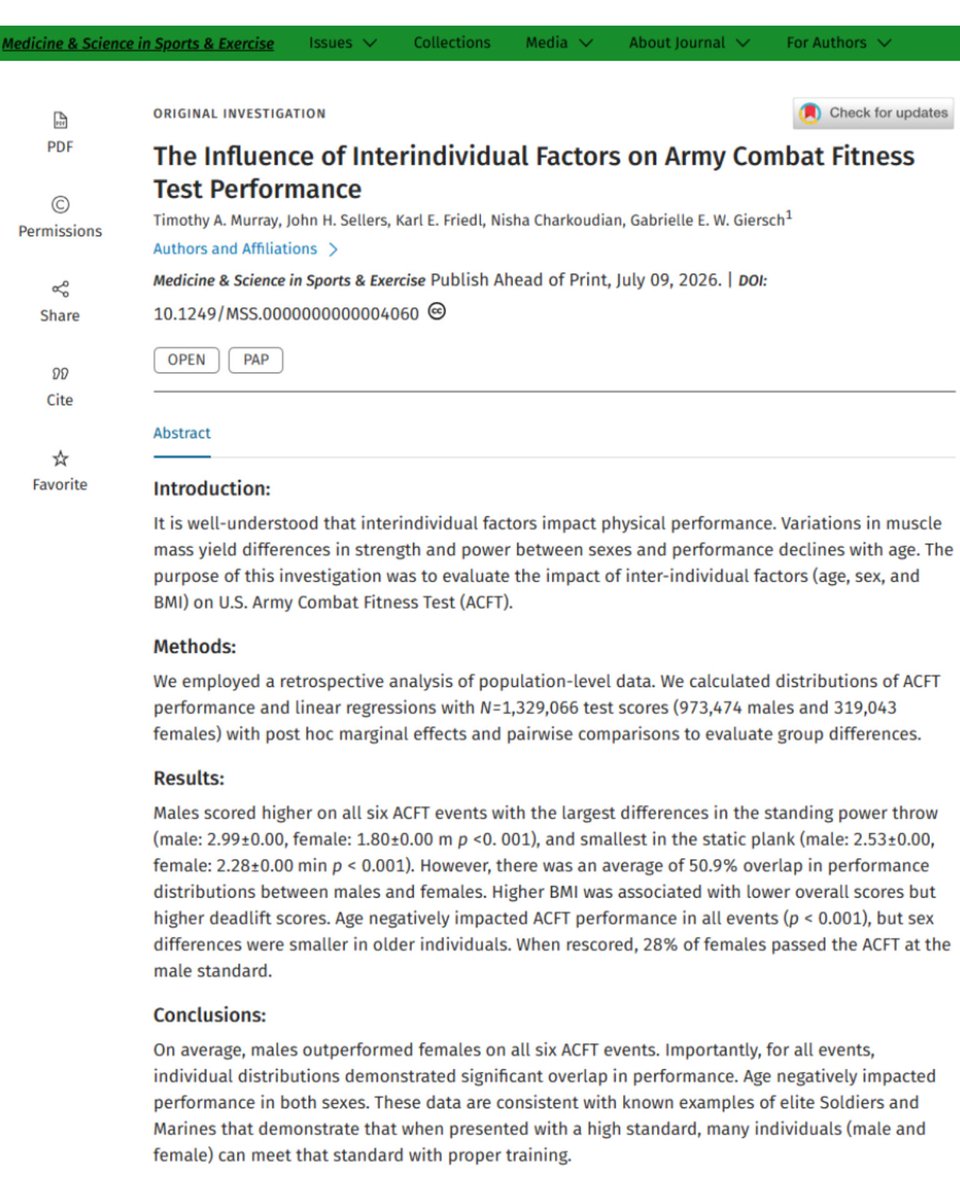
"The Influence of Interindividual Factors on Army Combat Fitness Test Performance" is now out in Medicine & Science in Sports & Exercise!
We used over 1.3 million ACFT scores to evaluate how age, sex, and BMI impact ACFT outcomes, including rescoring female scores to the male standard to evaluate the impact of sex-neutral scoring.
Key Findings:
➡️ While males outperformed females in all 6 ACFT events, individual performance distributions showed significant average overlap of 50.9% between sexes
➡️ When rescored using the male standard, 28% of females passed the ACFT. When we removed the standing power throw, 58% of females passed (which is the current AFT setup)
➡️ Age negatively impacted performance on all events, but the performance gap between sexes decreased in older individuals
➡️ Soldiers in combat roles outperform Soldiers in non-combat roles
➡️ Higher BMI is associated with lower total ACFT score
These findings emphasize that group averages do not tell the whole story. When presented with sex-neutral standards for combat roles, a significant portion of women can meet those requirements. With defined sex-neutral standards and training, evidence suggests that proportion will increase over time.
A huge thank you to my outstanding co-authors: John Sellers, @gabegiersch, Karl Friedl, and @ncharkoudian
Full Open-Access Paper available here: https://t.co/80Zoj0ECGA
@USArmy | @T2COM_HQ | @FCCTransforms
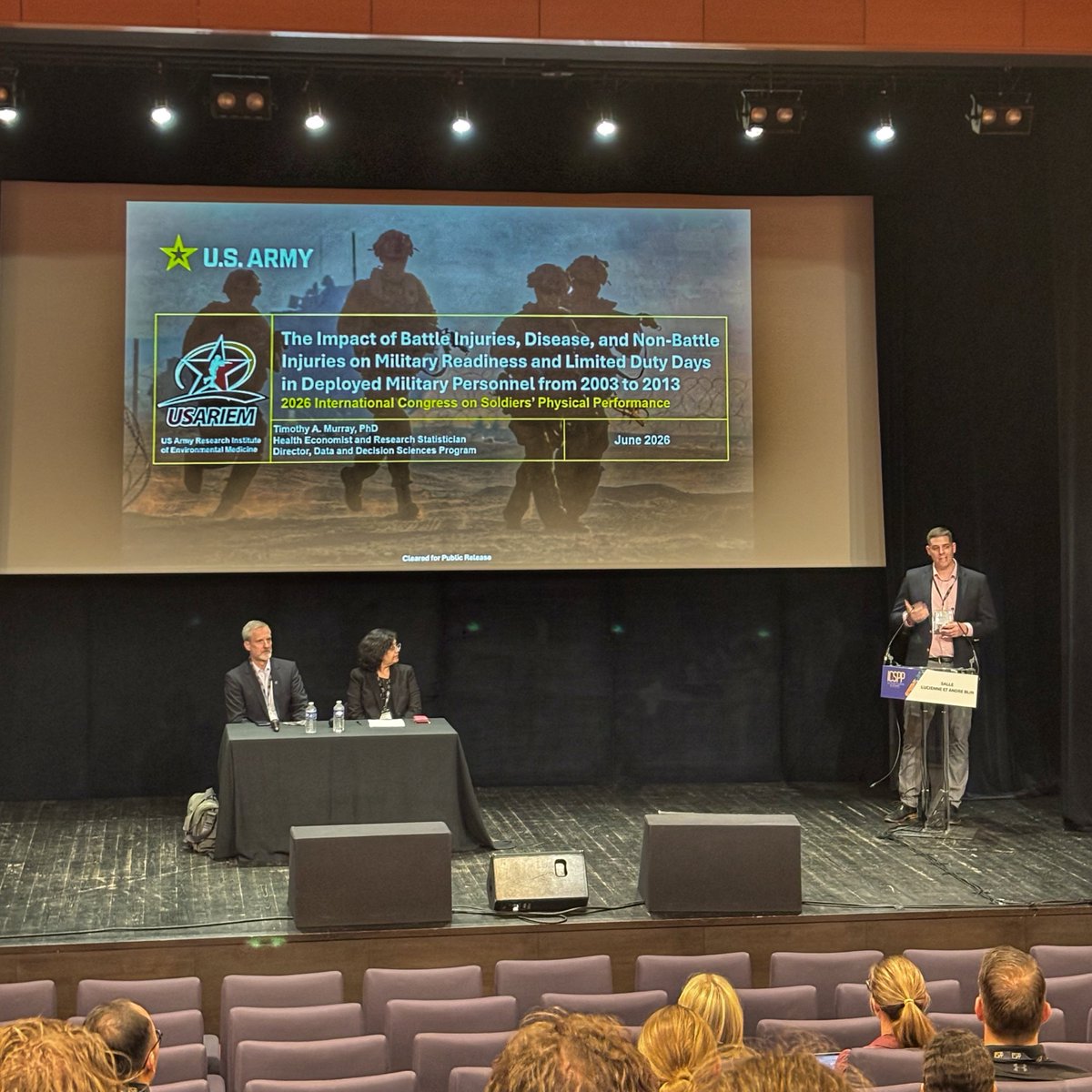
Had an incredible week at the 7th International Congress on Soldiers' Physical Performance (ICSPP) in Paris 🇫🇷
It was a privilege to connect with international Warfighter health and performance experts and give two presentations
The problem with a De’Aaron Fox trade is: Who wants Fox? Most teams that need a PG are gonna draft one. This class is loaded with guards. Teams that would trade for one will prefer the younger and cheaper Ja Morant. There’s a chance San Antonio is just stuck with Fox.
Last week, I had the privilege of attending the National Security Seminar at the @USArmy War College
The seminar brought together 160 civilian leaders from across the country to engage with graduate students and military leaders. We dove into and discussed US national security strategies across critical global theaters, including the Polar regions, Indo-Pacific, Europe, Africa, and the Western Hemisphere.
As a civilian researcher within an Army research organization, stepping back to look at the "big picture" was incredibly impactful. Understanding why these regions are of strategic importance from economic, legal, and military lenses provides invaluable context to the work we do at USARIEM, MRDC, @FCCTransforms, and @T2COM_HQ.