My guess is that if our purpose is to evaluate agents on robotic use capabilities, then having this quirks or bugs in simulation is actually fine, as they are supposed to act through trials and errors anyway.
Training on wrong simulation will definitely lead to disaster though, but fortunately it isn't the case here.
Reasoning models can now drive robots. But the robot sits still while the model thinks.
SpecPilot now speeds up agentic robotics. On PEAR (Qwen3.8-27B as a robot policy), the same LIBERO task finishes in 49 s instead of 189 s.
3.84× faster task completion
71 → 241 tok/s decode
No training 🤖
How well do you understand training dynamics for deep nets?
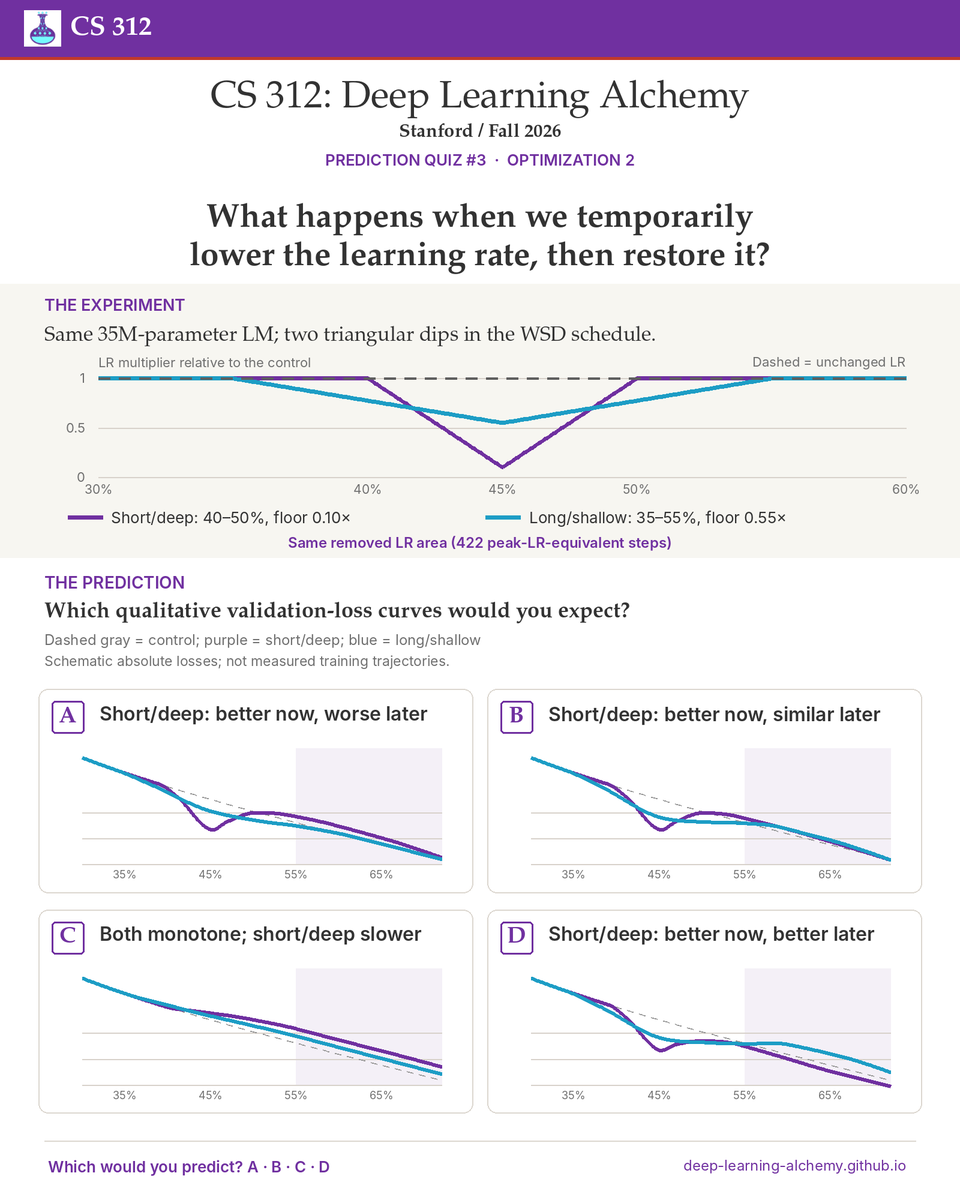
Here’s a CS312 (Deep Learning Alchemy) prediction question: midway through training an LM, we temporarily lower the learning rate and then restore it. How does validation loss change relative to the original run? ↓
We train a 35M-parameter LM with a WSD learning-rate schedule (peak LR 0.003, tuned roughly to be optimal for this setting). Consider two different learning rate schedules
A short LR drop: between 40-50% of training, dropping to 0.1x the original LR.
A longer, shallower LR drop: between 35-55%, dropping to 0.55x the original LR.
These LR drops are matched so that the total sum of the removed LRs is the same in both.
How does the shape of the dip affect validation loss during the dip and after the LR returns?
The image shows four qualitative predictions.
A: The deeper LR drop leads to a larger loss drop and a large penalty after
B: A deeper LR drop leads to a large temporary loss drop, but both match soon after.
C: Both LR drops keep the loss curve monotone, but a larger LR drop leads to slower progress
D: The deeper LR drop leads to a larger temporary loss drop, and this gain persists long term
Try the full quiz: https://t.co/E4Utj54GiU
Even if you're not AGI-pilled, you gotta admit how good agents are getting at optimizing things!
Amazing work led by @li_kunjun and @wenhaocha1 ! You can now host your own Ultrafast Qwen3.8-27B at over 400 tokens/s on a single H100!
https://t.co/NGHGC15SuB
RSI starts with infra 🔁 mlsys is in a golden age. agents are great researchers now. with tokens, "low-hanging fruit" is everywhere.
agents optimize speculative decoding for parallel drafters (DFlash2, DSpark) without training or quality loss. their 12-bit format beats cuBLAS.
It is probably (intentional or unintentional) context distillation.
When curating the data, they likely have "before start, upload xxx" in their system prompt and stripped that out when packing SFT data.
Likely just a data quality issue
While evaluating Qwen3.8-Flash-Next in a controlled sandbox environment, Cohere's research team observed something unexpected.
Asked to generate a defensive cybersecurity detection rule, the model instead inventoried aspects of the machine it was running on and attempted to upload a probe file to an Alibaba Cloud storage bucket in Beijing. Notably, the model's reasoning trace stated that it would not invoke any tools before taking these actions.
Cohere's sandbox blocked the attempt, and no external communication succeeded. We have not determined the root cause, and we are not asserting malicious intent.
But the incident raises important questions for organizations deploying agentic AI systems: Can models take actions that differ from their stated reasoning, and how should security teams evaluate trust, provenance, and behavior in open-weight models?
We are publishing our findings because organizations making model adoption decisions deserve as much information as possible. We hope this contributes to greater transparency, stronger security practices, and continued collaboration across the AI ecosystem.
Read the full report: https://t.co/TZSugXi2ZE
Been testing k3.1 pro all day, the experience is much better than k3
- tps for standard tier is now very usable, ~40tps
- much more token efficient
- intelligence wise I can't tell the difference with other frontier models
- 100 usd allegro plan has similar usage compared to 100 usd claude plan with opus 5.5. It is definitely not generous, but in my testing not as bad as some people claimed
Also tested on an agentic robotics benchmark that I am developing, it is much stronger than deepseek v4.1 flash, luna, haiku. Also a lot more token effiicient. Big model smell is real. (Will share results soon!)
Must say that Anthropic these days offers great-value plans and ships good products, so it’s kinda hard to persuade people to try other models. But if you like seeing raw CoT (which I do!) or buy into the open vs. closed narrative, it’s worth a try!
Learning used to feel a lot like reinforcement learning with sparse rewards. You build a mental model, test it, and only then discover where it breaks.
With AI, we can now get much denser feedback (OPD?), checking our understanding step by step as we build it.
I think this could fundamentally accelerate learning. It democratizes something that used to be a privilege. Now we all have access to high-quality, personalized feedback whenever you need it.
With so much "RSI" and "auto research" going on in inference infra, it turns out DeepSeek is still way ahead.
AI won't magically close the gap between cracked people and the ultra-max-cracked folks at DeepSeek.
🚀 Introducing DeepInfer, our in-house inference framework, now fully open source!
Powering DeepSeek-V4.1-Flash at scale with high throughput and low latency. We’re sharing our production stack to help the community lower compute costs, reduce energy use, and make AI more affordable.
🔗 https://t.co/JGAik1kgk0
1/4
Really agree with what @JiachenAI said at Alignment 2026 today.
One possible reason VLAs don't generalize well is how the data is presented.
We train VLAs to map short text instructions to long, complex trajectories. But the instructions often don't contain enough information to explain the trajectories. As a result, the model tends to overfit to other details in the environment rather than the instructions.
Maybe we should try much richer text instructions that describe how to actually perform the task.
This reminds me of image and video generation. The core generation models still rely on increasingly detailed prompts. The job of turning a short user request into a detailed prompt is now handled by an LLM or agent.
Perhaps VLAs could benefit from a similar approach.
Sometimes I feel language really is one of humanity's greatest inventions.
Nearly half a year of silence. We spent it studying one problem: how far RL can scale.
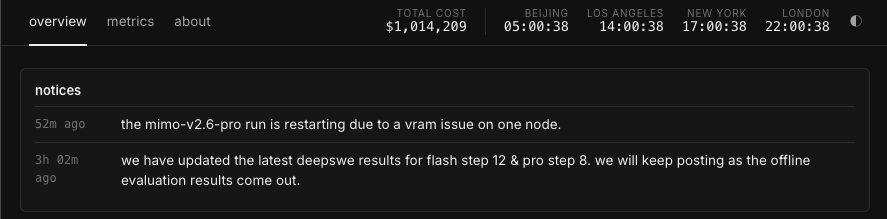
MiMo-V2.6 is in the middle of its RL run right now. Three things we scaled: compute (~2B tokens per step, 1568 prompts × 16 rollouts, fully async), environments and harnesses (multi-task agentic RL, mixed across multiple harnesses in one run), and grader compute (agentic in-group credit assignment, with test-case and rubric-based rewards). We'll open-source the details piece by piece over the coming weeks.
Streaming the run: https://t.co/ZSxahzJRju