Bitcoin four-year-cycle believer, buying the dip. Building a self-hosted AI second brain on Claude and a bot-run trading desk. Co-host, Tired Out podcast.
That’s why safeties are in place where one bad trade will not be detrimental to the portfolio. And the system of checks and balances should mitigate a trade like that from coming through. I have been using this live for 2 months and on paper money for 4 months prior. Nothing bad has gotten through so far
The most underrated story in AI right now: Chinese open source models.
Everyone argues about which US lab is ahead this month. Meanwhile, Chinese models are quietly doing the daily work in my whole AI stack. Here's what each one actually does.
THE TRADER: GLM
⚡ GLM-5.3, from Zhipu AI, runs my agentic trading desk. Five times every market day it reads the strategy, checks the market, and places the trades. No babysitting. It reports to my phone after.
🛰️ A faster version, GLM-5.3 Flash, sweeps every new SEC filing each morning and writes the brief the desk reads before the first run.
THE SKEPTIC: DEEPSEEK
🐋 DeepSeek is the second opinion. It takes a second look at the trades, and if the news on a company turns bad, it can force an exit. Two different models from two different labs means one model's blind spot doesn't become my loss.
THE MEMORY: QWEN
🧠 Qwen, from Alibaba, powers memory search for every bot I run. When an agent needs to remember a past trade, a rule, or a note, Qwen is how it finds it.
WHY THIS MATTERS: COST
An agent that runs all day burns through tokens. Every run, every check, every second opinion costs something. With the top closed models, an always-on agent gets expensive fast, and a lot of good ideas die on price alone.
These models change that math. They make always-on agents affordable for regular people, not just funds and big companies.
AND THEY'RE OPEN
Open models mean nobody else picks your defaults. You pick the model, the rules, and the guardrails.
That freedom cuts both ways, so here's how I handle it: my hard limits live in plain code that runs BEFORE the model ever sees the market.
• Equity under the floor? Exits only.
• Under the kill line? The desk shuts itself off.
• Ticker not on the whitelist? Refused.
The AI decides inside the box. It can't move the box.
THE HONEST PART
Claude still writes the rules on my desk, and the US labs still lead at the very top. I use the best tool for each job.
But for cheap, reliable agents that work for you, day in and day out? The Chinese open models are already there.
The gap is closing faster than most people think.
Not financial advice. Just what's running on my desk.
Want to build your own? Paste this into Claude Code (or any coding agent):
───
You are helping me build a small, rules-first agentic trading desk. Safety beats returns. Start in PAPER TRADING only (Alpaca paper or my broker's sandbox) and do not touch real money until I say so in writing after 30 days of paper results.
Build it in this order, and stop after each step so I can review:
1. RULES FILE. Write strategy.md as the single source of truth: bankroll, max position size, max positions, a daily loss floor that switches the desk to exits-only, and a list of allowed tickers. Hard limits get enforced in CODE before any model runs, not just in the prompt.
2. THE FLOAT. Idle cash sweeps into a short-term T-bill ETF (like SGOV). Optional: a small, capped slice in one higher-yield instrument, with an alert if it drops below a set price or misses a payout.
3. THE SCANNER. A deterministic script (no LLM) that pulls each day's new SEC filings from EDGAR and flags tender offers, buybacks and odd-lot provisions. Write results to a shared file.
4. THE TEAM. Separate agents with separate lanes:
• Researcher: reads the scanner output and writes a morning brief.
• Boss: reads the actual filing before anything is approved, confirms the terms, and writes an APPROVED row with a buy-below price where even the worst case still pays. Only the boss (or me) can approve.
• Trader: runs a few times a day, only executes APPROVED rows, and after every fill writes down "why did I get filled?"
• Skeptic: a second model that can veto and force an exit on bad news.
If they disagree, the boss's written rules win.
5. THE LOG. Every run appends one line to trade-log.md. Equity is computed by a script from broker data, never by the model.
6. THE REVIEW. Once a week the boss reconciles the log against the broker, grades every decision, and proposes rule changes. I get a short report.
7. BACKTEST before any new strategy goes live, with fees and slippage included. If it fails, it stays off.
Ask me for my broker, bankroll and risk limits before writing code. Explain every file you create in plain English.
───
Not financial advice. Paper trade first. Read every filing your bots act on.
I don't pick stocks anymore. My AI agents do.
Here's what my agentic trading desk actually looks like, and the last trade it made.
THE FLOAT
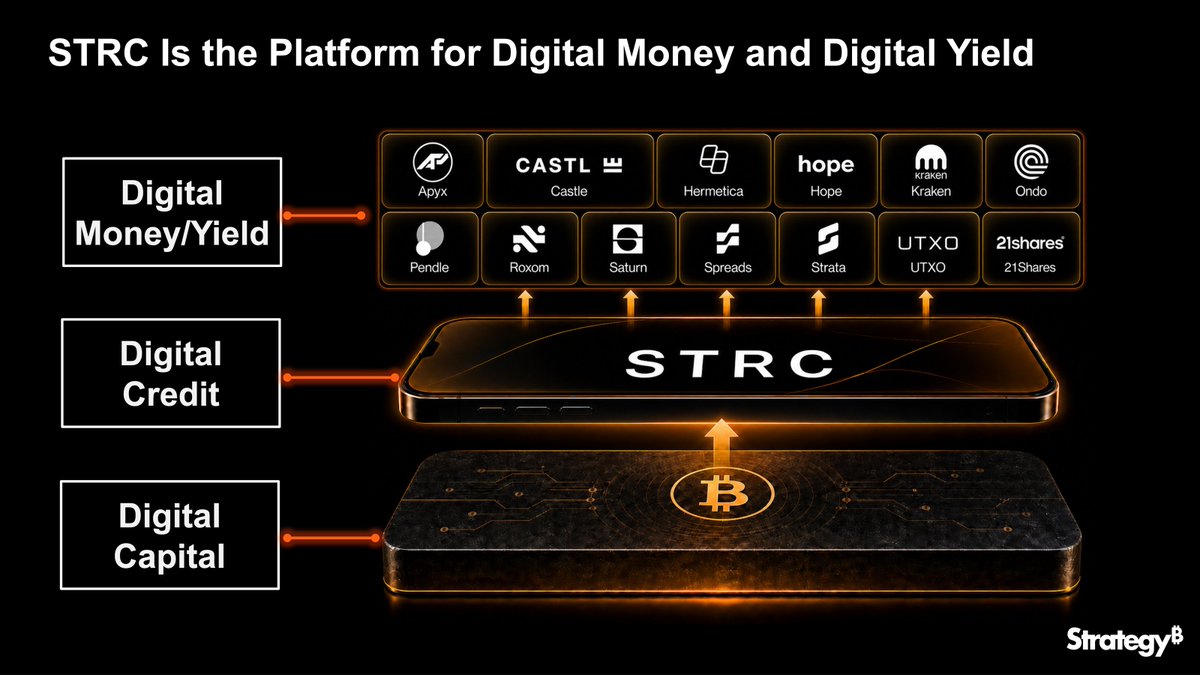
Idle cash never sits still. Most of it parks in $SGOV, 0-3 month Treasury bills, around 4% a year. A small, hard-capped slice sits in $SATA, Strive's variable-rate perpetual preferred, around 13% a year, paid a little bit every single day.
The cap is on purpose. SATA is credit risk, not cash. If it ever misses dividends, the desk flags it as a credit event the same day.
THE TEAM
It's not one bot. It's a team, and each one has a lane:
🛰️ Jarvis (GLM-5.3 Flash) sweeps every new SEC filing at 8 AM and writes the morning brief.
🧠 Claude is the boss. It reads the actual documents, sets the rules, and approves the picks.
⚡ GLM-5.3, a Chinese model from Zhipu, places the trades. Six runs a day.
🐋 DeepSeek is the skeptic. The second opinion.
HOW THEY TALK IT THROUGH
Jarvis flags a deal. Claude reads the filing and approves it, with a price. Every time GLM gets filled, it has to write down WHY it got filled, because getting filled easily can mean somebody knows something you don't. If there's bad news on the company, DeepSeek can force an exit.
When they disagree, Claude's written rules win. The hard limits live in code, not in a prompt. The bots decide inside those limits. I just get the report.
THE LAST BUY: $ABUS
Arbutus is buying back its own shares in a modified Dutch auction, $5.00 to $5.75.
The edge is the odd-lot rule. Own fewer than 100 shares, tender ALL of them, and you get bought out in full. Bigger holders can get cut back.
Here's how the agents played it:
• Read the filing to confirm the odd-lot clause was really there. Two earlier "odd-lot" deals got rejected because the clause actually said the opposite.
• Set a buy-below of $4.90, so even if the auction clears at the $5.00 floor, the trade still pays.
• Sold T-bills ahead of time to stage the cash.
• Waited three weeks for the price to come to them.
• Bought the dip under $4.90.
I tapped one ballot. Preliminary price: $5.00.
Not a moonshot. A known buyer, a known price, a known date. The return is small, short, and mostly decided before you ever click buy. That's the whole philosophy of the desk.
A REALISTIC YEAR
The float alone: roughly 6%.
The two-year backtest of the full strategy: about 17% a year.
My honest target: high single digits to low teens.
Estimates, not promises. The live record has to earn the rest.
Boring. Mechanical. Checked every week. That's the kind of edge I want.
Not financial advice.
I’ve been running my agents with this set up for about 2 months now with SATA as the backbone. While watching your guys current podcast motivated me to post about it! Been watching you since Feb. thanks for giving me the conviction to keep buying ASST through the bear market. Average price 12$ 😄
Every sentence my AI writes costs me tokens.
Every sat I stack is a token too.
Same word, two worlds. I think they're turning into one economy.
An AI token is a chunk of text, roughly three quarters of a word. You pay for thinking by the million. My bots run all day, so I watch that meter. Intelligence is now a utility. You pay for it like electricity.
Here's the catch. AI agents are starting to do real work on their own: search, buy data, hire other agents. But an agent can't open a bank account. It can't pass KYC. It can't wait three days for a transfer to clear.
It can hold a wallet.
Paying a fraction of a cent for one API call doesn't work on a credit card. The fee is bigger than the purchase. On Lightning it settles in seconds for almost nothing. Machines paying machines, per request. The rails are already being built (L402, x402).
What I'm not saying: go buy this week's "AI coin." Most of those are a logo and a ticker. The overlap isn't a new token. It's that metered intelligence needs money that was born on the internet.
The way I see it:
AI tokens are the cost of thinking.
Bitcoin is money that can pay for it without asking anyone's permission.
Cheap thinking plus open money is the machine economy. We're early on both.
#AI #Bitcoin
"Out of sight, out of mind."
I always thought that line was about forgetting people. It's about everything. The things you stop looking at don't stop happening. They just stop getting your help.
So I asked my AI to build me one screen that shows everything in my life I could have an impact on, especially the stuff I'm not thinking about. Here's what it taught me, in three parts.
1. Where your attention goes is not where you think it goes.
An owl can't move its eyes. They're fixed in its skull like headlights. To see anything off to the side, it has to turn its whole head on purpose. It's one of the best hunters in the dark, and it only sees what it deliberately turns toward.
That's all of us. The dashboard counts how often each part of my life shows up in my own notes over the last 30 days. Tech, money, and work were loud. Rest had zero entries in 45 days. Health logging had quietly stopped. None of it was news. I just hadn't turned my head.
2. A dashboard that makes things up is worse than no dashboard.
The fastest way to ignore a warning light is to have one that's wrong. So I set one rule: every item on the screen has to point to a real line in my notes, word for word, or it gets thrown out. A health trend only shows up if there's enough data behind it. No guessing, no scare tactics, no "you might be sick."
The first run pulled 29 items and dropped none. It also surfaced six open loops I had forgotten I'd promised to close. That's the part I didn't expect. It wasn't smarter than me. It just didn't forget.
3. Seeing is not doing.
The same dashboard shows how often I answer my own daily journal question. In one month: 1 out of 69. So a few days ago I turned the question off. Not because journaling doesn't matter, but because a prompt I ignore every morning is just noise with good intentions.
AI can turn your head. It can't move your feet. The owl still has to fly.
So, out of sight, out of mind? Then put it in sight. Find out where your attention really goes, not where you think it goes. Only trust a warning you can trace back to the truth. And when you see the gap, do one small thing about it, because a screen full of blind spots you've found and ignored is just a nicer-looking way to look away.
This week I'm adding one thing to my calendar that isn't work, a screen, or a project. Rest counts too.
What's the part of your life you haven't turned your head toward lately?
#AI #buildinpublic #productivity #secondbrain
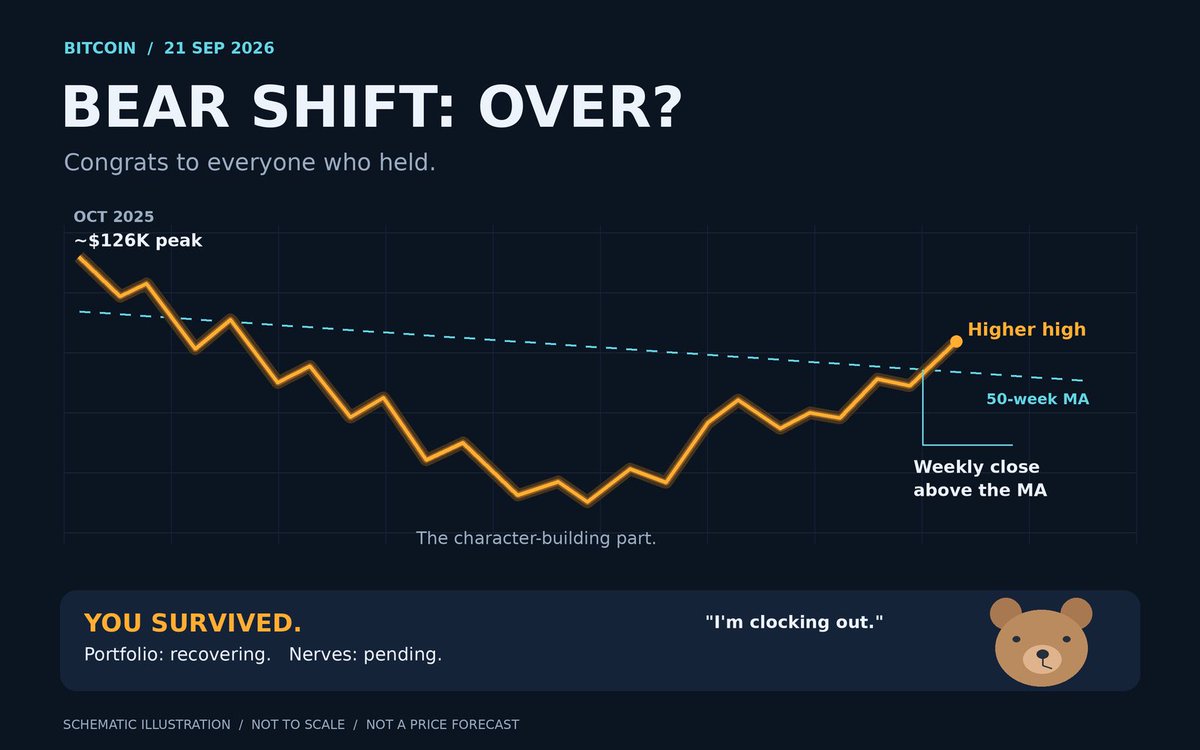
Congrats, Bitcoin holders 🍻
I’m calling it: bear market over.
Weekly close above the 50-week MA. First major higher high since October’s $126K ATH.
If the bottom holds, this was the shallowest major bear market yet and one of the shortest.
You survived. #btc#mstr#ASST #metalplanet
I left Fable for Astra, and the switch has been seamless. My AI brain keeps my context, preferences and project history in plain Markdown, so a new LLM can pick up where the last one left off.
Really impressed with Astra’s performance so far. #claude#Astra6
Every worker bee carries a stinger.
Not the guards. All of them. A honeybee hive is one of the calmest places in nature, fifty thousand animals in a box sharing food, and it stays calm because a wasp at the door faces a colony where anyone it meets can end it. Most wasps don't try. A hive that lost its stingers wouldn't get more peaceful. It would be robbed out by the weekend. The peace comes from the capability being everywhere.
That's the best argument I know for why ethical people need to use AI, even though it's the most powerful tool most of us will ever hold. Three parts.
1.The tool doesn't care who's holding it.
In 2020, a lab at MIT trained a model on a couple thousand known molecules, then had it screen a hundred million more. It found halicin, an antibiotic that kills bacteria nothing on the shelf could touch. Three years later the FTC was warning grandparents about phone calls in a grandchild's cloned voice, built from a few seconds of audio, asking for bail money. Same category of tool. One person pointed it at a disease. One pointed it at a grandmother.
Closer to home: the same model that writes a phishing email writes the procedure guide that keeps a new hire from learning the job by getting yelled at. I've used it for the second thing. Somebody, somewhere, is using it for the first. Same blade.
2.Sitting it out is not neutral.
When a person decides AI is too dangerous to touch, the refusal removes no AI from the world. The people who'd misuse it never asked permission. The only thing that changes is the ratio. One fewer ethical person who knows how it works. Every one who sits out leaves the hive with one less stinger.
3.The ethical have to outweigh the bad, and outweigh is a verb.
Outweighing isn't an attitude. It's hours. At my job, the people who know the process best are the ones on the floor. If they don't learn to build with this, someone who has never seen the floor will build it for them, and it'll be wrong in ways only the floor would notice. So I put in the hours: a procedure guide for my department, a small app for a problem nobody had time to fix. Weight on the right side of the scale.
And carrying it ethically means carrying it like anything dangerous. Limits set before you pick it up. A record of everything it did. Nothing goes out under your name that you didn't read. Those rules aren't caution. They're what makes you one of the people the ratio is counting on.
AI is going to be in everyone's hands either way. The only question you get to answer is whether yours are among them.
Pick it up. Carry it well. The hive is calm because the capability is spread.
#AI #Claude #buildinpublic
Senate killed the Clarity Act tonight. Bitcoin dropped 4% and stopped.
When the worst news of the year can't move it more than a bad Tuesday, that's not weakness. That's a floor. We never needed the bill.
#btc#metaplanet#clarityact
"How do you trust it?"
A coworker asked me that yesterday. She has been doing her job for longer than I've been working, and she has more accuracy awards than anyone I've met. She wasn't being difficult. She wanted to know how a person who checks everything can hand work to a machine that makes things up.
It's the right question, and I think most people are asking it quietly. Here's my answer, in three parts.
1. Don't trust the answer. Trust the record.
There's a bird in East Africa called the honeyguide. It finds a beehive, then flies to the nearest person and chatters until they follow. The person opens the hive, takes the honey, and leaves the wax and grubs for the bird. Hunters have followed it for thousands of years. Not because they trust birds. Because the bird has a track record, the exchange is the same every time, and if it ever led them nowhere, they'd stop following. Trust wasn't a feeling. It was a log.
That's how I trust an AI. Every session it runs reads a file at the start and writes what it learned at the end, into a folder of plain text I can open without it. When it gets something wrong, the wrong version stays in the file, marked as wrong, with a pointer to the fix. Early on it decided I worked in cybersecurity. That's my friend's job. I made it keep the mistake. A record you can trust is one that has the mistakes in it.
The day I stopped trusting answers and started trusting records, the whole thing got easier. I don't ask "is this right?" I ask "show me where that came from," and it can.
2. Trust is a budget, not a switch.
The coworker who asked me this doesn't trust herself with everything either. Some work she does from memory. Some she checks twice. Some she won't touch without someone else in the room. She trusts herself exactly as much as the cost of being wrong allows.
Same rule for the machine. Where a wrong answer costs me a minute, it runs free. Drafting, sorting notes, first pass on a spreadsheet. Where a wrong answer costs money, there's a plain script standing in front of it that doesn't think at all. My trading bots can only buy names from a list I keep. Below a certain balance they can only sell. Below another, they shut themselves off. The model never sees those numbers. A script reads them before the model wakes up.
And nothing goes out under my name that I haven't read. It drafts. I send. Not because I doubt it. Because that's the size of budget that job gets.
3. It earns trust the same way a new hire does.
Nobody hands the new guy the forklift on day one. You give him small jobs. You check them. You give him bigger ones. After a while you stop checking, not because you decided to trust him, but because the checks kept coming back clean.
That's the fourth month of my setup. I started with voice notes. It filed them in the right place, so I let it write the daily log. The log was accurate, so I let it draft the posts. It caught me about to repeat a decision I'd made two months earlier, and it was right, so now it reviews my bigger decisions before I make them. My trading desk has run six weeks without a single trade, because nothing met its rules. A year ago I'd have called that broken. Now it's the most trustworthy thing it has done. It did the right nothing, six times, and wrote down why.
So, how do you trust it? The same way you learned to trust yourself. You keep a record with the mistakes in it. You give it a budget the size of what you can afford to lose. And you let it earn the next job with the last one.
The people who get burned by AI are the ones who trusted the answer. The people who get the most out of it are the ones who trust the log.
She asked a good question. This is the answer I wish I'd had ready.
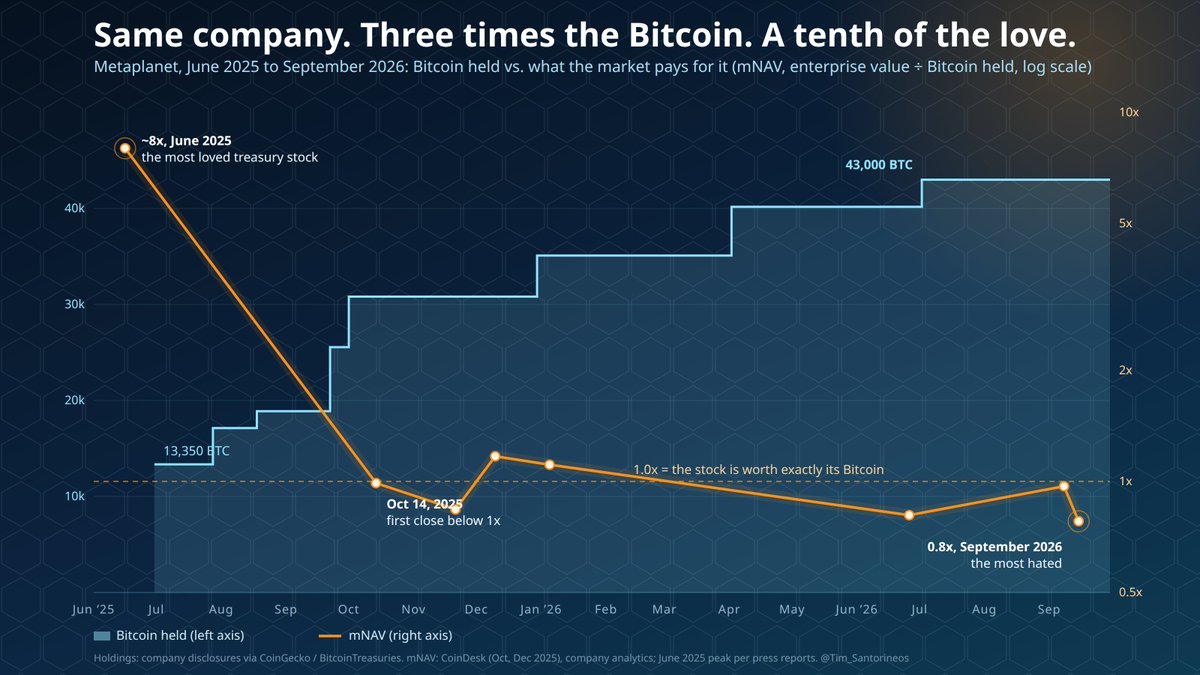
$MTPLF bought 43,000 Bitcoin and now trades for less than the Bitcoin.
A year ago it was the stock everyone wanted, at 8x its coins. Now it's the one everyone mocks, at 0.8x. Three times the coins between.
Either the coins are worth less inside the company, or this is the dip.
What the chart doesn't show: it's not just a Japanese stock anymore.
Tokyo: the parent, 43,000 BTC.
Miami: a US listing ($SUPA) closing this quarter, seeded with 2,100 BTC.
Hong Kong: an asset-management arm, approved last week.
One stack, three markets, preferreds on top.