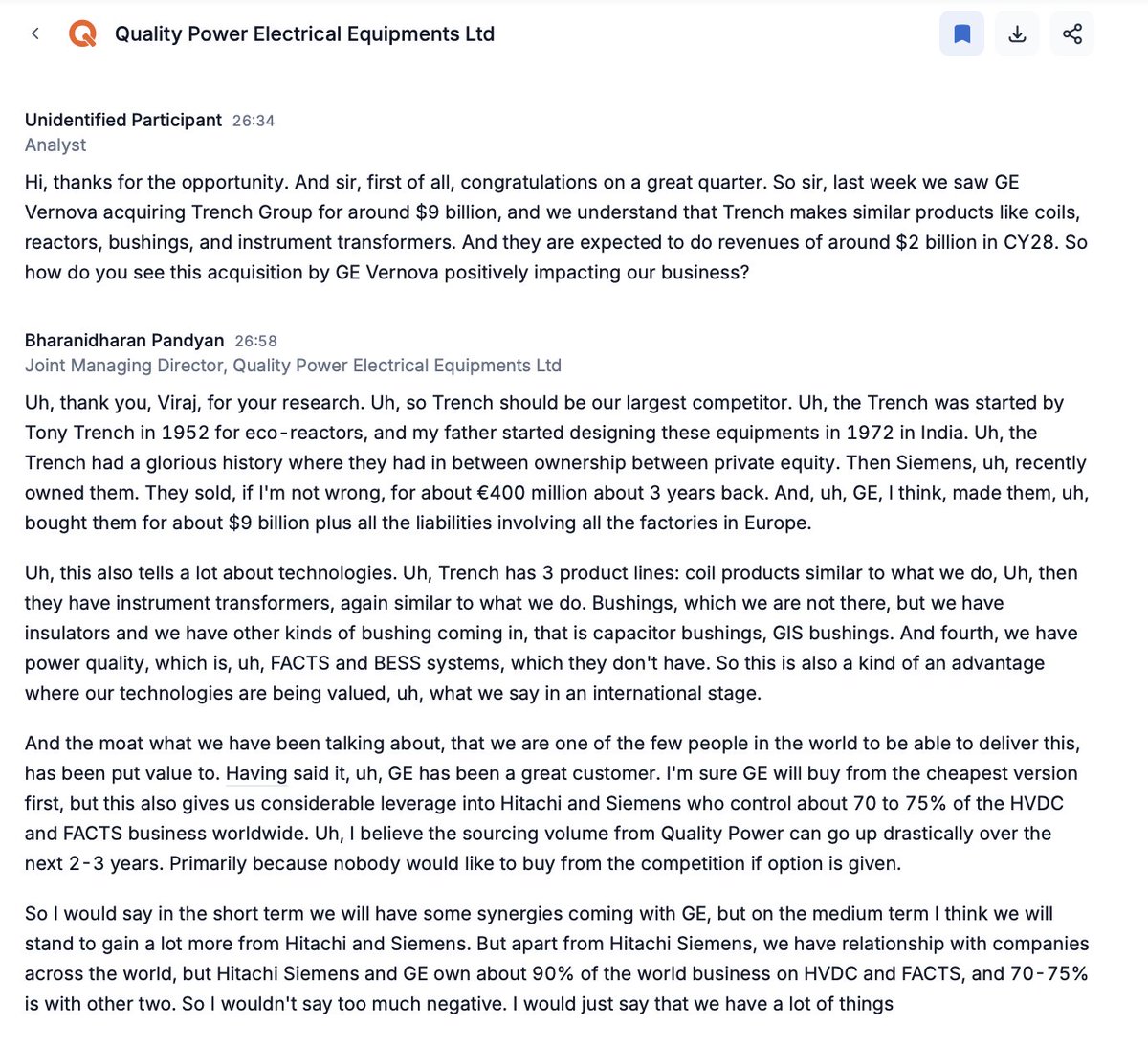
Trench is Qpower's largest competitor overlapping in coils/reactors and instrument transformers
Hitachi + Siemens control ~70-75% of HVDC/FACTS and GE acquiring Trench can be a tailwind for companies like Qpower where thy are expecting the volumes with these 2 customers to go up significantly as GE uses Trench for its in house consumption.
This can be a key factor to track for other power equipment suppliers supplying to the likes of Hitachi and Siemens.
Disclaimer - Not a recommendation to buy/sell
Every time an app delivers your groceries in 10 minutes, there's a possibility that a Shadowfax rider made it happen. We looked at the company behind the bike.
Shadowfax is India's second-largest delivery company. It started in 2015 as a food-delivery startup named after Gandalf's horse, and it has grown by owning almost nothing. The riders are gig workers and the trucks are rented, so costs only rise when orders do. Quick-commerce apps like Blinkit, Zepto and Amazon Now use it to help handle their rush-hours better.
Its biggest boost came when rivals collapsed, which pushed its share of India's parcel market to nearly 30%. Revenue is growing over 60% a year, profits are at a record high, and management just raised FY27 growth guidance to 38–40%.
It's not all smooth riding. Meesho brings in half the revenue, the stock isn't cheap, and gig-worker rules could tighten. But few companies have turned a near-death price war into a lead this strong.
And anyway, in Gandalf's words 'A wizard is never late, nor is he early; he arrives precisely when he means to.'
Has Shadowfax arrived on the exchanges right in time for growth?
If you're keen to read more on the company, check out our substack:
https://t.co/f0ve4FJyRl
Since Crude is all that anyone can talk about offlate, we thought why not discuss Antelopus Selan.
Antelopus Selan went from ₹357 in January to ₹1,000+ today. Worth asking what actually changed, because three separate things did and they are not equally durable.
1. The war. Brent bottomed at $58 in December, then the Hormuz conflict took it to $120 in April and back above $100 this month. A domestic producer sells at the international price without paying freight, war-risk insurance, or an import bill. Every barrel from Gujarat is a barrel that doesn't have to survive a choke point.
2. The policy. India rewrote its 1948 oil law, cut royalties for small fields to 7.5%, and opened ~1mn sq km of previously off-limits acreage. Buried in that: the law allowed PSC tenure extensions, so the company stretched its amortisation by 10 years. Same wells, same capex, spread over a decade longer.
3. The company. Q1 FY27 showed profit +384%, revenue +157%, margins at 70% on flat volumes.
So the quarter was price plus accounting. Not one extra barrel. Price is a gift and gets taken back when the shooting stops. The amortisation relief is real but it is cash-neutral. The barrels are the only part you get to keep, and they haven't arrived yet, but they might arrive soon.
If you're interested in knowing more, read our whole blog on substack!
https://t.co/r1fg8tKQT6
one of the most exciting and toughest time we have faced as investors over last 7+ yrs - stock discovery is happening within days, you feel you are working on something different, and meanwhile the stock is up 20% in a week - you are pulling triggers out of panic and not research.
AI has led to shorten time dedicated to research but at the same time, a lot of understanding in investors are fictional in our opinion. best of the minds we have interacted in past have started talking like AI given that is what an investor is using day in day out.
we use to talk about hypothesis of what if AI shortens the cycle which investors see in markets - and we think its happening right in front of us. so many stocks which are interesting - all ripping.
if a capex is going live in Q4, based on whatever the unit economics were there of the new capex - investors would usually want to come either when capex is announced, or when it is just about to complete. now, based of whatever economics of the capex would be, stocks are getting discounted way earlier.
++ retail investors are no longer uninformed, being uninformed is a choice now rather than access. the resources between a retail vs insti is 90% same nowadays. infact, incrementally we have got better ideas from family offices + individual investors rather than instis - reason is simple, now you cannot move slow now - move fast, act fast, make money fast and sell fast.
it all boils down to who have balls to pull trigger now even w 70% of research probably and even if you are wrong, be wrong quick and realise asap cause you need to sell early as well.
ps - dont be surprised with a lot of 1 crs to 50 crs in 3 years journey now - which was rare earlier, but a lot more stuff like this will happen, we are seeing this trend massively.
I feel there’s a liquidity squeeze in certain quality #smallcap names.
One way rally and no supply. Smart money moving from #largecap to smallcap.
Choose your pick smartly
Here's a brief on Power Transmission and Quality Power.
If you like stories that are built on a demand and supply mismatch, this one's for you.
Keeping India's grid stable while it goes heavy on renewables needs serious hardware, and @QualityPower1 makes the good stuff: the reactors, coils and STATCOMs that live inside the substations Siemens, Hitachi & GE Vernova build.
23% revenue CAGR, a ₹256cr Q1 FY27 at 47% gross margins, a 9x capacity expansion, and a genuinely wild comeback story, reviving an insulator plant for ~₹315cr.
Tailwinds are government-mandated (₹9L cr T&D capex, FACTS now compulsory in a third of renewable parks), but the stock's priced at ~45x FY27E, leaving little space for errors.
The grid needs its shock absorbers; question is whether the price already has enough of its own.
If you want to understand what the story is in more detail, do read our substack: https://t.co/vHOELj4BTS
@wideclops Nope, neither have commercial production yet. Most of the players mentioned are in pre-revenue stages. The figure given are based on figures given by the management.
Off-late, the market seems quite charged up about battery chemicals. And with good reason. India used to import basically all its battery materials. Now a whole crew of chemical companies wants to make them here instead.
So here's a quick tour of the battery chemicals space and who makes what inside your EV, minus the jargon.
First, what's even in a lithium-ion battery?
It's a five-part sandwich, tiny and intense: a cathode (LFP or NMC, the priciest bit), an anode (graphite, every single cell needs one), the electrolyte that ferries ions back and forth, a separator refereeing so the electrodes don't touch, and copper and aluminium foils on the outside.
With me so far? Now, who's making each piece?
Let's start with the cathode and its precursor, iron phosphate. Sudeep Pharma pivoted from food-grade iron phosphate to battery-grade. Meanwhile GFL and Himadri are building the LFP cathode itself.
On the anode side, it's all about graphite. Himadri (yes, them again) makes it from coal tar pitch they already produce at scale, they've even sold precursor to Chinese anode giants. GFL (honestly, GFL wants to make everything) is in the game too, and graphite veterans like HEG, Graphite India and Epsilon are circling.
The electrolyte is the secret sauce, and Neogen Chemicals is the clear specialist; the LiPF₆ salt, the additives, the formulations, with tech licensed from Korea and Japan. GFL is here as well (told you, they're everywhere), and Tatva Chintan handles the tiny-dose additives. Rounding out the supporting cast: conductive additives like carbon black and nanotubes come from PCBL and Himadri, and GFL supplies the PVDF glue that binds it all.
The separator, though, is currently a gap as no big Indian maker yet, mostly imported. Consider that door open.
For the backdrop: China runs nearly all commercial LFP capacity today, which is exactly why everyone wants supply chains outside it. LFP is winning globally, and India's ₹18,100 crore PLI scheme is pouring fuel on the localisation fire. This China+1 opportunity is no longer just a good option to have, but become more of a necessity as the US released a list of FEOC (Foreign Entities of Concern). The list includes China, North Korea, Russia and Iran. Which means any manufacturer hoping to tap US clean-energy support has a strong reason to keep China-linked material out of its supply chain.
The story is looking like it just starting to play out, the market is quite charged about it, what do you think?
If you’re keen on reading more about the space in depth, read our detailed blog:
https://t.co/GGzw0qDF8Y
India moves 90% of its trade by sea but owns less than 1% of the world's ships. Now to that equation add a neighbour with 4x our navy, and you get a decade-long shipbuilding boom: ₹2.35 lakh cr of naval orders and a new warship every ~40 days approximately for a decade (if we reach even half way, thats some major impetus).
But the fun bet? A company called Krishna Defence that started out making milk cans in 1997 and today makes the steel "ribs" holding up nearly every Indian warship. For submarine-grade steel, they're the only approved supplier in the country; a monopoly with a security clearance.
Sometimes the best seat at a gold rush isn't the mine. It's the shop selling shovels. Or here; ribs.
If you're interested in knowing more about this sector read our full blog:
https://t.co/854JqfGCR2
While you've been busy with wars and tariffs, an Indian private company designed, built and launched a rocket into orbit.
Skyroot's Vikram-1 lifted off from Sriharikota at 12:05 on 18 July. Sixteen minutes later its payloads were in a 450 km circular orbit at 60 degrees inclination. Four stages, all nominal, first attempt. Very few private companies anywhere have reached orbit on the first go.
A few listed companies were a part of that journey:
The article mentions - Solar Industries, TechEra Engineering, Inox India and Difussion Engineers
https://t.co/qoRXeakzBg
Incase you were wondering why majority pharma and CDMO companies were looking spooky today, our friend Mr Trump has suggested upto 200% tariffs on generic drugs.
And you thought he had a war to focus on...
SG Finserve: The Side Hustle
Every family has that one relative who starts a side hustle and it turns out to be the smartest thing anyone in the family's done in years. For the APL Apollo Group, that relative is SG Finserve.
Except the founding story is basically an accident that someone had the good sense to notice.
How a Steel Company Backed Into Lending
SG Finserve was built out of one of the best motivators for an entrepreneur, no, not passion but irritation.
Back in April 2020, APL Apollo Tubes (India's largest structural steel tube maker) went cash-and-carry with its distributors, doubling the upfront-payment discount to 2%. Simple enough logic: pay now, save roughly 16% a year if you do that eight times over.
Except some distributors kept walking away from a 16% discount. Which makes no sense, until you realise the reason was access. These were dealers APL Apollo had worked with for two decades without a single default, and yet no bank would touch them at even a 12-13% interest rate. Banks look at balance sheets. APL Apollo looked at twenty years of repayment history and saw a business opportunity banks were too rigid to see.
So in October 2022, promoters Rahul and Rohan Gupta (Sanjay Gupta's sons) took control of a dusty old BSE-listed broking shell called Moongipa Securities, renamed it SG Finserve, raised ₹720 crore, and started lending at 12-13% to exactly those dealers. The company keeps roughly 3-4% as spread, the dealer still comes out ahead versus the 16% they'd have paid up front, and everybody wins.
Is This Really a Defensible Business?
Anyone can lend money at 12%. The trick is not losing it, and SG Finserve's answer to that is pretty blunt: the loan goes straight to the anchor corporate (APL Apollo, Tata Motors, Havells, Vedanta, Polycab), never into the dealer's pocket, and it's secured by the inventory the loan just bought. Skip a payment, and the anchor simply stops shipping you more steel, or vehicles, or whatever you sell for a living.
Zero NPAs in the first 24 months of operation. Zero NPAs still, on ₹25,000 crore of disbursements for FY26. Though it's worth remembering that structural advantages have a way of looking bulletproof right up until the quarter they aren't.
Then the Leadership Changed, and the Guidance Became a Soap Opera
Here's where it gets entertaining, if you enjoy watching analysts corner management on an earnings call (and if you're reading this, you probably do, we surely do).
Founding CEO Sorabh Dhawan and CFO Sahil Sikka, the duo who built the book from scratch and kept it at zero NPA, exited. Vinay Gupta stepped in as CEO, Sanjay Rajput as CFO, with Anubhav Gupta continuing as Group Chief Strategy Officer. And on the Q3 FY26 call in January, the new team promptly lowered the long-term AUM guidance from an earlier ₹6,000 crore FY27 target down to a trajectory implying ₹7,500 crore only by FY30.
The analyst community did not take this well. One investor pointed out, quite fairly, that guiding ₹1,000 crore of flat annual AUM addition while claiming a 20% CAGR is mathematically a bit of a fudge. Another asked why give an FY30 guidance at all if it's just going to get rewritten every quarter. Management's defence was essentially "new team, please be patient, we're deliberately sandbagging".
Then Q4 Happened, and the Sandbagging Paid Off Spectacularly
Three months later, on the April call, the same team walked in with a loan book at an all-time high of ₹3,936 crore (up 75% YoY), full-year PAT of ₹128 crore (up 58%), ROA of 4.8%, cost-to-income still under 15%, and nil NPAs, unchanged. They'd also just picked up a factoring licence, onboarded two TReDS platforms, and had ₹350-odd crore of fresh warrant money landing to push equity past ₹1,450 crore.
Naturally, the very same investors who'd grilled them for lowballing guidance in January were now grilling them for having lowballed guidance in January. You cannot win with this crowd, and to be fair, you probably shouldn't be able to. New FY27 guidance: 35-40% AUM growth, a marked upgrade from the "let's not get ahead of ourselves" tone three months earlier.
And Then Q1 FY27 Happened, and They Did It Again
If you thought two quarters of "we lowballed you, sorry" would be enough to cure this management team of conservative guidance, you underestimated how much these people enjoy the bit.
Q1 FY27 (June quarter): highest-ever quarterly PBT of ₹72 crore, up 27% QoQ. Loan book at a record ₹4,552 crore, up 16% QoQ and 82% YoY. Net worth of ₹1,539 crore, leverage now at 2.2x (up from 1.9x in March, still nowhere near the 3x ceiling management keeps promising to eventually use), capital adequacy at a plush 32%. Annualised ROA of 5.1%, ROE of 14%, and, the star of the show as always - nil NPAs.
They're now doing over ₹2 crore of profit per employee per year, which for a company that prides itself on a lean, digital-first team is basically the whole thesis in one number.
Buried in the presentation was the real juice: the FY30 AUM target moved from ₹7,500 crore (the number they'd walked everyone down to in January, to general outrage) to ₹10,000 crore. An analyst asked, quite blatantly if this meant an increase in guidance, and the answer was yes. Management even admitted they might hit the FY30 number by FY29 "because the speed and velocity of the business is faster than anticipated."
There's also a nice bit of continuity comedy here for anyone who was paying attention in January. Back then, when analysts pushed management on the four mooted new business lines (ARC, AIF, insurance broking, fintech), the promise was explicit and repeated multiple times: not even $1 of investment or hiring for the next 2-3 years, pure ideation-stage stuff. Fast forward five months, and SG Finserve has already incorporated a wholly-owned insurance broking subsidiary, applied to IRDAI for a licence, gotten board approval to explore AIF and ARC structures, and is eyeing a GIFT City entity for cross-border supply chain business. None of it is revenue-generating yet, and management insists it's all still "broad-based vision," but the gap between "not $1 for 2-3 years" and "wholly-owned subsidiary incorporated within two quarters" is the kind of thing this crowd of analysts will absolutely bring up again the next time guidance moves.
The one candid moment worth flagging: when asked directly about the prolonged geopolitical tension and its effect on the MSME supply chain, management didn't dodge. They said the incremental working-capital demand some traders and end-users used to need has genuinely come down, and they're compensating by chasing new customers and geographies rather than deepening existing ones as fast. It hasn't shown up in credit cost, but it's the first time in three quarters the company has flagged something as an actual headwind.
The Part That Should Matter More to a Shareholder Than the Drama
Strip away the guidance theatre and what's left is a lending business now compounding its loan book at 82% YoY, still running at a moderate 2.2x leverage against a self-imposed 3x ceiling and a stated ambition to reach ₹10,000 crore of AUM without needing a single rupee of fresh equity. Management keeps saying they could lever up faster and choose not to - which, whether you read it as admirable discipline or excess caution sitting idle, is still not the usual complaint levelled at Indian NBFCs.
There's also a mild concentration wrinkle worth flagging: APL Apollo-linked business has come down to roughly a third of AUM (from being effectively the whole book at inception), with the rest split across non-Apollo working capital and factoring. That's a genuinely healthy de-risking trend, though the parent ecosystem is still, by design, the anchor of anchors.
So, Bottom Line
This is a business built on a clever insight; that a 20-year relationship is better collateral than a balance sheet. This thought has now strung together three consecutive quarters of beating its own conservative guidance and then raising it again. The lending model hasn't wobbled once. The empire-building ambitions (insurance broking, AIF, ARC, GIFT City) are moving faster than management said they would just two quarters ago, which is either healthy opportunism or the first sign of scope creep, and it's probably too early to tell which.
Whether the new leadership ever settles into guidance nobody has to argue with on the call is, at this point, less of an open question and more a running joke that everyone including management seems to be in on.
Would you take a second look at APL Apollo group’s side hustle?
-------------------------------------------------------
This is not investment advice, just an idea we found interesting enough to study further. Please do your own work or find someone who can do it for you
Here's why SG Finserve should be on your tracking list post Q1-27 Numbers:
•Revenue: +101% YoY, +29% QoQ
•PBT: +111% YoY, +27% QoQ
•Gross disbursements: ₹7,300 Cr (+39% YoY)
•Loan book: ₹4,552 Cr (+82% YoY)
This set of numbers is not just a one-off, but seeming like structural growth which has been visible for a few quarters now.
Where they're headed:
•FY27 PBT guidance: ~₹300 Cr (75% YoY) → ~₹225 Cr PAT
•AUM: ₹5,500 Cr by FY27 → ₹10,000 Cr by FY30
•Long-term CAGR: 25-30% AUM | 30-35% profitability
•ROA held at ~5%, ROE stepping up from 14% to 16%
And they're not chasing growth at the cost of quality:
•NIL NPAs, best-in-class asset quality
•Cost-to-income sub-15%
•OpEx at just 1% of average book
The next legs of growth are already in motion:
•Factoring & TReDS — commercialized this quarter
•Digital lending + loan against property — in the pipeline
•Insurance broking subsidiary (fee-based, B2B) — 2-3 quarters away
A supply-chain financing NBFC trying to more than double its AUM and go past ₹10,000 Cr by FY30 while improving ROE and keeping the balance sheet clean is something that surely deserves another glance.
Yes the growth might eventually taper, but the base will also keep getting bigger. Definitely a company to add to the Watchlist post Q1FY27.