Simulated scenario: Harborlight Foundation — Raise the endowment draw rate for 3 years to meet a disaster-recovery surge?
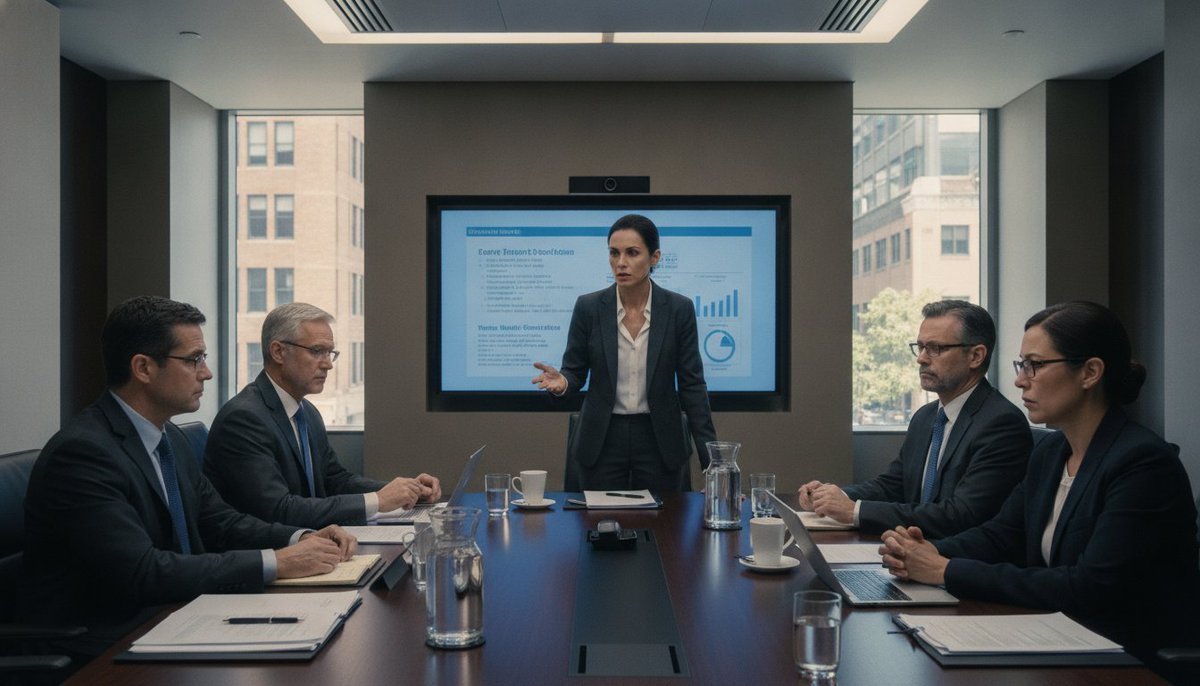
The board of directors of a nonprofit foundation holds an urgent…
A Timepoint AI demonstration, not a real customer.
Simulated scenario: Cobalt Robotics Labs — Focus the whole roadmap on cold-storage warehouses, or stay horizontal?
The executive team of a warehouse-robotics startup holds a critical…
A Timepoint AI demonstration, not a real customer.
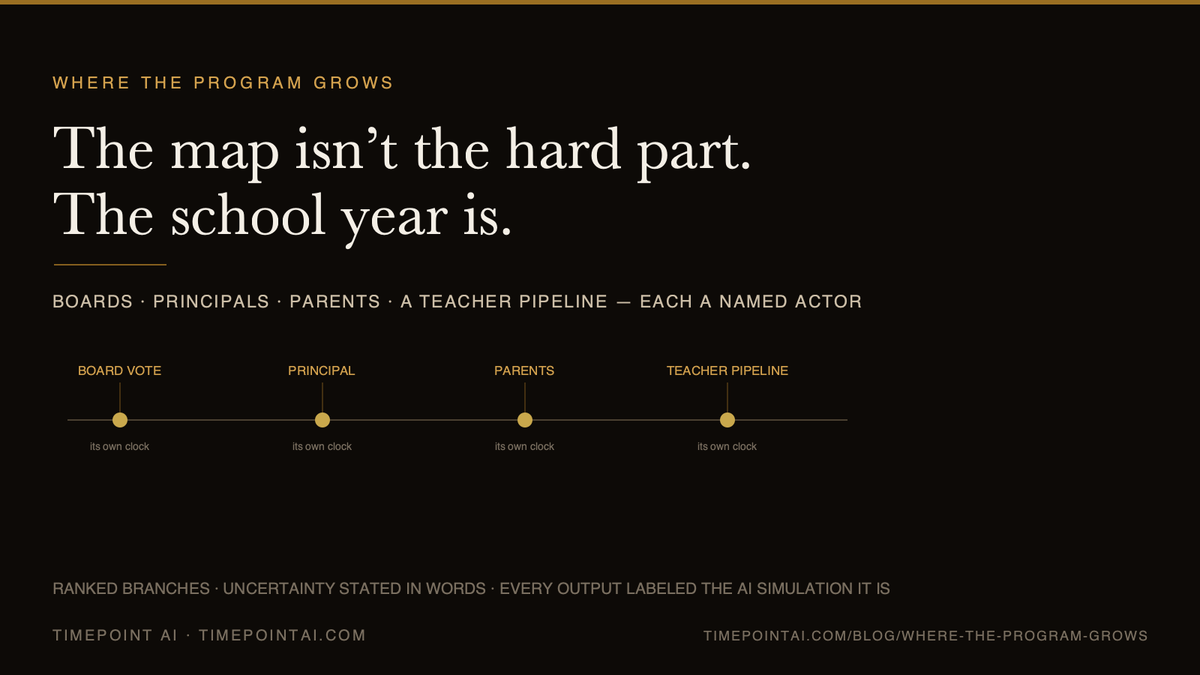
Expanding an education program isn't a market question. It's a calendar of other people's decisions — boards that vote on their own schedule, principals who champion or stall, a teacher pipeline with its own clock.
We simulate that room, not the map.
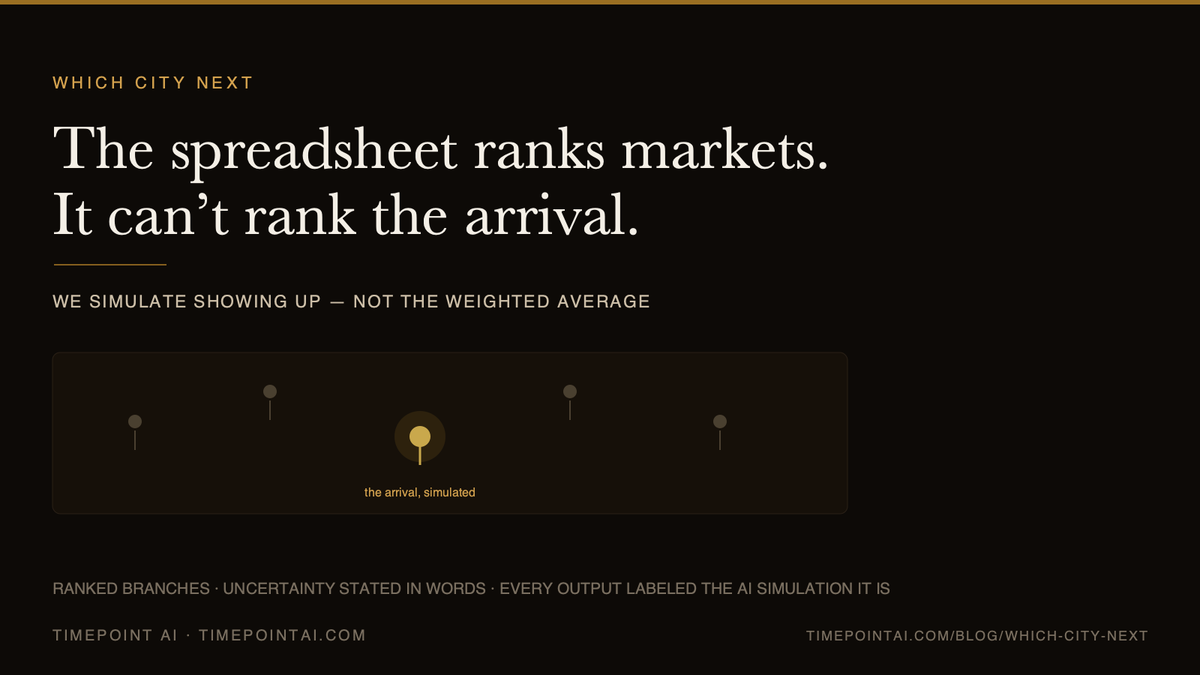
Your market-entry spreadsheet ranks metros by TAM, density, labor, permits — a column per city, a winner by weighted average.
It ranks markets. It can't rank what happens when you actually show up in one.
We simulate the arrival, not the average.
Three credible format bets. One production slot. A greenlight meeting where the loudest conviction usually wins.
The research that would settle it — a pilot, a panel — takes a quarter you don't have.
We simulate which format survives contact with the audience.
Simulated scenario: Beacon Health Clinic Group — convert 2 of 6 clinics to telehealth-first hubs, or keep all 6 full-service?
We ran the strategic-planning room before the first closure. A Timepoint AI decision simulation, not a real customer.
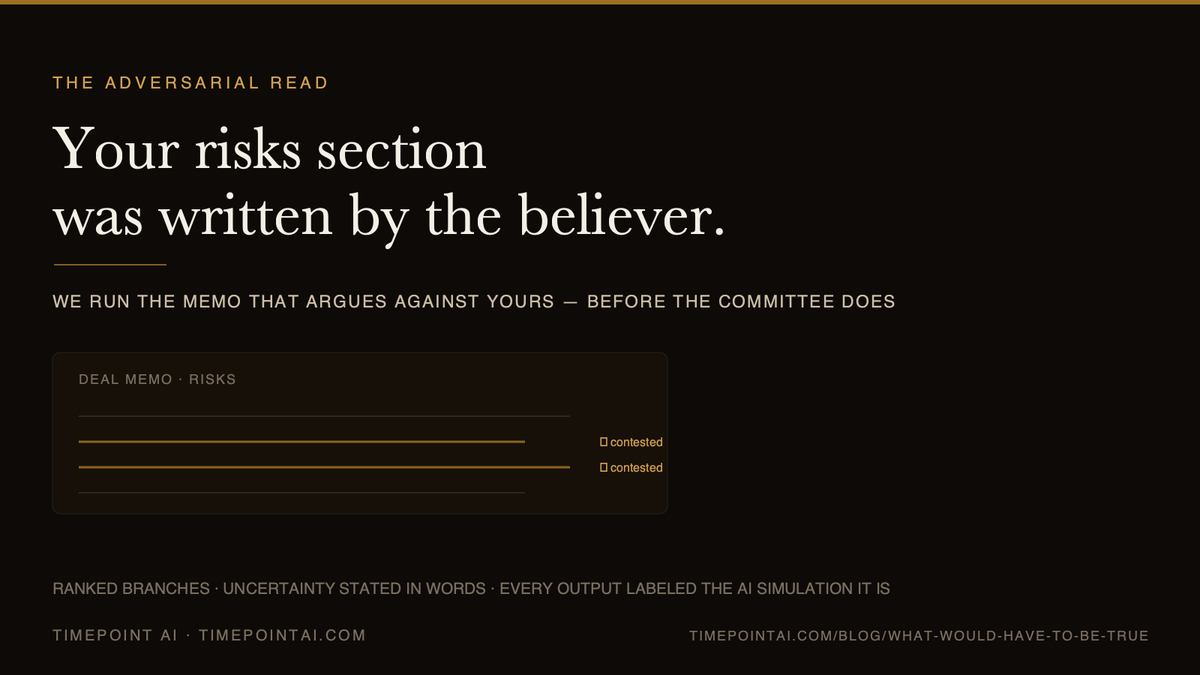
Every risks section in every deal memo has the same flaw: it was written by the person who wants the deal done.
Big funds staff an adversarial read. Small funds don't have the bodies.
We run the memo that argues against yours — before the committee does.
Your strategic plan models you — your funnel, your margins, your milestones.
What decides whether the pivot works is sitting in your competitor's Tuesday meeting — and your plan doesn't model that room at all.
We simulate the other side of the table.
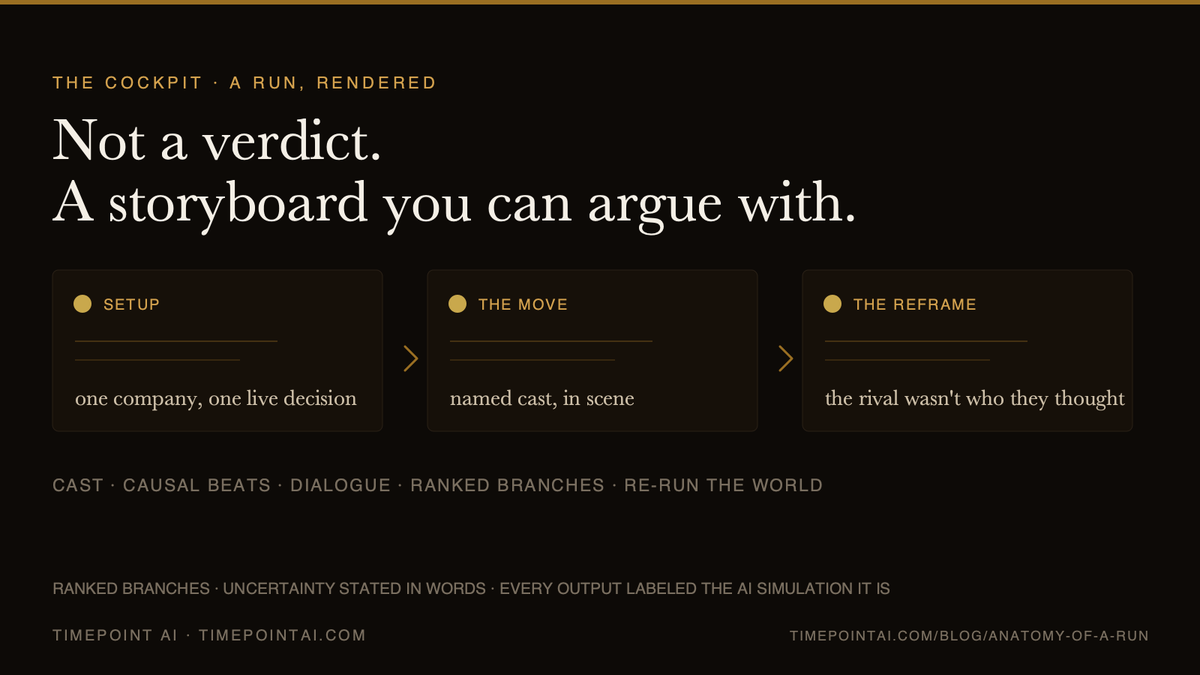
Most "AI for decisions" hands you a verdict. We built a cockpit that hands you a storyboard.
Cast, causal beats, dialogue, and the "this happened because of that" behind every scene — plus ranked branches, uncertainty stated in words.
Challenge a beat, re-run the world.
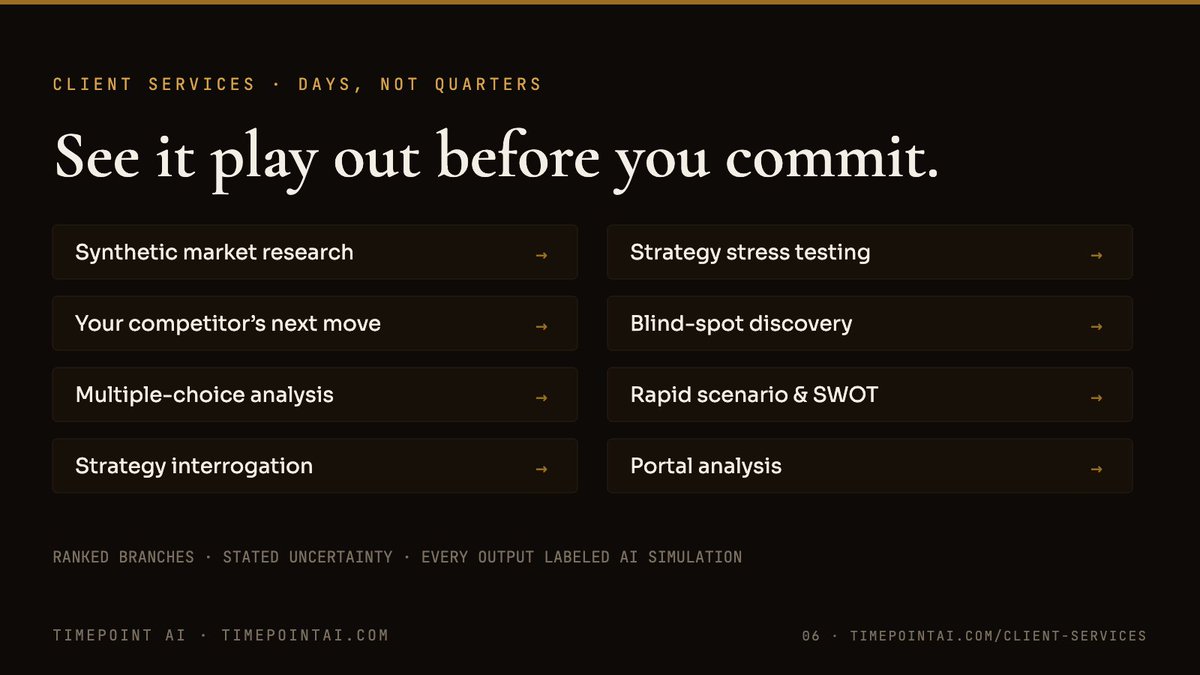
What clients actually bring us: synthetic market research. Strategy stress tests. The competitor's-eye view of their own plan. Blind-spot discovery. Three options, one deadline.
Days, not quarters. Ranked branches, stated uncertainty — every output labeled the simulation it is.
You tell me nothing. I tell you what I find.
In a zero-knowledge engagement the client gives four spoken things — who to simulate, for what decision, why now, what questions — and hands over nothing. No files, no data room, no NDA.
A fictional, labeled walkthrough: