Exciting news from WeatherXM! We’re
- Deploying 2,270 weather stations across the Global South to improve data accuracy
- Addressing disparities in weather forecasting for underserved communities
- Supported by the WeatherXM-Swissborg Alpha Deal
Read the full blog post👇🏼
https://t.co/mjOS9Vot5k
#WeatherXM #GlobalSouth #WeatherData #ClimateEquity #ImpactInvesting #Infrastructure #Sustainability #CommunityImpact
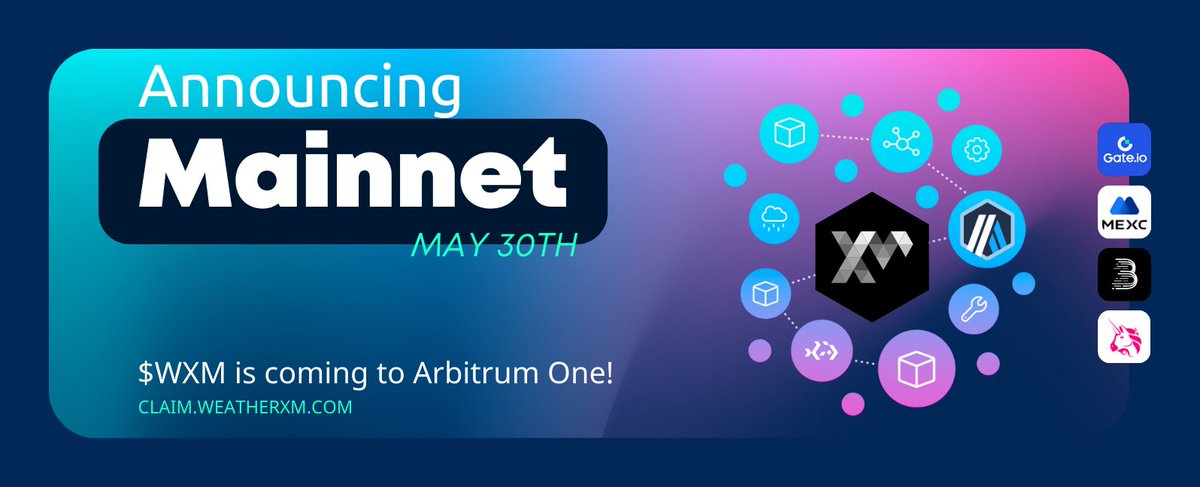
🚀 WE ARE LIVE ON MAINNET 🚀
$WXM is officially live on Arbitrum One!
You can Buy/Sell/Swap our token on:
@gate_io
@MEXC_Official
@BitMartExchange@Uniswap
Join our growing ecosystem and be part of the weather data revolution!
Happy Mainnet Launch!🔥
https://t.co/HE9ZR0xUtj
Wen Mainnet?
Get ready, $WXM is officially going live on May 30th! 🚀
We've successfully closed Series A, led by Lightspeed @FactionVC, to build the largest weather network.
- Mainnet
- Exchange Listing
- Series A Funding
- Next Big Steps
Read more 👇🏼
https://t.co/ZfkDDvktwK
🔥 Time is ticking!
🚀 We will go to the Mainnet soon, and our weather stations are your ticket!
Harness the power of hyper-local weather insights and join a thriving network of enthusiasts. Secure your station today and start earning! ⛈️
🛒 Shop now!
https://t.co/Z8o3e2L3lS
#ICP says advanced AI models need to run as smart contracts on blockchain.
How? Why? It's easiest to understand by example...
Imagine an LLM (Large Language Model) AI that acts as a company oracle, which sits at the heart of an organization as it grows larger, making it more cohesive, helping with information flow and coordination, and making it more effective.
We'll call this LLM "Delphi," and she feeds on sources of company data, such as GitHub repos, JIRA tickets, Slack conversations, email threads, Google calendar, and every other enterprise information source that's important.
Team members will regularly chat with Delphi to obtain information, and also update her with their ideas, concerns, and the latest goings on.
You can ask "how is team X progressing with their task, are they blocked by anything, do team members have new concerns or ideas, what are their recent interactions with customer Acme, Inc, does legal have thoughts, what does Bob's calendar look like this afternoon?"
Delphi will quickly become the glue that holds the organization together, and the engine of its efficiency.
Now let's consider the risks.
First of all, if Delphi is running on a traditional server computer in a co-location facility, say (i.e. on traditional IT infrastructure), there's a risk that she goes offline due to a technical problem, which will greatly disrupt the organization.
But the danger hackers pose is worse. She's slurping a whole lot of confidential data. What would happen if hackers got onto her infrastructure, and started intercepting the feeds? She's a honeypot, where they can steal everything.
Moreover, hackers, or even malicious insiders, might start to tamper with the way she works, either for a bit of malevolent fun, or in the mode of commercial espionage.
When somebody asks how the team Bob leads is doing today, the response might be modified to say "Bob hates you, and is thinking of resigning!"
When somebody in PR asks whether there is any company news that might make a good tweet, the response might be modified to suggest broadcasting a damaging lie.
Even input prompts created by users might be surreptitiously modified, such that when Delphi's response is delivered, the response has a misleading meaning within the context of the correct prompt the user thinks she processed.
Worse, input prompts entered by honest users might be maliciously modified to update Delphi with fake and misleading information – fatally corrupting Delphi, since by the time it is seen that she has been ingesting faulty data, her neuron weights will have been changed in irreversible ways, requiring a massive retraining effort to get her functioning properly again, involving substantial time and effort that's inevitably very expensive and damaging for the organization to deal with.
Finally, Delphi might go completely offline for reasons other than simple infrastructure bugs and glitches that can be relatively quickly fixed: somehow, ransomware might get onto her infrastructure, and encrypt Delphi, and demand bitcoin to restore her – resulting in an outage lasting days, and/or the loss of Delphi's recent learnings if she has to be restored from a backup.
The risks of such problems occurring might prevent the organization leveraging Delphi to anything like her full potential – since if they come to depend on her too heavily, they risk serious disaster in various forms.
Is there a solution?
Naturally, yes, and it is something that those working on #ICP are making steady progress on.
The solution is to run Delphi in the form of a smart contract, which is tamperproof and unstoppable, and can guarantee that 1) she receives submitted prompts in unmodified form (since, behind the scenes, they are submitted as signed transactions), that 2) inference (the calculation of results) is performed correctly (since smart contracts always run their correct logic against their correct data, including neuron any weights they store), and that 3) responses users receive (the results) are not maliciously modified. Another plus is that ransomware is unable to encrypt smart contracts!
On the Internet Computer, #ICP "canister" smart contracts are "software actors," which comprise bundles of WebAssembly bytecode logic (compiled from software languages such as Rust, Motoko and TypeScript, or even cross-compiled binaries once created to run on other systems...), and persistent memory pages this logic uniquely and privately runs within, in a scheme of orthogonal persistence.
Recently, some Internet Computer subnets were upgraded to allow individual smart contracts to pack as much as 400GB in persistent memory pages each, which is enough to run very substantial LLMs.
Using such capabilities, some people are already experimenting with running LLMs as canister smart contracts, but there is more coming.
DFINITY is working on ways to transform LLMs, such as Llama 2 (but the transforms will work with nearly all AI models) such that hardware optimization, essential for model efficiency, works in deterministic ways, and can therefore be performed by blockchain nodes. With special 4X low-replication "AI subnets," we plan for it soon to be possible to tag smart contracts "AI model," so that the network automatically runs them with very decent levels of efficiency.
We consider compute infrastructure to be foundational societal infrastructure, which drives automation in ways that enable more productivity, efficiency, growth and freedoms – and on the Internet Computer, redefines governance and ownership models for public services – delivering widespread benefits to mankind.
It is of crucial and increasing importance to the world that compute infrastructure becomes tamperproof and unstoppable, as it is on blockchain. That traditional infrastructure does not have these properties is why cybersecurity is becoming a key issue of our time on a par with war and climate change.
AI now makes the issues of cybersecurity, resilience and trust even more important in two ways: 1) AI shall make cybersecurity vastly more challenging, and 2) AI will massively increase our dependence on our compute infrastructure, and tie us ever more closely to its fate.
"Blockchain Singularity," a core tenet of #ICP thinking, is that blockchain will inevitably become humanity's default compute platform to solve for the aforementioned challenges, and running AI on-chain will be a key part of that future.
TLDR
Please someone just built a simple, transparent, decentralized Bitcoin mining pool on ICP.
All code can be controlled by the miners themselves, extremely transparent, integrity and honesty with high guarantees.
With Rust, TypeScript, JavaScript, Python, of C++ and Wasm, would it be that hard?
1/ Unbounded transparent execution sharding.
Unlimited shards for horizontal scale, equal in computational ability, transparent/abstracted to the end developer.
I've searched for years to find a blockchain that can achieve this.
ICP has the best implementation that I know of.
1/ Bitcoin devs...
Imagine a cloud platform that let's you build apps in a familiar server programming environment, but without taking direct custody of your user's private keys.
This is ICP. Using threshold ECDSA, you can programmatically control private secret shared keys.
1/ ICP now has the ability to bridge BTC and ETH.
The bridging tech is unique, with interesting security properties.
For those interested in the major technical details, I highly recommend searching the DFINITY forums for the most in-depth discussions: https://t.co/q7tcmdYWrB