Today I start a "la Caixa Foundation Junior Leader postdoctoral fellowship" at @biobizkaia in Barakaldo. I will use multimodal neuroimaging to find depression biotypes that predict treatment response. Thank you @BecariosFLC@FundlaCaixa#laCaixaFoundFellows
As we have shown befor in https://t.co/qseDHYs697. The relationship between imagery & mental health is mediated by alexithymia and interoceptive processing, not imagery itself.
This challenges treating aphantasia as one condition. Subtypes matter for our understanding !
New Neuropsychologia Paper🧠! When we analyse mental health with larger sample sizes across the traditional aphantasia range (VVIQ 16-32), we find something counterintuitive:
Weak imagery (hypophantasia) is worse than almost none (core aphantasia). 🧵
https://t.co/lkzYhnu67q
Why? We found it's about interoceptive balance.
Hypophantasics seem to TRY using body signals for emotion processing—but fail. High effort, low success.
Core aphantasics may bypass this entirely, developing stable external strategies that actually work.
People more attuned to their inner world—bodily sensations, emotions, mental images—may be better equipped for emotional regulation.
But it's not all protective: inward focus also relates to increases involuntary memories, which can be distressing.
Mental imagery is much more than internal visual perception.
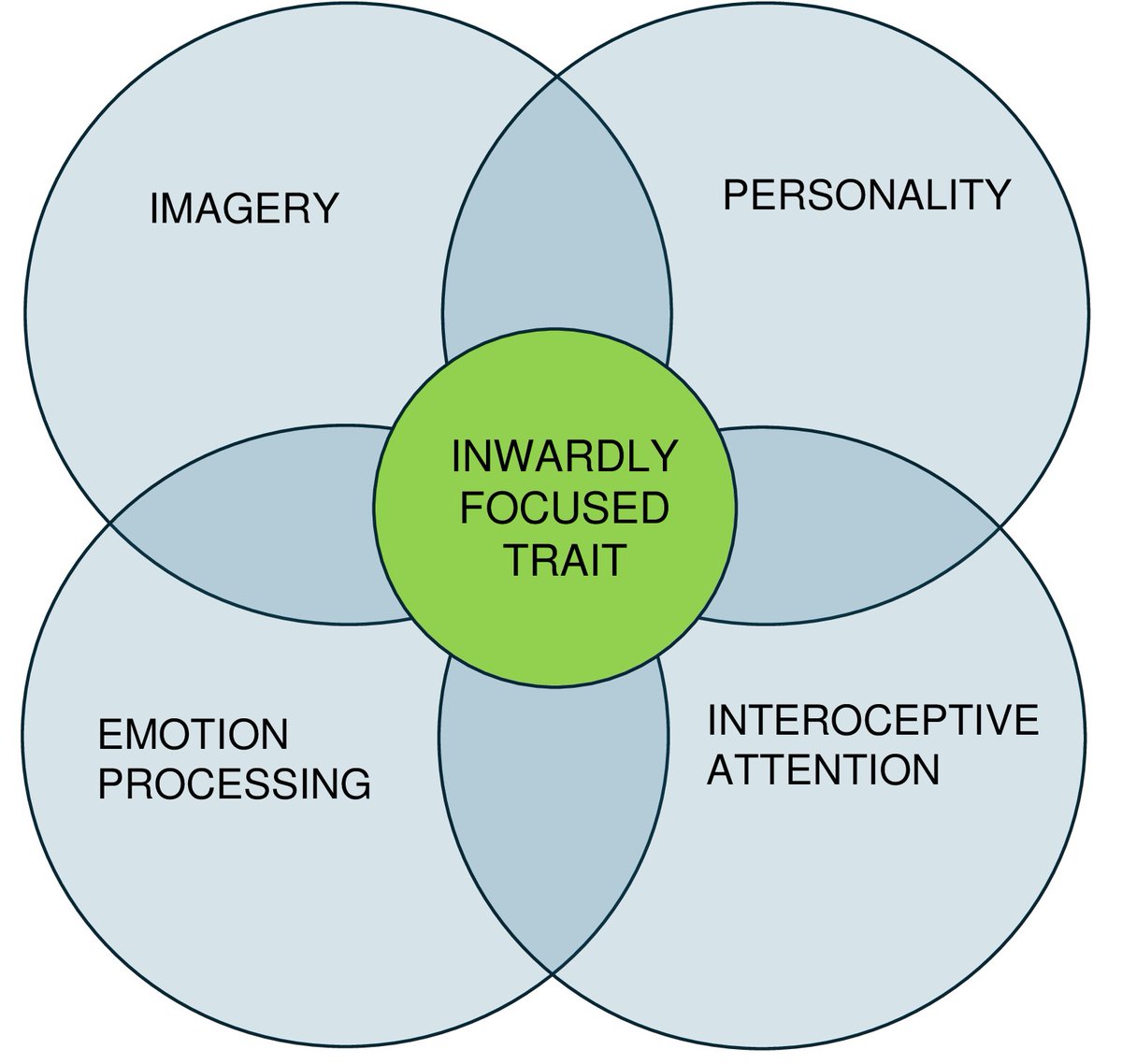
Our new paper shows vivid imagery is part of an "inwardly focused" cognitive style—linking imagery to interoception, mindfulness, and emotional awareness. https://t.co/qseDHYs697
In 591 participants, imagery vividness correlated with interoceptive attention, mindful presence, openness, and conscientiousness.
This "inward focus" mediates the imagery–mental health link—largely via reduced alexithymia.
Using recurrent-event survival analysis in 16k+ Spanish opioid patients, we show that the factors driving treatment readmission differ from those predicting death.
Notably, treatment adherence lowers readmission risk but doesn't protect against mortality.
https://t.co/bO06XEPWMQ
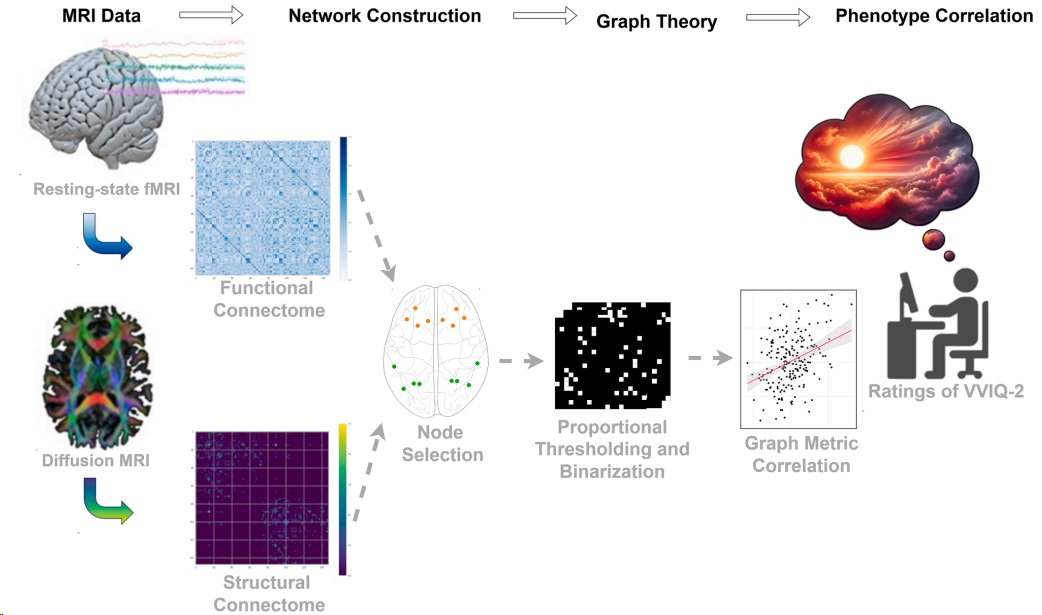
The takeaway: Vivid imagery emerges from interplay between sensory-based structural networks, high-level visual integration, & salience-driven regulatory control. Multivariate outperformed single regions. Reconciling decades of fusiform-centered vs. early visual cortex debate.
Just published in NeuroImage: What makes some people's mental imagery vivid? We analyzed 500+ brains using graph theory on structural & functional connectomes to ask: which neural networks support imagery vividness? https://t.co/uNTQewAKls
I am opening two PhD positions in Barcelona. These will be to work on machine learning problems at the intersection between methods development, computational neuroscience and clinical applications.
https://t.co/OKxRgVo2uq
https://t.co/Wt8l75zabU
Apply/disseminate please
Weak Imagery is Worse Than None – 🧠💭Our study finds that weak mental imagery (hypophantasia) is linked to worse mental health than no imagery at all (core aphantasia). We find that interoception & alexithymia are important mediators! https://t.co/sDqcV1tVEu…
Our model proposes that mental imagery is part of an ‘inwardly focused’ cognitive style, geared towards prioritizing attention to internal experiences like emotional awareness, and interoception. Check out our 3 page paper: https://t.co/NeDJVh8mHn exploring this overlap 2/2 🧵
Mental imagery is like sensory perception, but stands apart as a more complex cognitive process. It's deeply tied to introspection and shares similarity with interoception, mindfulness, and correlates with personality traits 1/2 🧵
New paper alert🚨: hypnosis and mindfulness interventions in brain injury patients show similar effects on sleep and slightly favourable effects for hypnosis on self-rated reports. https://t.co/tixbrfxK3D. It only took 9 rejections! 😆 The academic publishing model is the best🤥
@RCarhartHarris I go straight to the
William James definition in The Principles of Psychology "a (neural) structure weak enough to yield to an influence, but strong enough not to yield all at once"
Our findings suggest that vivid visual imagery is optimized by a network with greater localized information transfer and interconnectedness, and that globally integrated networks may dilute neural activity essential for generating vivid imagery 3/3 🧵 #CognitiveNeuroscience
🧠✨ Ever wonder why some people can visualize images in their mind with incredible detail while others can't? Our preprint dives deep into the brain's network dynamics to explain the vividness of visual imagery.
1/3 🧵 https://t.co/W11DLy0fvt
#Neuroscience#VisualImagery
In our study (n=273) we investigated the neurobiological basis of imagery vividness using graph measures such as local efficiency & clustering coefficients to show correlations between DTI/rs-fMRI connectomes and enhanced visual imagery. #Neuroimaging#BrainConnectivity 2/3 🧵