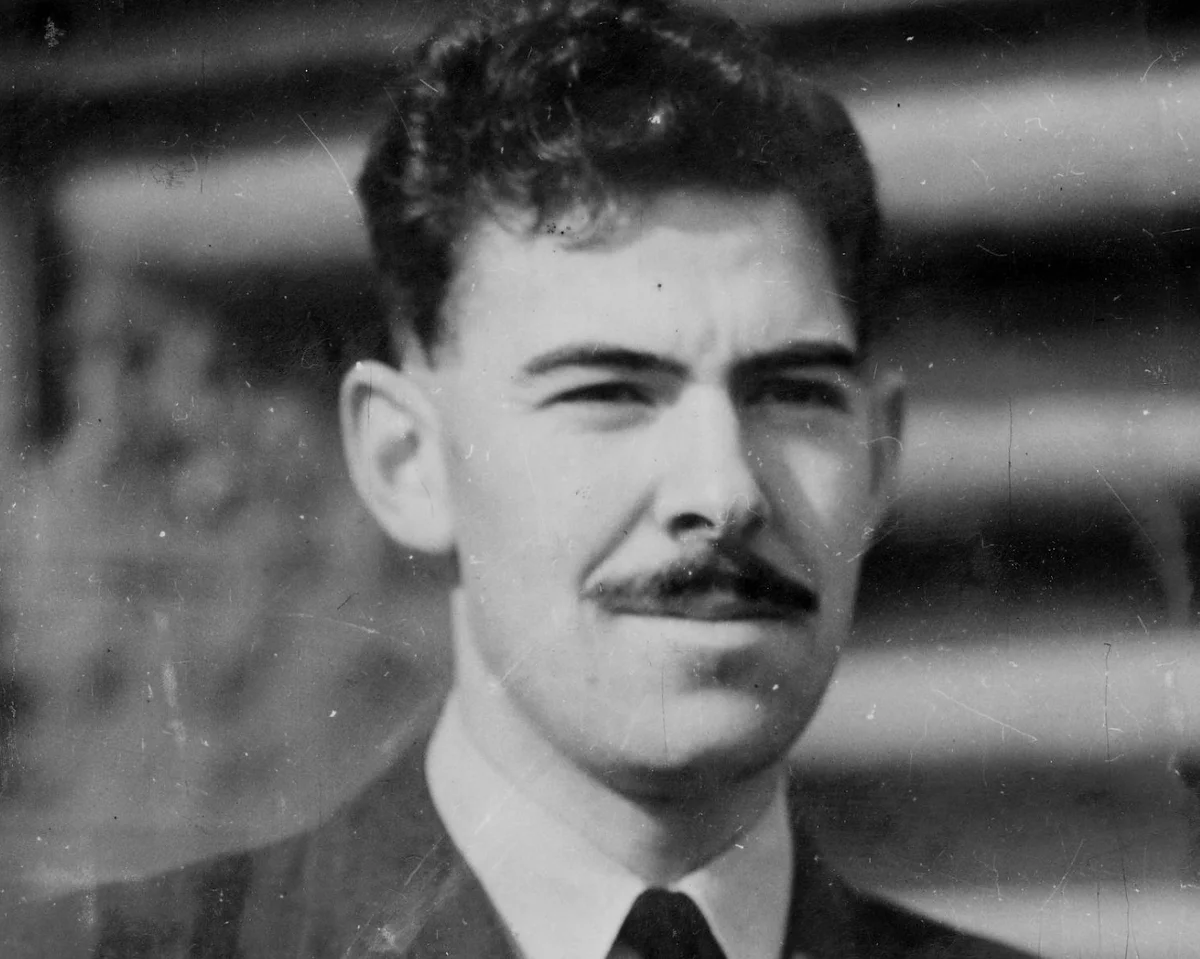
Seventy-two. That is how many separate wounds John Cruickshank had in him, two of them through his lungs, while he lined up a burning flying boat for a second run at a U-boat that had just shot his aircraft to pieces. Most men have one of those wounds and they are finished. He had seventy-two and he pressed the attack.
He was 24, a former bank clerk from Aberdeen, flying a Catalina flying boat out of the Shetland Islands with Coastal Command. The job was the long, freezing, mind-numbing patrol, fourteen hours over the grey Atlantic hunting the U-boats that were strangling Britain. On the 17th of July 1944, far out over empty water, they caught one on the surface, U-361, and Cruickshank took the big slow flying boat down to attack.
The first run failed. The depth charges would not release. Any sane man makes a note and turns for home. Cruickshank swung the aircraft around and came back for a second pass, low and straight, and this time the submarine's gunners were waiting. Flak ripped through the Catalina. It killed the navigator, wounded half the crew, and tore into Cruickshank again and again, those seventy-two wounds, two punching into his lungs, ten into his legs.
And he flew the attack home anyway. Bleeding everywhere, in agony, with the fuselage holed and on fire, he held the aircraft dead level, aimed, and released the depth charges himself. They straddled the U-boat perfectly. It broke apart and sank beneath him.
Then came the part that should have killed him. He collapsed from blood loss, and the wounded co-pilot, who had never landed a Catalina, took the controls for the long flight back. Cruickshank refused the morphine that would have knocked him out, because he knew the man flying needed him. Drifting in and out, he had himself carried back up to the cockpit again and again through the night to help nurse the shot-up aircraft down, and at dawn they got it onto the water safely. He had lost so much blood the doctors said he had no business being alive.
He lived. He took the Victoria Cross from the King, went quietly back to banking after the war, and rarely spoke of it. And he kept on living, and living, and living. John Cruickshank died in 2025 at the age of 105, the last man on earth wearing a Victoria Cross earned in the Second World War. Seventy-two wounds over the Atlantic, and he outlasted every other hero of that war by decades.
@SGTWipper1Each A Brit football hooligan type once told me “I wanted to join the Army - me uncle was in the Paras - but I could never go six months without a conviction.”
On this day in 1944, Theodore Roosevelt Jr. died in his sleep in a stone farmhouse in Normandy. He was 56 years old, and he had spent almost his entire adult life trying to be worthy of a famous last name.
He was the eldest son of President Theodore Roosevelt. In the First World War he went to France and was gassed and badly wounded at Soissons leading his men. That same summer his younger brother Quentin, a pilot, was shot down and killed over France. Ted came home with lungs and a leg that never fully recovered, and before he even left Europe he helped found the American Legion so that ordinary soldiers would have someone looking out for them.
Between the wars he did almost everything. Governor of Puerto Rico. Governor General of the Philippines. Businessman, explorer, writer. He could have spent the Second World War safe behind a desk. Instead, at 54, arthritic and walking with a cane, he talked his way back into uniform and into combat.
By 1943 he was fighting in North Africa and Sicily under Terry Allen, and their loose, unpolished, soldier-first style rubbed General Patton the wrong way. Patton had them both relieved of command. Roosevelt didn't sulk. He asked for another job, any job, as long as it kept him near the fighting. They made him assistant commander of the 4th Infantry Division.
Then came D-Day. He hid a heart condition from the Army doctors. He wrote to his commander three separate times, in writing, begging to go in with the very first wave rather than watch from a ship. He was the only general to land in the first wave on any beach that morning, the oldest man in the invasion, walking through machine gun fire with a cane in one hand and a pistol in the other.
The boats came in a mile off course. Officers froze. Roosevelt limped up and down the beach under fire, studied the ground, and said, "We'll start the war from right here." Then he spent the morning waving men forward and sorting out the chaos so calmly that terrified 20 year olds looked at this old man with a cane and decided that if he wasn't scared, they wouldn't be either.
His son Quentin, named for the uncle killed in the last war, landed at Omaha Beach the same morning. They were the only father and son to come ashore together on D-Day.
He died a month later. A heart attack in his sleep. And here is the part that gets me. On the very day he died, the orders had just come through promoting him to major general and giving him his own division. He never saw the paperwork. He never knew he'd earned the Medal of Honor either.
At his funeral his pallbearers were seven of the most famous generals of the war, Bradley, Hodges, Collins, Barton, Huebner, and George Patton. The same Patton who had fired him. Patton wrote in his diary that Roosevelt was one of the bravest men he had ever known.
Years later Omar Bradley was asked to name the single most heroic thing he witnessed in all of World War II. He didn't pause. He said, "Ted Roosevelt on Utah Beach."
In their first-ever World Cup, Cape Verde played against:
Argentina (FIFA #1)
Spain (FIFA #2)
Uruguay (FIFA #16)
Saudi Arabia (FIFA #61)
They didn’t lose to any of them within 90 minutes. The smallest nation to ever make the World Cup knockouts. Thank you Cape Verde 🇨🇻