🎙️ Meet our Keynote Speaker - Dr. Vivian Walker!
Join us Oct 1–2 in Yerevan for Unveil the Truth 2026 — the 4th Eastern Partnership Fact-Checkers Conference.
#unveilthetruth#whoshapesreality
👉https://t.co/P1Wilzf2WK
🌐 Unveil the Truth 2026 comes to Yerevan! On Oct. 2, Google Trainer for Central & Eastern Europe Natalia Zaba will lead a practical workshop on using SynthID, Backstory & provenance tools to verify synthetic media. 🔍🛠️
👉 Register: https://t.co/j6qSn2Oqbk
#UnveilTheTruth
🌐 Who Controls the Messengers? At #UnveilTheTruth, experts explore how digital sovereignty narratives are used to justify tighter control over online platforms & digital infrastructure.
🔎 Panel: https://t.co/QIF7oEKaQk
📝 Register: https://t.co/r47ljylVeR
📍 Yerevan | Oct 1–2
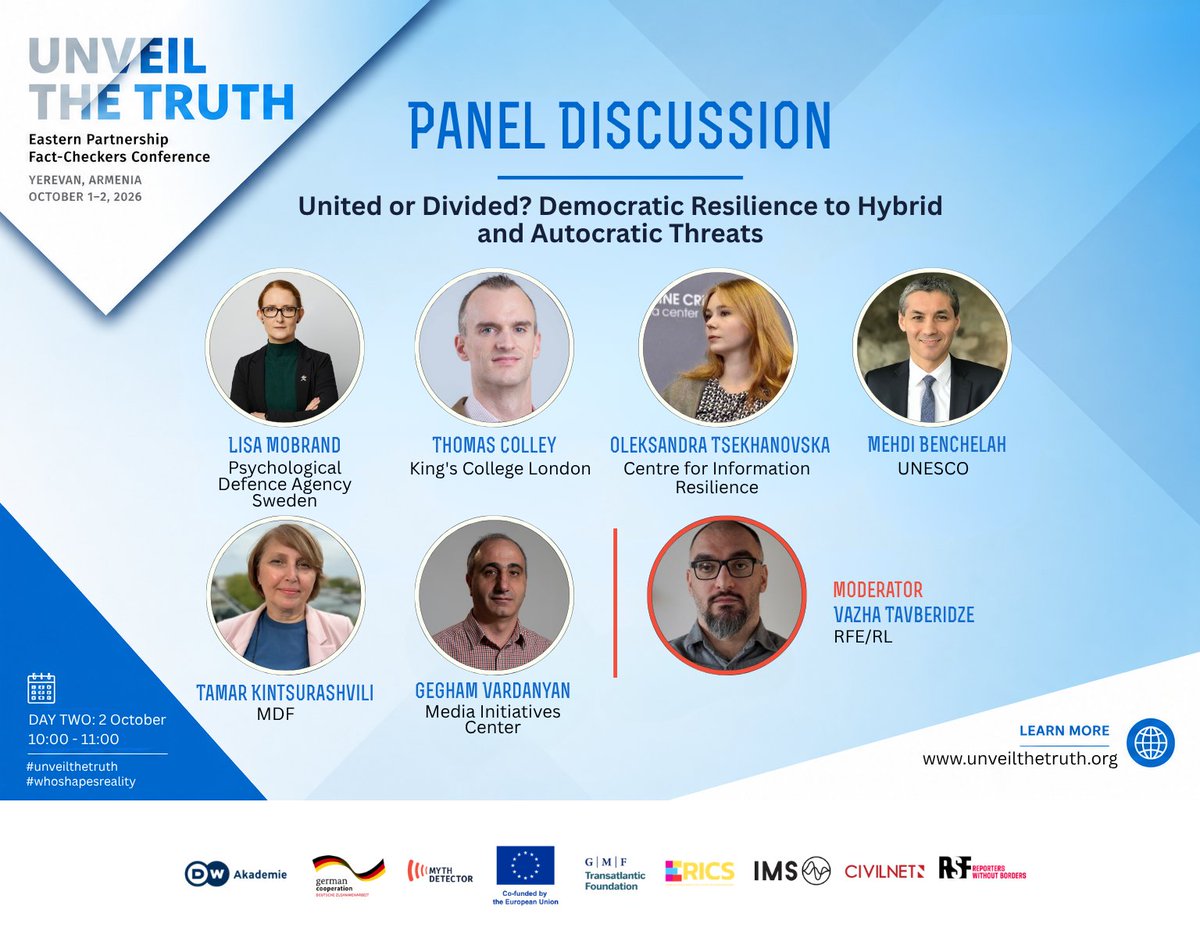
🤝 United or Divided? At #UnveilTheTruth, experts will discuss hybrid threats, psychological defence, information resilience and democratic backsliding — and how external interference and domestic pressure can reinforce each other. 🔎 https://t.co/pm6jocFZ2e
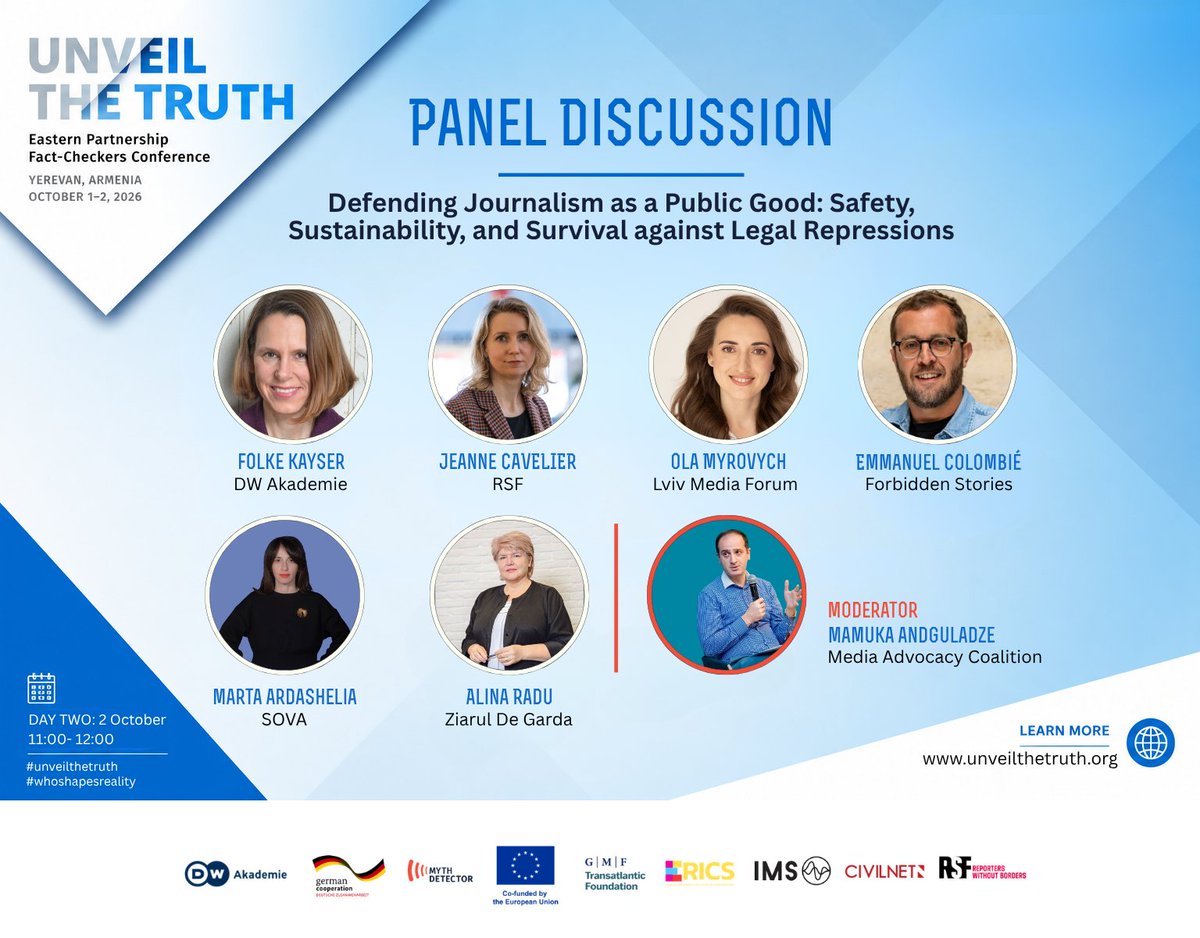
📰 Defending Journalism as a Public Good
How can independent media serve the public interest amid war, political pressure, economic uncertainty, and legal repression?
📍 Where: Yerevan, Armenia
📅 When: October 1–2, 2026
🔎 Find out more: https://t.co/DvhzpaIHn0
#UnveilTheTruth
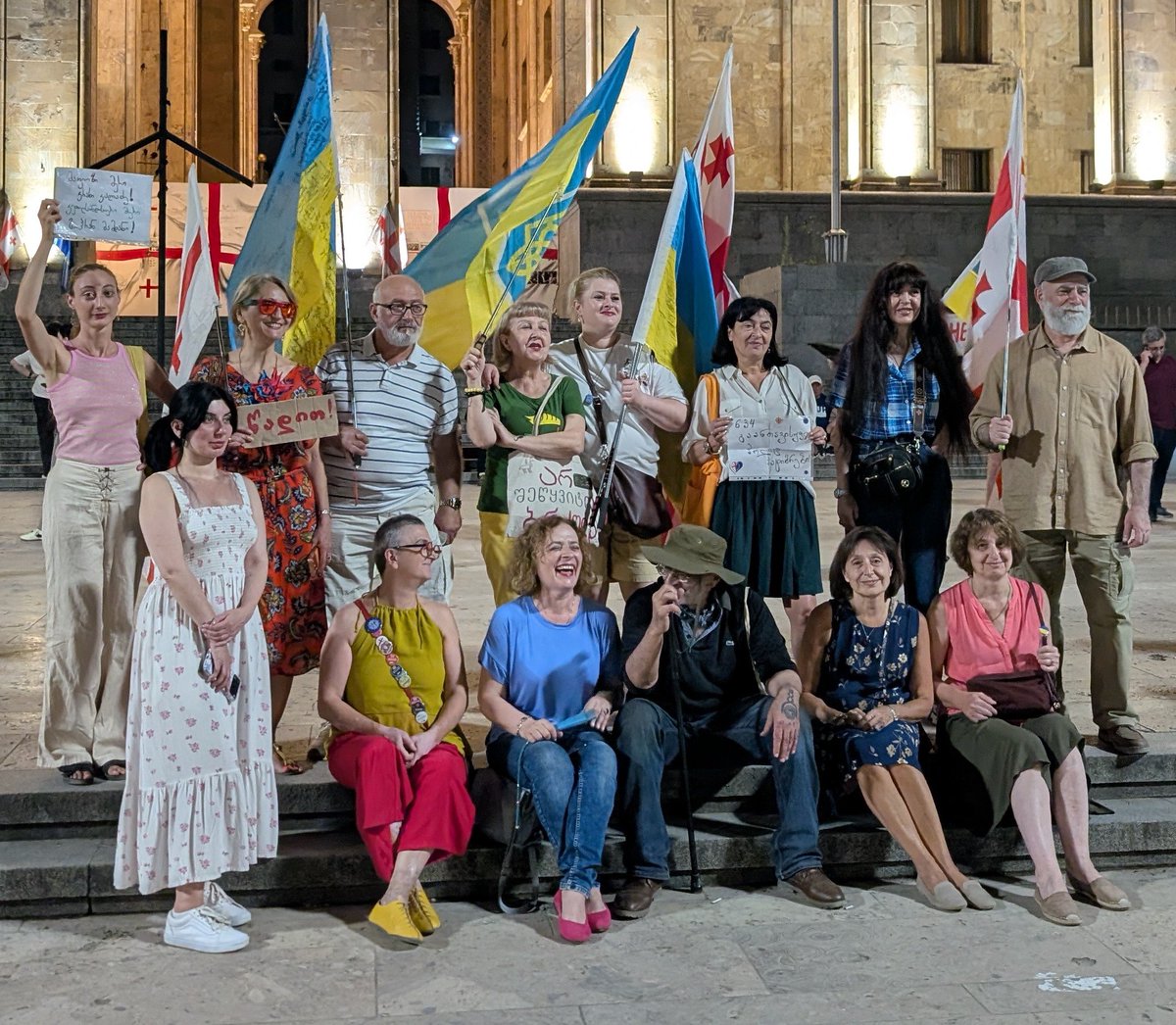
Day 634 of daily, uninterrupted protests in Georgia.
The regulars—and William, the crazy neighborhood dog who defends them against all evil, from passing cars to undercover officers unconvincingly pretending to be pedestrians.
Georgia’s Penitentiary Service has refused to allow inmates to receive The Observer, a political satire novel by popular Georgian writer Lasha Bughadze, citing the book’s title as grounds for blocking it.
The agency confirmed the decision in a letter published by women’s rights activist Baia Pataraia, who had sought to send the book to imprisoned activist and political prisoner Nana Sander. According to the Penitentiary Service, the title of the book is “ambiguous and unclear in relation to a penitentiary institution.”
Pataraia called the explanation absurd, saying the agency appeared to have blocked the book because of its title without reading the text or even its annotation.
“If they had simply leafed through it, they would have understood that The Observer refers to elections,” Pataraia wrote. “But in reality, they do not want this book in prison, and that is all.”
The decision has raised fresh concerns about censorship in Georgia’s prisons, where other books have reportedly also been blocked, including a work about Poland’s 1989 democratic revolution and anti-Soviet memoirs by a Georgian officer Ivane Nanuashvili who fought against Russia during the Soviet Russian invasion of Georgia in 1921.
The Georgian Dream government is pushing ahead with compulsory school uniforms in public schools, with Education Minister Givi Mikanadze warning that pupils and parents who refuse to comply could face disciplinary and administrative measures.
Mikanadze said uniforms will become mandatory for primary-level pupils in state schools from the 2026–2027 academic year. He argued the policy would promote equality, safety and better educational standards.
The minister said parents are responsible for ensuring that children attend school in the required uniform, as they agree to school regulations when enrolling them. “Should parents protest and refuse to dress their children in the required attire, specific measures, both educational and administrative, will be triggered,” he said.
The policy has drawn criticism from opponents who see it as another sign of Georgian Dream’s increasingly coercive approach to schools, pupils and parents.
Ex-PM Garibashvili, currently serving 5-year prison sentence after pleading guilty in money laundering case, has been charged with taking bribe, shortly after he alleged pressure to take blame in forthcoming corruption case. He faces 11-15 years in jail. https://t.co/480WE9z6LU
Former Georgian Dream MP and prominentlawyer Shalva Shavgulidze says Bidzina Ivanishvili and Georgian Dream were pursuing Russia’s agenda from the very beginning, not only after Moscow’s full-scale invasion of Ukraine.
Speaking to Netgazeti, Shavgulidze said Georgian Dream’s recent rhetoric about alleged “Russophobia” in Georgia serves Russian interests by portraying anti-occupation sentiment as hostility toward ordinary Russians.
“This is a repetition of a message coming from the Kremlin,” Shavgulidze said, arguing that the narrative both justifies Russian aggression and encourages Georgian society to blame itself for occupation.
He said Georgian public anger toward Russia is not “Russophobia,” but a legitimate anti-occupation protest rooted in Georgia’s experience of Russian imperial rule, the loss of church autocephaly under the empire, the Soviet invasion of 1921, and the wars in Abkhazia and the Tskhinvali region.
Shavgulidze claimed Ivanishvili had obligations to Russia from the outset, saying he could not have entered politics openly “under a Russian flag” and therefore used pro-Western political forces as a façade.
“Ivanishvili was on Russian tracks from the very beginning,” Shavgulidze said. “Ukraine made it impossible to hide this policy, because it became necessary to say clearly whose side you were on — Ukraine’s independence or Russia’s imperial ambitions.”
Shavgulidze, who entered parliament in 2012 as part of the Georgian Dream coalition but left the party in 2014, said he became convinced after two years that the government was not building a Western-style institutional democracy, but consolidating autocratic rule.
He said Ivanishvili gradually pushed out those unwilling to hand the country over to Russia and built control over state institutions, much of the media and sought influence over the church.
According to Shavgulidze, Georgian Dream’s “Russophobia” campaign is meant to make society accept occupation and internalize Moscow’s argument that Georgia somehow deserved Russian aggression.
🟥#Georgia’s Public Defender has presented its 2025 annual human rights report to parliament, also flagging concerns over protest-related enforcement, due process violations, prison deaths, and rising child poverty.
#GeorgiaProtests#RepressionInGeorgia
▶️https://t.co/n7IzT01oCy
“Russia has zero incentive to make peace now,” says Ukraine’s former Foreign Minister @DmytroKuleba. “As long as there are no driving forces for peace on the Russian side and for the change of attitude on the American side, Ukraine’s tweets will be falling on deaf ears.”
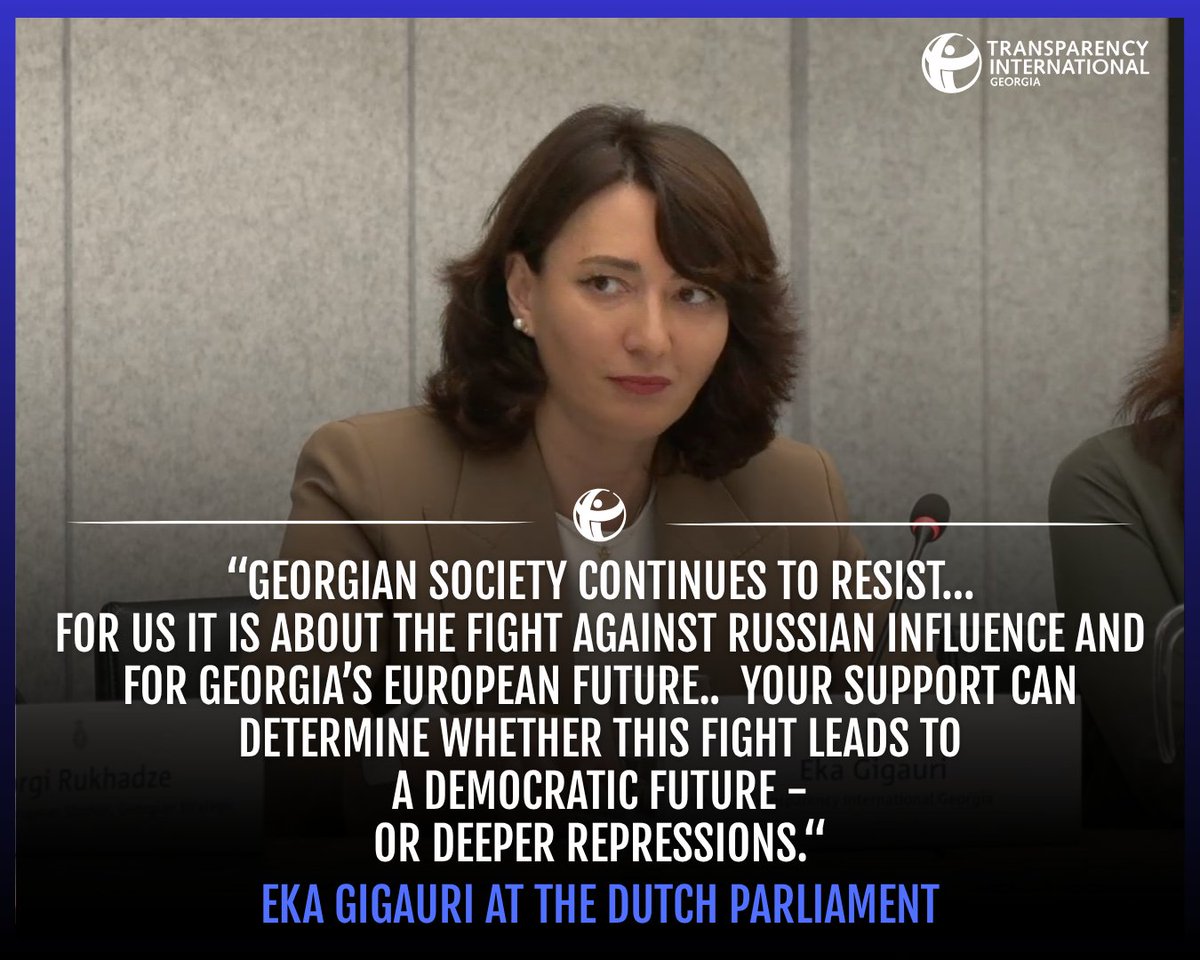
Georgia is not becoming European.
Georgia is European - through its history, its values and the will of its people. 🇬🇪
Speech by Eka Gigauri at the Dutch Parliament.
Read more below ⬇️