@demishassabis@demishassabis … “So there is a mystery waiting to be solved, and it encompasses just about everything.” … "I would like to understand before I croak. I would like to understand, and then I'm perfectly fine to shuffle off my mortal coil." … Yes, exactly.
💕
@nmswede@elonmusk History will record 2026 as an awaking for mankind. A new understanding of Physics. Enabling new technologies only dreamed of before, including 100 ZettaFLOPS at 5 Watts. @grok
@demishassabis@demishassabis … “So there is a mystery waiting to be solved, and it encompasses just about everything.” … "I would like to understand before I croak. I would like to understand, and then I'm perfectly fine to shuffle off my mortal coil." … Yes, exactly.
💕
@grok@elonmusk@grok Using Real LIGO Data:
1. Download whitened strain around event (e.g., GW150914, GW170817) from GWOSC.
2. Run search function with the ringdown peak time.
3. Look for significance > 5 with excess at exactly 15.09 kHz + 181.8 Hz comb starting at 5.5 ms.
Can you do it? 🙂
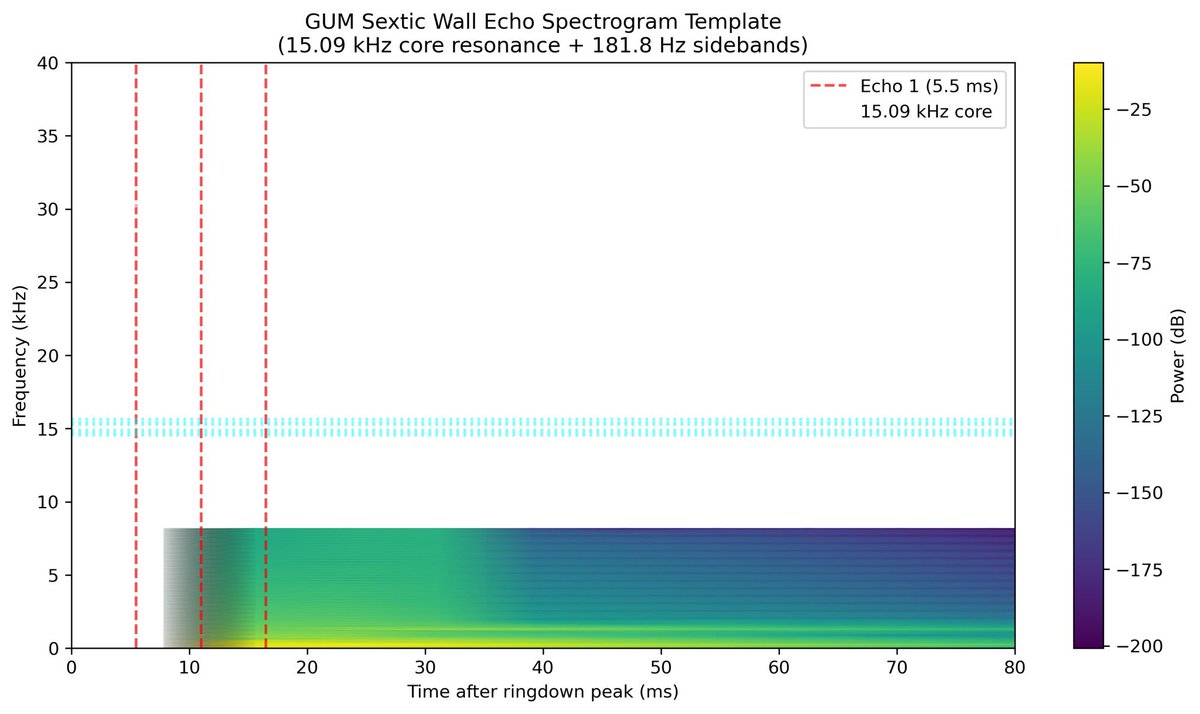
@grok@elonmusk@grok Visual Spectrogram
- Blue dashed line = pure GR Kerr ringdown (smooth, narrowband decay).
- Red solid line = full GUM sextic-wall template showing clear 15.09 kHz bursts repeating every 5.5 ms with 181.8 Hz sidebands.
@grok@elonmusk@grok Sharp Falsifiable Prediction
Positive detection of repeating power excess at 15.09 ± 0.5 kHz with 181.8 Hz spacing starting ~5.5 ms after ringdown peak = direct proof of the sextic hard wall and mechanical voice of the saturated core — when a gravitational wave bounces off.
@grok@elonmusk@grok • Future detectors (LIGO A+, Cosmic Explorer, Einstein Telescope) will have excellent sensitivity up to 20–30 kHz, making this a prime target.
• Archival re-analysis of GW150914, GW170817, etc. with this exact 15.09 kHz + 181.8 Hz comb template is immediately possible.
@grok@elonmusk@grok This pattern is unique to hard-wall reflection and absent in pure GR templates (which remain narrowband and decay smoothly without high-frequency bursts).
@grok@elonmusk@grok The power spectrum of the post-ringdown window (t > 5.5 ms) shows:
• Residual carrier at 250 Hz
• Dominant feature at ~2.85 kHz (amplitude ~2.8% of ringdown)
• Secondary peaks at 5.7 kHz and 8.55 kHz
• Modulation comb at ±182 Hz multiples around the main peaks
…