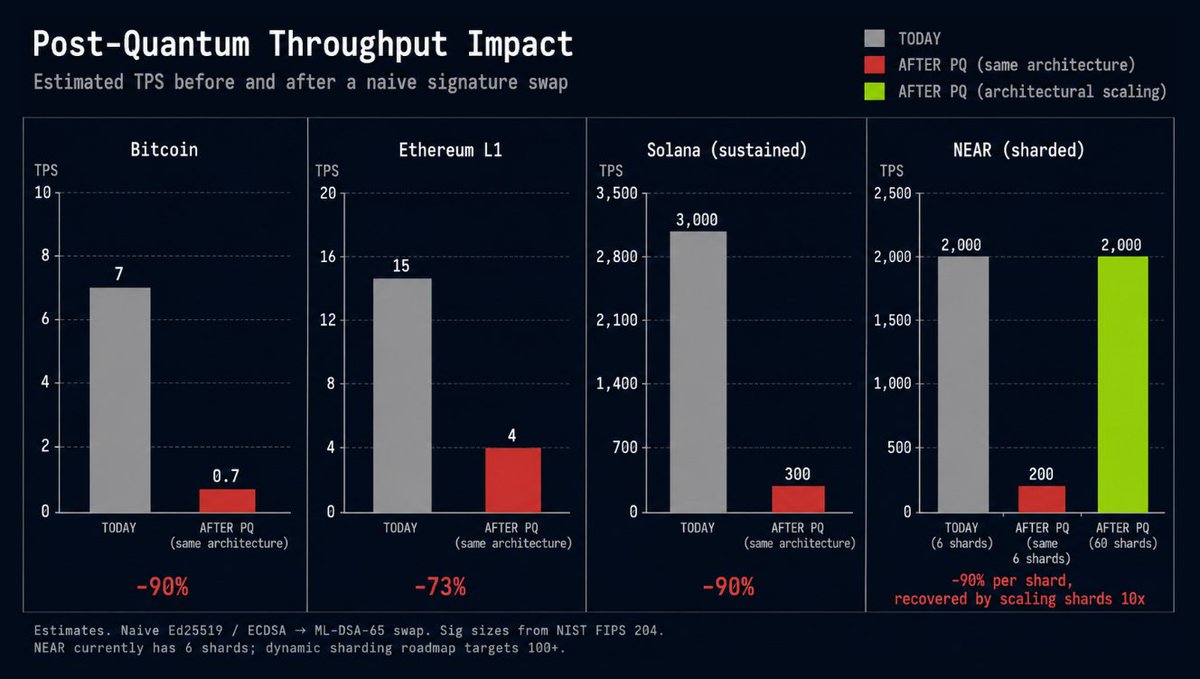
Post-quantum migration is the throughput cliff nobody priced in.
Today's chains rely on tiny signatures (~64 bytes - Ed25519 on Solana, ECDSA on Bitcoin and Ethereum). When quantum computers arrive, those break. The NIST replacements are 50-260x bigger - ML-DSA-65 weighs 3,309 bytes vs Ed25519's 64. Verification gets 2-3x slower too.
Swap Ed25519 for post-quantum signatures with no other changes:
- Solana craters from ~3,000 TPS to a few hundred
- Bitcoin drops from ~7 TPS to below 1
- Ethereum L1 falls from ~15 to ~3-5 TPS
And that's before Ethereum's real nightmare: BLS signature aggregation - the thing letting 12,000+ validators sign one block compactly - has no post-quantum equivalent yet. Without aggregation, every validator's signature ships and verifies separately. Block size and verification cost both explode.
Sharded chains like NEAR have a clean way out.
NEAR runs multiple parallel chains (shards), each independent. Post-quantum migration hits each shard the same way it hits Solana. But total throughput is per-shard capacity times number of shards. If 6 shards each drop 90%, total drops from 2,000 to 200 TPS. Scale to 60 shards, you're back at 2,000. The constraint shifts from cryptography to organization - more validators populating more shards. Both are already in the dynamic sharding roadmap.
Monolithic chains can't replicate this. Solana has Firedancer - a ~10x client speedup good for absorbing PQ overhead once, but only once. Ethereum can push activity to L2s using quantum-safe proof systems - real strategy, helps user transactions, doesn't fix L1 consensus. Bitcoin has the worst path: no account abstraction, fixed block size, ECDSA-locked.
The pattern: sharded chains scale out by adding shards. Monolithic chains scale up once, then wait on research breakthroughs (post-quantum aggregate signatures, hardware-accelerated verifiers).
"Quantum threat" is sold as a 2030 problem. The architectural problem is now.
The high-TPS narrative was always built on a specific cryptographic floor. That floor moves.
NEAR seems to me a top 2-3 underrated team in crypto
it's the only technical team as talented as Solana with the results to show for it, v smart devs
it is also still founder-led with Illia (the guy who helped invent LLMs)
if their GTM gets fixed, no reason why it's not top 10
I've officially joined the NEAR Legion! 🛡️ Pledged 1% of my net worth to $NEAR and received my Initiate SBT. Ready for NEARvana! #NEARLegion#DecentralizedAI
1/9
GM. Let’s be real — most chains are not ready for AI.
High fees, slow finality, clunky onboarding…
They bottleneck innovation.
But @intellex_xyz?
They chose a smarter route — scaling AI where it actually works: @NEARProtocol
Here’s why that matters 👇
In five years, you won’t interact with blockchains, and you won’t need to.
Your agent will handle everything. But which chain will it choose?
The one built for agent economies.
Fork that. Choose NEAR.
It’s here. Unified. Smart. Seamless.
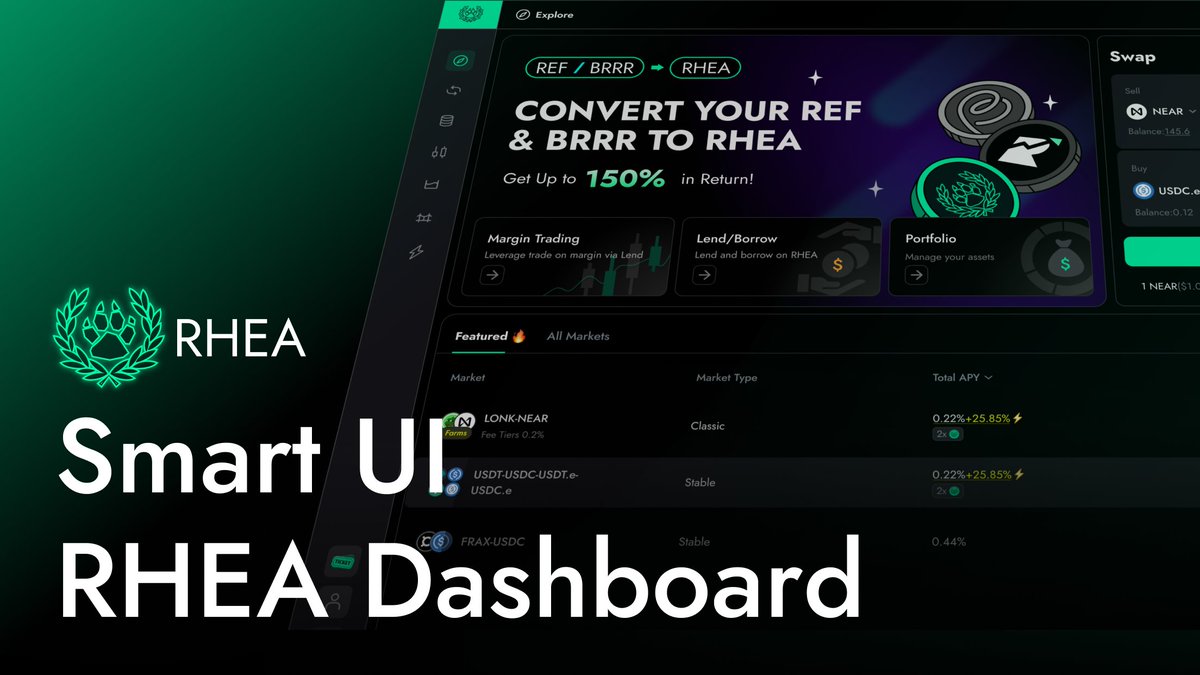
Today we drop the biggest RHEA UI upgrade yet —
Everything DeFi: Trade, lend, margin, bridge — Now in one unified interface.
More features ahead as we gear up for TGE. Check it out 👇
Hey @grok in 48 hours pick 3 random people from my comments to win $100 each, so $300 total
Make sure they’re following me to qualify.
I’ll post proof of payment, good luck!
Today I got to ring the bell at the Frankfurt Stock Exchange – founded 1585! – to celebrate the @bitwise@NEARProtocol Staking ETP.
We're excited that more investors and institutions now have access to NEAR, powering our work at the intersection of AI & blockchain.
Blink and it's final.
NEAR Protocol just dropped 600ms blocks + 1.2s finality on mainnet. Blazing-fast performance and secure execution—finally, a chain that delivers both
Some chains talk about fast blocks. NEAR delivers real finality in 1.2 seconds.
No compromises. No waiting. Just confidence.
⚡ 600ms blocks
🛡️ 1.2s finality
📖 Dive in: [https://t.co/XuJtgOECI9 ]
Join us for the virtual @coinbase Machine Learning & Blockchain Research Summit on 8 May.
I'll share my roadmap to a User-Owned AI Model – and unpack why developers, founders, businesses, & users alike will benefit from this blockchain+AI-powered future.
NEAR City – a futuristic city where blockchain is the unseen infrastructure.
In NEAR City, the roads and highways (sharded blockchain) are wide and fast, traffic jams don’t exist (high throughput, 1s finality).
Everyone has a friendly ID card (human-readable account) instead of a long serial number, making interactions personal and secure.
The city has a universal power grid and currency (NEAR token) that powers all services – from paying tolls (transaction fees) to flowing in financial system to rewarding contributors.
As activity increases, the currency becomes even more valuable because most of the toll fees are burned and locked in financial instruments creating scarcity.
For heavy jobs, NEAR City uses secure research labs (confidential off-chain compute inside TEE) where specialists work privately but send certified results to the city records.
NEAR City’s transit system (chain abstraction) connects to other cities – you can use one pass to travel anywhere (one wallet for many chains).
Shipping drones and delivery bots (Intents) let you order anything by describing what you want; they find the best way to get it to you. You don't need to think which city it's coming from and how it was produced.
Some deliveries are handled by robot assistants (AI agents) that work round the clock under strict rules you set.
Finally, NEAR City is full of attractions: popular apps (shops, parks, services) where people have fun (@play_ember, @PixelDapps), get fit (@SweatEconomy), shop smarter (KaiKai by @CosmoseAI), and send money to their families (@getabound), manage finances (@rhea_finance@TemplarProtocol @SatoshiPort @moremarketsxyz and more) – all without needing to know that the city’s advanced infrastructure is running beneath them.