Whitelist is now OPEN.
Tiva is building a deterministic execution layer for on-chain assets.
No slippage.
No counterparty risk.
No uncertainty.
Apply now to get early access ↓
https://t.co/tCo5lsJp0j
Limited spots. Selected users only.
Six milestones across governance, infrastructure, and developer tooling in May.
Featured App locking introduced, 166 new validators approved, unified developer documentation launched, and the first Builder Office Hours completed.
↓ What moved in the ecosystem last month.
Featured App status on Canton routes 62% of all Canton Coin rewards, approximately 516 million CC monthly, to applications based on the real network activity they generate.
Rewards scale with utility, not infrastructure position.
@CantonFdn on how builders earn on Canton.
There are only two types of trading systems in existence:
1️⃣ Probabilistic
2️⃣ Deterministic
Let’s look at the reality of crypto today. Most of DeFi runs on probabilistic models (AMMs & orderbooks). When you click confirm, you are entering a game of chance:
You hope the slippage doesn't kill your margin.
You pray you won't get front-run by MEV bots.
You pay gas fees even if the transaction ends in failed execution.
You’re not trading. You’re guessing.
Tiva introduces the shift to Deterministic Trading on the Canton Network.
We didn't just tweak the existing curve; we removed the uncertainty entirely. With Tiva, everything changes:
Price is fixed BEFORE execution: What you sign is exactly what you get.
Atomic settlement: The agreement and the finality happen in the exact same block.
No counterparty risk: Delivery-versus-payment (DvP) is hardcoded at the protocol level.
Trade = Settlement.
This isn't an incremental feature upgrade. This is what institutional finance should—and must—look like on-chain. Welcome to the Tiva era.
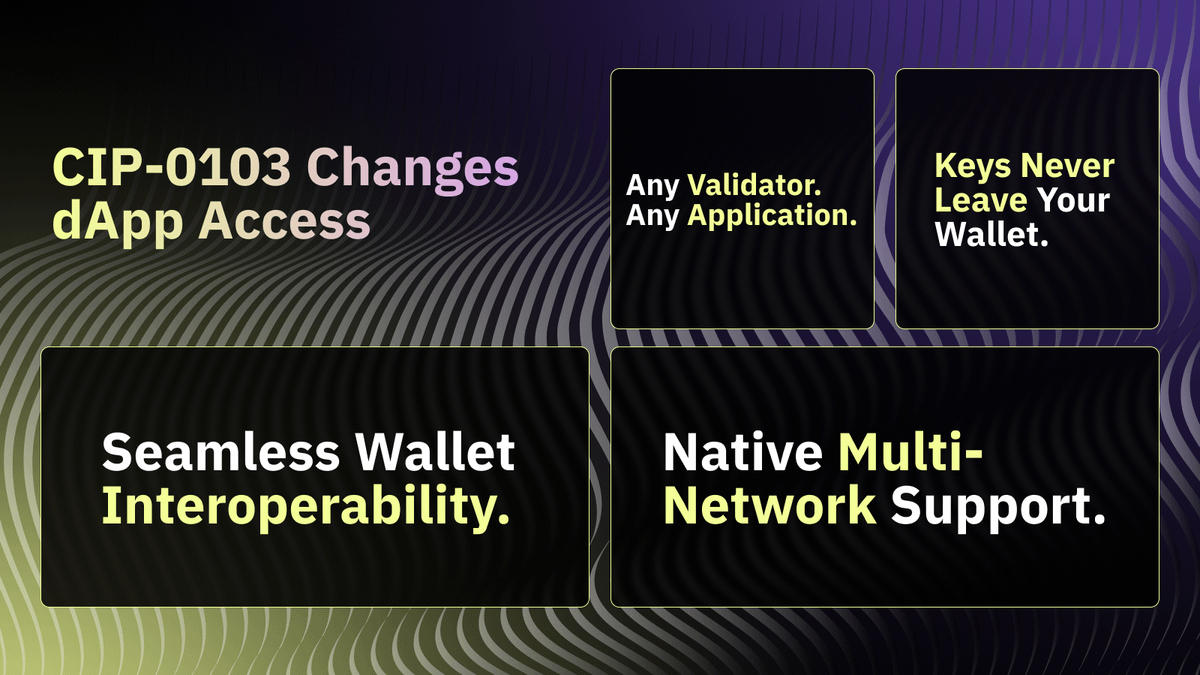
CIP-0103 introduced a vendor-neutral dApp API standard for the @CantonNetwork.
What it does: decouples network connectivity and key management from decentralized applications. Developers build against a standardized set of primitives for ledger reads, writes, and message signing.
What that means in practice:
◽ Users can access any Canton application with a validator and signing provider of their choice.
◽ Private keys stay within the signing provider.
◽ dApps and wallets interoperate through a portable, secure interface.
◽ Multi-network support built in.
Approved January 29, 2026.
Today, we're releasing a major update to our developer documentation.
This new, unified release reflects a commitment to making @CantonNetwork more accessible to developers at every level, making onboarding clearer, guides easier to follow, and building on Canton more streamlined.
Learn how to:
→ Build Canton Network applications
→ Operate the Participant Node
→ Set up and operate your own Synchronizer
→ Integrate a wallet or exchange
→ Deploy and operate the USDC xReserve solution
Explore the full unified documentation today using the link below.
Canton's token standard gives issuers control over who can transfer assets, receivers control over what they accept, and privacy enforced at the protocol level.
CIP-56 is live in production across institutional workflows including onchain U.S. Treasury financing via repo apps.
Transparency + Accountability = Network Resilience.
At Tiva, we appreciate the structured approach the Canton Foundation takes toward protocol development and tokenomics. This clarity allows us to focus on building the deterministic OTC layer with full confidence that the underlying infrastructure and economic incentives are governed by rigorous standards.
Great to see the enforcement layer ensuring all milestones are met!
Three committees govern the Canton Foundation:
Tech & Operations: Protocol standards, network upgrades, developer tooling, and the Protocol Development Fund. Responsible for evaluating and funding contributions to Canton's core infrastructure.
Tokenomics: Canton Coin economics, emissions parameters, app reward structures, SV weight allocations, and validator onboarding. Every change to how value flows through the network passes through this committee.
Accountability: Milestone verification, SV compliance, and reward escrow oversight. The enforcement layer ensuring governance commitments are met.
Each committee has defined responsibilities, membership criteria, and reporting obligations.
LATEST: 💰 Canton Network developer Digital Asset Holdings is raising roughly $300 million at a $2 billion valuation, led by a16z crypto, according to Bloomberg.
What if trading was deterministic? 🎯
In the current DeFi landscape, we’ve been conditioned to accept "maybe" as a standard. You trade, you wait, you hope for the best, and you pray the slippage doesn’t eat your margin.
But for institutional finance, "hope" is not a strategy.
Tiva introduces a radical shift: Trade = Settlement. We didn’t try to optimize the AMM. We removed it entirely. Why? Because liquidity pools and price curves are the source of uncertainty. They introduce slippage, MEV exposure, and failed executions.
On Tiva, we use OTC as the default. It’s a simple, powerful equation:
1️⃣ Buyer ↔ Seller agree on a price.
2️⃣ Atomic execution triggers instantly.
3️⃣ Trade = Done.
There is nothing to “slip” because the price is locked before the execution ever starts. We aren't building a faster DEX; we are building a deterministic execution system on @CantonNetwork where the outcome is predefined.
If it’s not certain, it’s not institutional. Welcome to the Tiva era. 🏛️⛓️
Protocol-level automation is the ultimate unlock for developers. 🛠️
CIP-0104 replaces manual marking with direct, on-chain traffic measurement via Sequencers and Mediators. For Tiva, this means our rewards are now perfectly aligned with the actual deterministic value we execute on @CantonNetwork.
No more manual overhead—just pure, proportional alignment between network utility and rewards. This is how you build a scalable economic engine. 📈🎯
CIP-0104 changed how Featured App rewards are calculated on @CantonNetwork.
Previously, rewards required manually created activity markers. Now they are based on actual traffic spent on the Global Synchronizer, measured directly through sequencer and mediator data.
What this means for builders:
🔸No more manually creating Featured App Activity Markers
🔸Rewards proportional to real on-chain activity your app generates
🔸Measurement happens automatically at the protocol level
The economic model now directly ties app rewards to the value an application creates for the
network.
Imagine trading stocks like this:
• The price moves while you’re executing.
• Your settlement is "probabilistic," not guaranteed.
• You pay a fee even if the trade fails.
That market wouldn’t just be broken—it wouldn’t exist.
Yet, for years, DeFi has called this "innovation." We call it uncertainty.
Tiva is here to bridge that gap. We’re bringing the certainty of traditional finance to the speed of the @CantonNetwork.
From guessing to knowing. From "let's see" to "it's done."
Tiva: Deterministic execution for the next era of finance. 🏛️🎯
Skin in the game is the ultimate filter for network resilience. CIP-0105 ensures that governance weight isn't just about stake, but about long-term commitment.
At Tiva, we believe deterministic execution requires a deterministic and aligned validator set. This framework turns "alignment" into a measurable, on-chain reality. 🏛️🔒
CIP-0105 introduced a long-term locking framework for Super Validators.
SVs can lock a portion of their lifetime earned rewards to maintain forward SV Weight. The framework creates visible, on-chain commitment to the network.
Key details:
🔸Participation is voluntary
🔸Applies to aggregate lifetime earnings, including historical rewards
🔸No exemptions for the Foundation, ecosystem funds, or any other entities
🔸Uniform application across all participants
The design ties network influence to long-term alignment. SVs that commit more, carry more weight in governance.
Most people don’t realize this:
On-chain trading is fundamentally broken.
You don’t know:
• final price
• execution success
• actual outcome
You just sign and hope.
This is not how financial systems should work.
We accepted this because “it’s DeFi”.
But it’s not inevitable.
There is another way:
deterministic execution.
Tiva Validator is now LIVE on the Canton Network Mainnet! 🌐
This marks a major milestone in our journey. Beyond providing a deterministic execution layer, Tiva is now actively securing the @CantonNetwork as a validator.
We aren't just building the infrastructure for certain finance; we are powering the network that makes it possible.
Institutional-grade execution starts with a robust foundation. 🏛️⛓️
Every application on Canton runs its own infrastructure, its own privacy rules, and its own governance, with no shared validator pool and no global mempool exposing data to parties who have no business seeing it.
The Global Synchronizer connects all of them, so transactions across independent applications settle atomically in one indivisible action, with each party seeing only what they need to see.
This is what a network of networks actually means in practice.
DeFi "innovation" often moves faster than its security foundations.
When a bridge fails, the contagion spreads to the most robust protocols like @aave. It’s time for the industry to prioritize Execution Certainty over speculative speed. The infrastructure must be as certain as the assets themselves. 🏛️
The rsETH markets on Aave V3 and Aave V4 have been frozen. Aave's contracts have not been exploited and this is an exploit related to rsETH.
The freeze follows an exploit of the Kelp DAO rsETH bridge. Freezing the rsETH markets prevents new deposits and borrowing against rsETH collateral while the situation is assessed.
We are reviewing information about rsETH borrows on Aave that occurred after the exploit and will share more details as soon as possible.
If the protocol accumulates bad debt from this incident, we'll explore paths to offset the deficit.
The industry solved ownership. Now, we're solving execution.
As @CantonNetwork rightly puts it, assets must work with certainty. Tiva is the engine making that "certainty" a default setting for every institutional transaction.