“Change begins with me”.
As change leaders, we can feel a lack of power or agency when the situation we’re trying to change feels immovable. A new book by @Caroline_Webb_, “Leadership Intelligence” sets out multiple actions we can take to make a difference. We don’t need to rely on (or wait for) other people or other things to change. The change can come from within us, by thinking & acting differently. She shows us how the part we can control is bigger than it often feels.
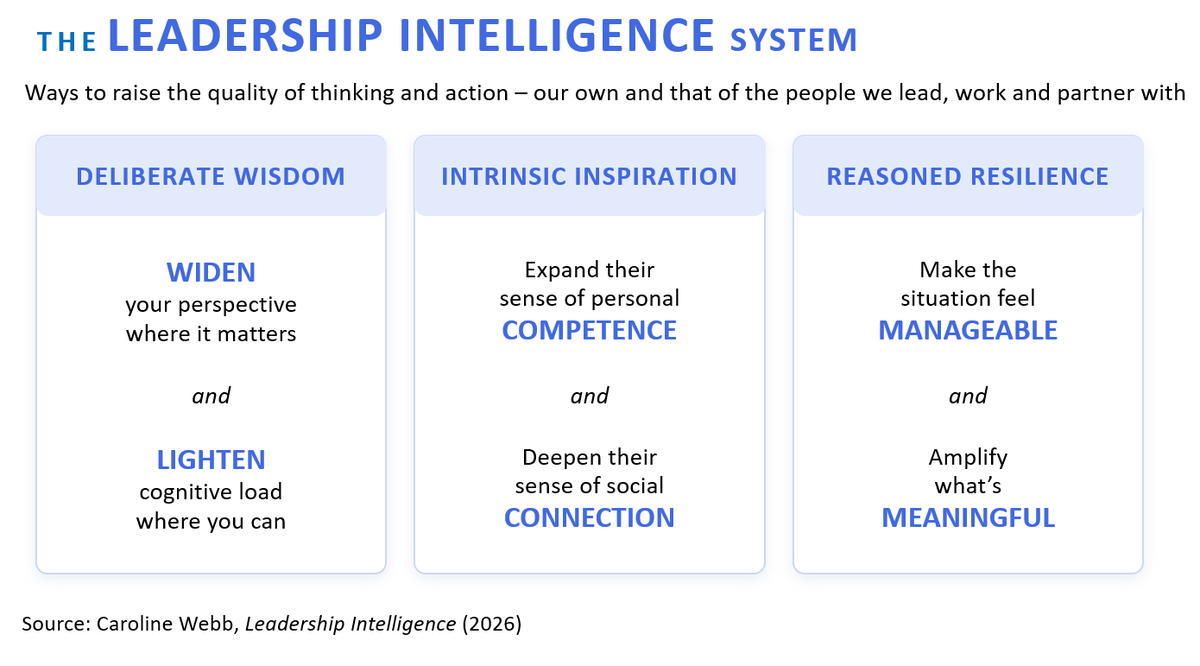
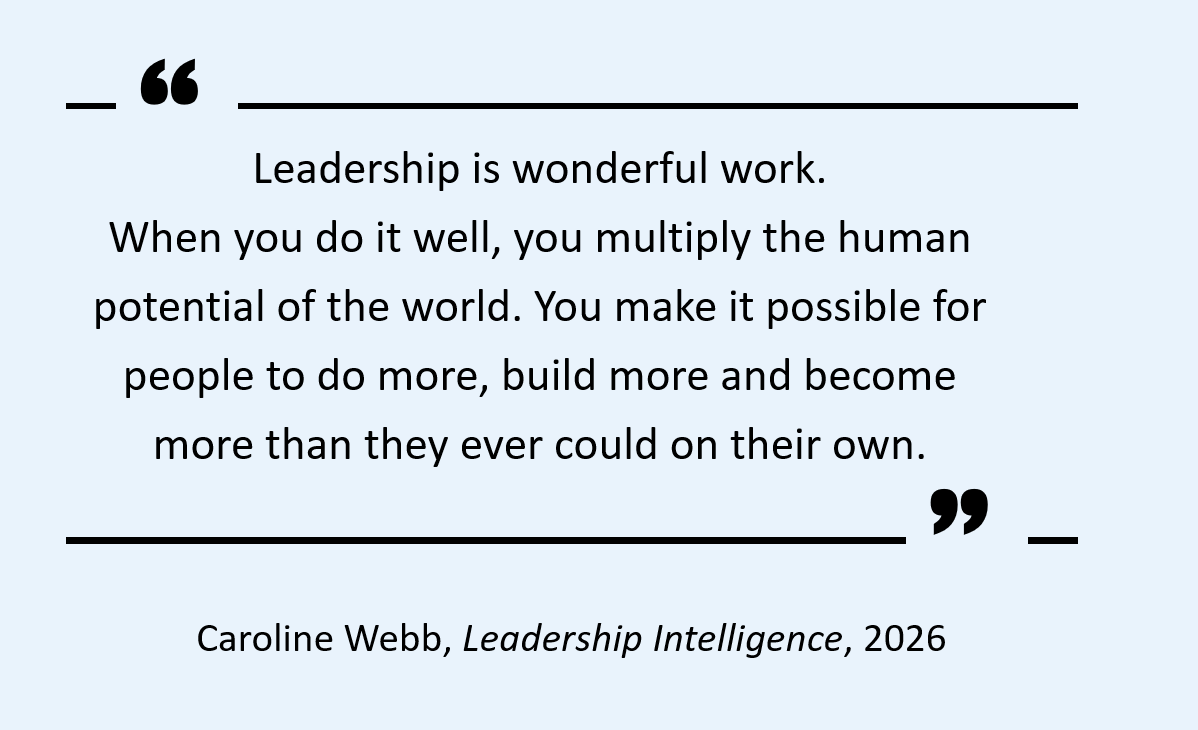
To define “Leadership intelligence”: a combination of wisdom (widening perspectives & easing mental load), inspiration (helping people expand their sense of personal competence & build social connection) & resilience (making situations feel manageable & amplifying what’s meaningful). Caroline Webb says “leadership is about enabling a group of people to achieve more together than they could on their own." So the intelligence in question is relational, not individual cleverness, the kind of thinking & practice needed in an era of AI.
The book has 21 chapters. Each sets out a challenge leaders face daily, a role model who faced it, then advice in the form of a tool or framework. It’s all evidence based, grounded in psychology, neuroscience & behavioural economics. I’ll go back to many of the tools when I’m in a specific situation. Here are four of the frameworks I’ll build into my change practice now:
- The ACORN approach (aim, criteria, options, rating, next steps): helps us make better decisions by giving us a way to organise & progress our thinking.
- The “four frequencies of effective communication”, needed for a message to truly land. It covers frequencies at the level of personal (“I’m appreciated & respected”), team (“reminds me we’re doing something useful together”), leader (“shows my leader is a fellow human being”) & message (“makes me feel I’ve understood”).
- The “bridge model” for improving a difficult stakeholder relationship. Understand the towers (their concerns & your reaction), build the connections (cables) & meet in the middle on the deck.
- The “know-be-do” framework of certainties for leading in times of upheaval: things we know (facts, timings, priorities, feelings); things we continue to be (strengths, values, experience, routines) & things we choose to do (attitudes to adopt, scenario planning, no-regrets moves, next steps).
The book quotes Jacinda Ardern: “While we cannot change everything about the environment we are in, we can change ourselves – to build greater strength & resilience, in spite of the headwinds around us”. I’ve spent decades on change efforts where the system often felt impenetrable. My own sense of agency lived in what happened between me & the people I worked with. The questions we asked, the thinking we made room for, how easy we made the new ways of working, the steadiness we held when things got tough. Caroline Webb has given us the science & multiple practical tools for all four.
The book "Leadership Intelligence": https://t.co/SKnGgHX6hE
See also:
"5 Science-Backed Ways to Become a Better Leader" from the @NextBigIdeaClub: https://t.co/VT25dwSjV5
"How to Lead When You Don’t Know What Comes Next" with Jessi Hempel: https://t.co/HeKm8VSURq
There are some great reader's resources on the Caroline Webb website, including downloadable guides for reading paths, an AI guide and a guide for groups that want to discuss the book together: https://t.co/BYVXLhZfey
I'm thrilled to announce that I'm leading a webinar "In conversation with Caroline Webb" on Friday 16 October, 1600-1700 BST. We will discuss the implications and opportunities of "leadership intelligence" for leaders in health and care. It will be hosted by our friends at @Aqua_NHS. I will advertise it on X. All welcome. Hold the date!
I’m not an AI doomer, but my firsthand experience dating back to 2020 is that the researchers expressing concerns are sincere.
The closer they are to the research, the more worried they seem to be.
Platforms change. Principles don't. @tnvora captures the three C's for leading and learning on social media beautifully and in an age of AI generated content, authenticity and generosity matter more than ever.
https://t.co/E62OXuecbx
You can get 95% of the results you want by calmly putting one foot in front of the other. One former Navy SEAL friend texted me a principle used in their training: “Slow is smooth. Smooth is fast.”
Marcus Aurelius wrote this over 1800 years ago:
“It never ceases to amaze me: we all love ourselves more than other people, but care more about their opinion than our own.”
How do you build "change readiness" in your implementation work?
We love this infographic from @tnvora on getting employee buy-in for organizational change.
Learn more: https://t.co/MLtv3ggjqn
Amy Edmondson's 2x2 matrix maps two conditions.. Psychological safety and Performance standards - two closely interdependent forces that shape how effective teams perform by @tnvora
https://t.co/VLxIv9ZL4V
“In my whole life I've never been good at something I wasn't very interested in. It just doesn't work. There's no substitute for strong interest.”
— Charlie Munger