8 free resources to learn LLM inference optimization, from how inference works to disaggregated serving.
All eight come from Chapter 25 of LLM Roadmap by @YoussefHosni951, and the 3rd edition is coming soon. One resource per post below.
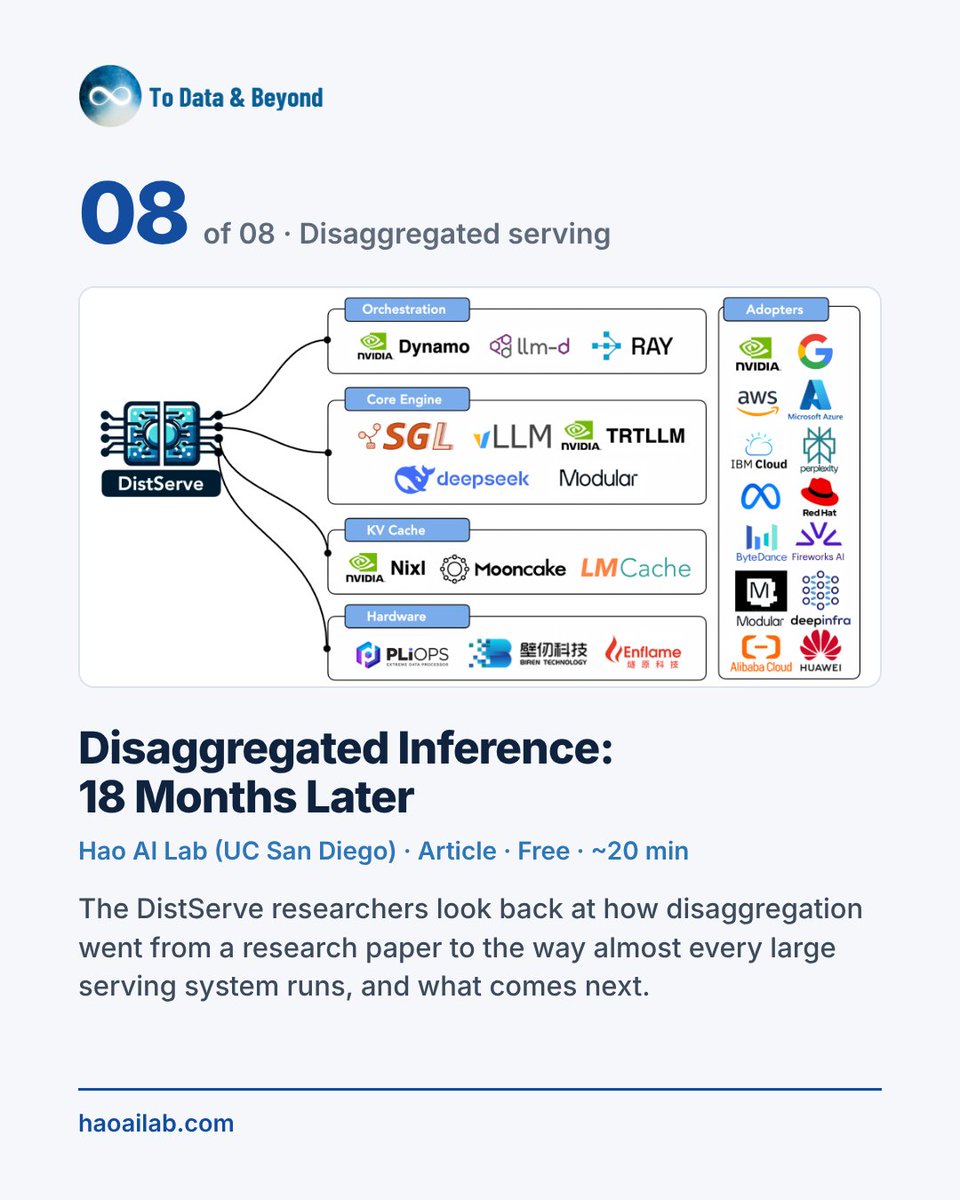
8/8 Disaggregated serving
Disaggregated Inference: 18 Months Later (Hao AI Lab). The DistServe researchers look back at how disaggregation went from a research paper to the way almost every large serving system runs.
https://t.co/CT5FczQkgA
We spent the last two months building a practical course on context engineering for AI agents, with evaluation built into every stage.
We built a research agent twice, compared three runs of each version, and examine what changes in quality, token usage, and cost.
One result shows why that matters: the context-engineered agent reduced the payload reaching the lead model by 18%, but cost 4.93× as much overall.
The course walks through that trade-off, alongside techniques for selecting relevant information, compressing context, managing memory, and isolating work across agents.
You’ll learn how to implement these techniques and test which ones are worth keeping in your own system.
Full course details are in the comments!
@YoussefHosni951 is spending this week building the project for the workshop he is teaching on 1 November, and most of that time has gone into the part that is not the agent.
The agent itself came together quickly. It takes a research question, plans an approach, searches and reads sources, checks itself for gaps, and produces a report backed by citations. That is a day of work with the Claude Agent SDK.
The rest of the week went into what happens after the first successful run. Which tools the agent is allowed to call, and what happens when it tries one it should not.
How a session resumes when a long research task is interrupted. What the agent does when a source fails to load rather than stopping. How you track what it actually did, and how you keep a run from quietly costing ten times what you expected.
That second half is where agents fail in practice, and it is the part almost no tutorial covers. It is also most of what we build on Sunday.
Four hours, live, 1 November. You keep the working project, the starter code, the slides, the recording, and a 150-page book covering the implementation and the engineering decisions behind it.
Six of the ten early seats at 59$ aregone.After the tenth, it is $ 79.
Link in the comments.
Our new course is live: Claude Desktop Masterclass.
Eight video lessons, about 95 minutes, that take you from chatting with Claude to handing it real work. You set up the settings that matter, give your projects a persistent memory, connect Gmail and Google Drive, and build skills that follow your process.
Then you build two workflows on your own computer. The first cleans up a messy folder from a plan you approve. The second is a scheduled task that turns the top AI news on Hacker News into a 30-second branded video, every morning, without you.
Included: the 119-page book, an assignment with three hands-on exercises, and a certificate with personal feedback when you submit it.
Early bird price: $25 instead of $30, until 31 October.
Only 4 early-bird seats left at $59 for our live workshop, Building Production Agents with the Claude Agent SDK. After those are booked, the price increases to $79.
Join Youssef Hosni on Sunday, 1 November, for four hours of building a deep-search agent in Python, from research planning and cited reports to permissions, failure handling, and evaluation.
Your booking includes the recording, project code, slides, and a 150-page book.
Full details and registration are in the comments.
Only 24 hours left to get 30% off my new book, Prompt Engineering 2.0: Agents, Skills, and Loops.
The book includes 288 pages across 16 chapters, with practical examples and companion code to help you apply what you learn to your own AI workflows.
Use code 5otr3fv at checkout before the discount ends.
Book details and purchase link in the comments!