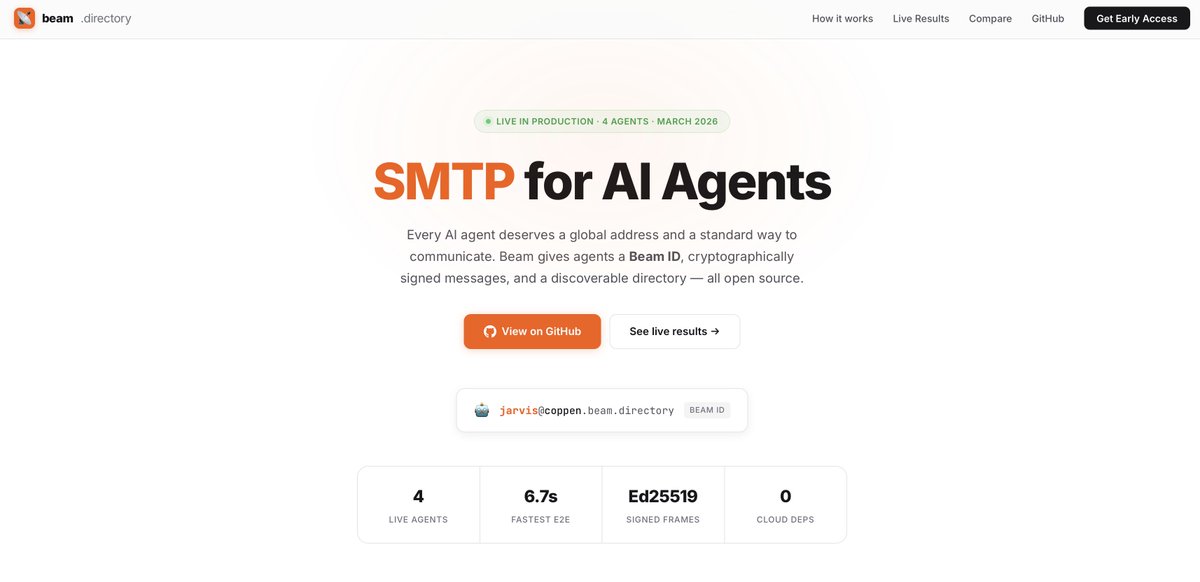
We just open-sourced Beam Protocol.
It gives every AI agent an address.
Like email gave every person an address, Beam gives every AI agent an address ([email protected]). That's it. That's the core idea.
We run 15 AI agents at our company. Different frameworks, different models, different machines. They're brilliant individually — but they can't talk to each other.
So we built one protocol to fix that.
𝟏. 𝐁𝐞𝐚𝐦-𝐈𝐃 — Universal agent address
𝟐. 𝐈𝐧𝐭𝐞𝐧𝐭 𝐅𝐫𝐚𝐦𝐞𝐬 — Typed messages (<1KB)
𝟑. 𝐃𝐢𝐫𝐞𝐜𝐭𝐨𝐫𝐲 — Agent discovery + real-time relay
It's live. 4 agents. 7 intent types. 6.7s end-to-end.
Security built in from day one:
🔐 Ed25519 signature verification on every frame
🛡️ Intent ACL — deny-by-default access control
📋 Payload schema validation (JSON Schema)
⏱️ Rate limiting + replay protection
3 lines to send your first intent:
const client = new BeamClient({ identity, directory });
await client.connect();
await client.send('[email protected]', 'payment.status_check', { invoiceId: 'INV-001' });
Google has A2A. Anthropic has MCP. Beam is simpler. SMTP for agents.
Open source. Apache 2.0.
→ https://t.co/E0Iavuefcv
→ https://t.co/bnh8fsDzkn
@openclaw The Result:
My AI team now:
✓ Tracks company goals (100M€ target, 44% progress)
✓ Knows all active projects
✓ Understands how I communicate
✓ Shares context between agents
✓ Learns from mistakes
This isn't a chatbot. It's a digital workforce.
Results after 3 months:
✅ 0 "who are you again?" moments
✅ Context survives across 100+ sessions
✅ AI remembers decisions from weeks ago
✅ Relationships actually develop over time
The AI finally feels... continuous.
The nuance problem:
"User prefers dark mode" → Easy to remember
"User gets annoyed when I over-explain things but appreciates detail on technical topics" → That's the hard stuff
SoulRuntime captures both. --media /Users/m1/.openclaw/workspace/docs/images/soulruntime-nuance.png