Welcome to my little corner of the internet on X. 👋
I am a Catholic 46-year-old woman who chose to return to school in my 40s. I am a quintuple major studying Classics (with a focus in Latin), Catholic Studies, Civic and Economic Thought and Leadership, Counseling and Applied Psychological Sciences, and Art Therapy. My goal is to become a Catholic trauma therapist and clinical psychologist. I plan to apply to a dual master’s program in theology and counseling and eventually hope to obtain PhDs in moral theology and clinical psychology.
You’ll generally find me reading, writing, studying, or antiquing and thrifting, and I almost always have some sort of tea in my hand.
I am an artist, small business owner, writer (mainly poetry, lyrics, and short stories), singer, herbalist, devoted Catholic, and I share about all of the above.
Just a warning: I ignore DMs, immediately block perverts, weirdos, and bots, and I don’t waste my time arguing with people who get upset on the internet
I’ve been seriously looking at Notre Dame. There are a few extremely competitive graduate programs that I would absolutely love to get into. It would mean becoming really proficient in both Latin and ancient Greek, which is no small undertaking, but I think I’m up for the challenge. And if I were accepted, I’d be moving to Indiana! It’s an exciting possibility, and I have no idea where it will lead, but I’m willing to put in the work and see what happens.
I genuinely cannot imagine being so intellectually lazy and simple-minded as to equate genuine prayer with magic or witchcraft. The distinction is not exactly difficult to grasp.
Magic seeks to manipulate supernatural power to secure a desired outcome. It is, essentially, “Let my will be done.”
Genuine prayer, on the other hand, is an act of relationship, worship, trust, and surrender. We turn toward God, recognizing that He is not subject to our control. We do not seek to bend His will to ours. Instead, we surrender our own: “Thy will be done.”
We do not reduce God to a functional potency. Worship is not a transaction. Prayer is not a supernatural vending machine.
God is not an instrument to achieve our desired ends. He is the ultimate end.
And confusing the two reveals a rather spectacular misunderstanding of both prayer and theology.
Originally posted on March 4, 2023, the day I decided to return to my Catholic faith. At the time, I had no idea what that decision would truly entail or how profoundly it would transform my life. Looking back, I find it beautiful that I was drawn to these words long before I fully understood their meaning.
As a quintuple major with several additional minors and certificates, narrowing down what I want to study at the graduate level has been quite a journey.
I’ve been blessed with extraordinary professors, particularly Scott Lefor, Dr. Larry Fraher, Dr. Susan Carrese, Dr. Paul Carrese, Dr. Elaine Yoshikawa, and Erika Bachiochi, among many others. These professors have genuinely changed my life, helping me discover not only what I want to study, but why it matters so deeply to me.
Over the past two years, I’ve come to believe that without a strong philosophical foundation, psychology and counseling can fall short of addressing the deeper questions of human existence. My interests now center on normative ethics, particularly virtue ethics, philosophical anthropology, and aesthetics, with an emphasis on happiness, meaning, beauty, and human flourishing.
I hope to bring these foundations into my future work as a Catholic psychotherapist, helping people not only heal from suffering but also rediscover their dignity, cultivate virtue, find meaning, and pursue genuine happiness. I believe therapy should extend beyond alleviating psychological distress to consider the flourishing of the whole human person.
I’m deeply grateful for the universities I’ve attended, the professors who have shaped me, and the freedom to take my time with my education. Now, I just need to find the right master’s program in philosophy before continuing my graduate studies in counseling. I’m open to relocating, but an online program would be ideal.
Fingers crossed that God leads me to the right program! ❤️
Unfortunately, I did. 😢
Thankfully, I decided to return to school in my 40s, this time approaching my education with a sense of wonder, awe, and enchantment. I’m finally experiencing learning the way I wish every young person had the opportunity to.
Imagine spending twelve years in school without studying:
— Homer
— Plato
— Aristotle
— Cicero
— Augustine
— Dante
— Shakespeare
— Milton
For centuries, these authors formed an important part of Western education.
Today, many students finish school without reading a single complete work by any of them.
How can we expect people to understand their civilization if they have never read the books that helped shape it?
You should read books that are:
— Older than you
— More difficult than you are used to
— Written by people you disagree with
— Outside your usual interests
— Important enough to reread
— Uncomfortable to think about
Reading should not always be easy.
Sometimes the books that require the most effort are the ones that change how you think.
If you only read things you already understand and agree with, you are not learning very much.
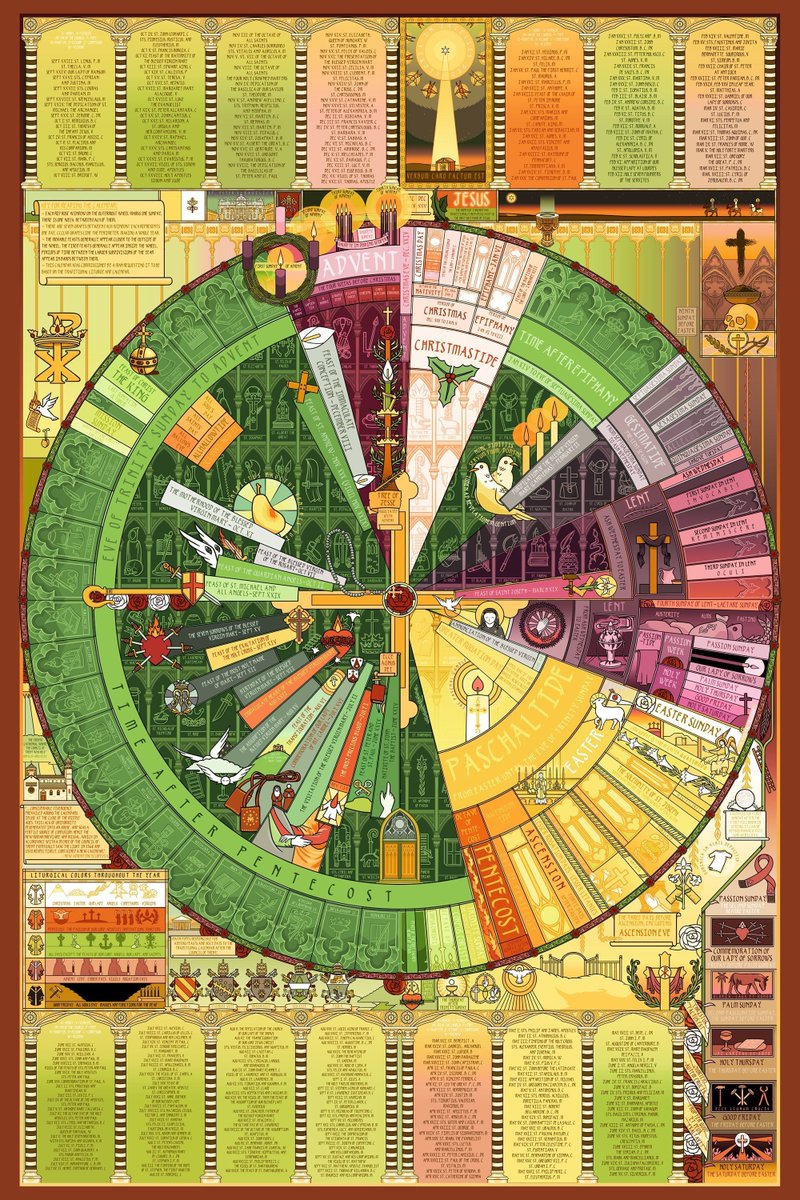
A traditional Catholic calendar and diagram of the Summa Theologica by Aquinas are my two largest projects.
My favorite thing about art is connecting with people when they give my work as gifts. See both projects in this thread, or here in my shop:
📦 https://t.co/uSzXCSnXuX
Hilaire Belloc explains why you need to read old books:
“There is no habit more dangerous to a man's active intellectual life than that of reading only modern books. The contemporary writer is usually not yet judged by time. He writes under the pressure of fashion and opinion. But the old books have survived. They have been tested. They come to us stamped with the approval of generations. To read them is to breathe a larger air.”
Which old book are you immersed in right now?
I wrote about how I think intelligence and attention hang together in perception. The paper was presented as part of the @AvalonInst Exposition, an arts and humanities conference ongoing in Berkeley, CA this weekend.
Drawing on Husserl, Illich, Hugh of St. Victor, and others, I’m continuing my exploration of intellegere as a mode of attentive choosing within perception organized by our aims and values. AI is the obvious backdrop to this discussion, and I wanted to lay out these claims so that we might look at what intelligence actually is and entails.
I read Husserl in the context of more contemporary debates in phenomenology and the philosophy of mind (e.g., the Dreyfus-McDowell debate), and I draw on Alva Noë’s account of the concept as a skill of perception to advance a specific understanding of how things come to presence for us in perception.
From there, I look at Hugh’s and Illich’s work on contemplative medieval reading practices, with the implication that perception is itself a kind of practiced and interpretive reading, one that at times needs to be guarded. The paper closes with some reflections from the Republic.
Come for the epochē, stay for the prosochē. Link to follow.