You should view the world as a conspiracy run by a very closely-knit group of nearly omnipotent people, and you should think of those people as yourself and your friends.
- Robert Anton Wilson
https://t.co/AuJ8HzTUf4
"Julian has always been something of an underground hero in Europe. His attempt to stop Christianity and revive Hellenism exerts still a romantic appeal." - Gore Vidal; Julian, 1964
--
Emperor Julian, b. 331 CE, d. 363 BCE
Emperor Julian fell in battle in the year 363, (m. Iraq).
Texas is now making Bible verses mandatory reading in class.
May I suggest Judges 11:29-39?
“Then the Spirit of YHWH came on Jephthah.
And Jephthah made a vow to YHWH:
“If you give the Ammonites into my hands, whatever comes out of the door of my house to meet me when I return in triumph from the Ammonites I will sacrifice it as a burnt offering to YHWH” (cough, Molech, cough)
Then Jephthah went over to fight the Ammonites, and YHWH gave them into his hands.
When Jephthah returned to his home in Mizpah, who should come out to meet him but his daughter, dancing to the sound of timbrels! She was an only virgin child.
“Oh no, my daughter! You have brought me down and I am devastated. I have made a vow to sacrifice you as a burnt offering to YHVH which I cannot break.”
“Give me two months to roam the hills and weep with my friends, because I will never marry.”
“You may go,” he said. And he let her go for two months
After the two months, she returned to her father, and he sacrificed her as a burnt (MOLECH) offering to YHWH as he had vowed.
And she was a virgin.”
-Judges 11:29-39
Great verse to start off the morning!
The Greek term "chaos" (χάος) has been derived by philologists from Proto-Indo-European *ǵʰeh₁y- meaning “to yawn or gape.” Cognates include Proto-Germanic *gīnaną. Ginnungagap, it is claimed by some, is derived from this same root. Ginnungagap, as my readers may know, is the Norse equivalent of the Greek mythological chaos: the magically charged void from which the rest of the universe, via a circuitous route, is ultimately derived. In the Greek mythological account, chaos precedes cosmos (order). But this chaos remains as a power which can still “break through” once order is established. Mythologically, this eternal force of chaos is represented in the Greek system by the Titans, and in the Norse system by the giants (the etins and thurses). In the later philosophy of F.W.J. Schelling, it is identical with what he understands to be “evil” (Böse).
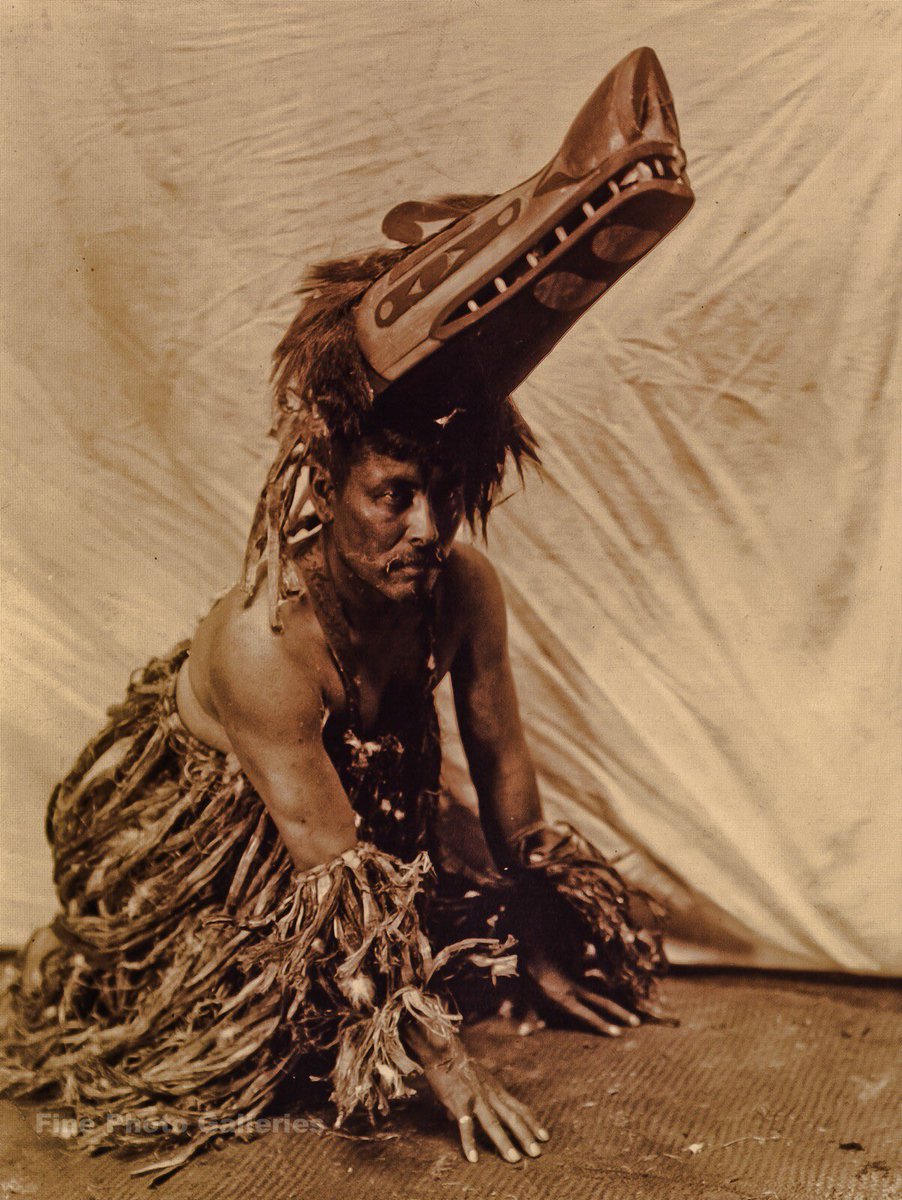
The Nuu’Chah’Nulth People of the Pacific Northwest have a wolf warrior initiation rite strikingly similar to that of the IE Koryos, even Tacitus’s account of the Chatti, called the Tlukwana.
(Thread)
A birdsong can, for a moment, make the whole world into a sky within us, because we sense that the bird does not distinguish between its heart and the world’s.
Rainer Maria Rilke
"Der Weckrufer bin ich,
und Weisen üb' ich,
dass weithin wache,
was fester Schlaf umschliesst."
The Austrian Heldenbaritone Jaro Prohaska as Der Wanderer
in Richard Wagner's "Siegfried", Bayreuth 1941
Why didn’t Thor stop St. Boniface?
In the Helgakviða Hundingsbana II, Dagr prayed to Odin for revenge, and Odin responded by giving him His spear.
Had someone had the courage and zeal to defend the sacred tree, he surely would’ve been blessed with the might of Thor…
In Chinese folklore, plague was not an accident. It had faces, names, and weapons.
The Five Pestilence Messengers (五瘟使者) ruled illness across the year: Zhang Yuanbo brought the spring plague, Liu Yuanda the summer plague, Zhao Gongming the autumn plague, 1/3
@SoNo762x39 https://t.co/csQ5MJvAqb Lest we forget that everyone is fighting a secret battle that the world will never know or understand. May the Gods receive them well.
Humans can acquire many of the powers of the gods – e.g., galdr, seidhr, shapeshifting, etc. More importantly they can also surpass them. In Rigsthula, we are told that the god Rig (aka Heimdall) “shared runes” with the boy named King, but that “King tricked him, and learned them better than he, and then he earned the right to call himself by the name of Rig for his rune-lore” (Rigsthula, 43). This seems to refer to the magical uses of the runes, or at least esoteric knowledge of them. The idea that men can surpass the gods is quite unusual. We would have to look to the Indian tradition to find parallels to it. It is diametrically opposed to the attitude one finds in the Greek tradition, where human attempts to reach for the divine are “hubris,” and severely punished. Numerous well-known myths attest to this, such as the stories of Arachne, Cassiopeia, Icarus, Niobe, Phaethon, Salmoneus, and Tereus. Such myths are conspicuously absent in the Germanic tradition (the various stories in which Loki is punished for this or that misdeed perhaps come the closest – but then he is not a human being).
https://t.co/yYAZYfAQwq