I’ve had a number of conversations with folks inside and outside government about the current situation with Anthropic, and here is what I believe to be true:
— As we know, Anthropic publicly released its Mythos class models earlier this week under the commercial name Fable.
— Fable is Mythos with guardrails. But if those guardrails fail, then you’ve exposed Mythos and its advanced cyber capabilities to people who shouldn’t have them. (Keep in mind that Anthropic itself widely promoted the idea that Mythos was a cyberweapon and needed to be regulated as such. They asked for government regulation of Mythos and championed the guardrails on Fable. If there is a vulnerability — big or small — it is Anthropic’s responsibility to patch.)
— A highly credible trusted partner of both Anthropic and the USG who was testing Fable came forward with a jailbreak of those guardrails. The Admin asked Dario to fix the jailbreak or de-deploy the model. Dario refused.
— In their blog post, Anthropic defended its decision by saying the jailbreak isn’t serious. That is not what the trusted partner and the USG believe; nor is that kind of minimizing language consistent with Anthropic’s brand as the AI safety company. It’s difficult to fathom how they could claim a jailbreak allowing operability of a cyber weapon could be defined as not “serious.”
— In the past, Anthropic has always said that safety must be top priority and taken super seriously. In this case, Anthropic prioritized the continued offering of the consumer model over safety.
— In reaction, the Admin issued the export control. The Admin did this reluctantly. It’s been very surprised that Anthropic hasn’t wanted to cooperate with a reasonable safety request (ie fixing the jailbreak issue). Anthropic’s reaction is very much at odds with their branding and ethos as a safe AI research community.
— The Admin’s hope now is that Anthropic remediates the safety issue, the export control is lifted, and Fable goes back into general release. The Admin wants all of this to happen as soon as possible. It is frankly bewildered that Anthropic hasn’t wanted to comply with safety requests that it previously said were its highest priority.
— Those trying to misdirect and tie this action to the prior DoW/Anthropic issues are wrong. The Admin values Anthropic’s technical capabilities and feels that this issue, while serious, should be easily resolved. The ball is in Anthropic’s court.
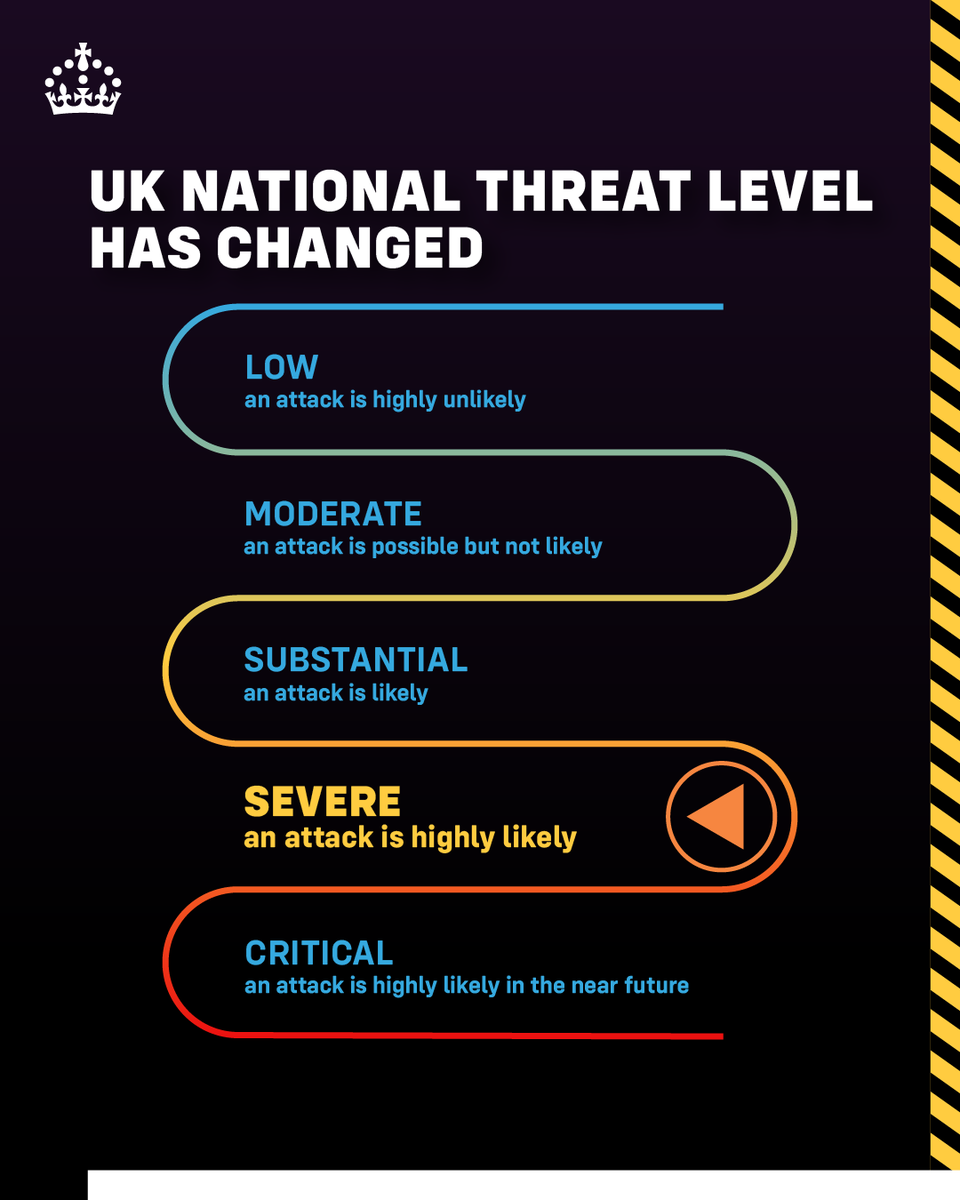
The UK's threat level has increased to “severe”. This follows a rising Islamist and Extreme Right Wing terrorist threat, and yesterday's abhorrent antisemitic terrorist attack.
People should be vigilant as they go about their daily lives, and report any concerns to the police.
Our world-leading police and security services continue to work, day and night, to keep our country safe.
🤯The 🇺🇦11th Separate Army Aviation Brigade "Kherson" demonstrated how the crew of a light-engine Yak-52 aircraft destroys Russian Shahed/Geran kamikaze UAVs.
This is the right decision but has taken far too long and inflicted far too much stress on Soldier B and his family.
It was always evident that he had acted lawfully, confirmed by the previous judgment on this incident on 8 October 2025.
The judge, Mr Justice McAlinden, stated:
“This challenge fails to get off the ground.”
“I cannot conclude this judgment without expressing my surprise that legal aid funding was made available to mount such a challenge…”
The fact that legal aid has been used again to drag Soldier B before the courts is beyond parody.
This was reiterated by Lady Chief Justice The Right Honourable Dame Siobhan Keegan, who said this was a misuse of public funds.
I welcome the decision to dismiss this absurd appeal. Let this be the end of the matter.
Beyond this case, all of the actions brought by IRA sympathisers against the SAS, who were acting at great risk to themselves to uphold the law and protect law-abiding citizens, should come to an end forthwith.
The fact that the Government's new legislation is facilitating such things is a disgrace and a scandal.
https://t.co/zz2UPS1IMR
The case against SAS Soldier B was funded by legal aid and presented, sequentially for judgement to three separate and independent courts.
Each ruled that he acted lawfully, and the second two ruled that the use of legal aid (taxpayer money) was wasteful and unjustified.
This isn’t a system seeking ‘truth’ or ‘justice’.
It is vexatious, state-sponsored persecution of ageing veterans that fought as skilled, highly trained soldiers to defeat violent, domestic terrorists in an armed insurrection; and in the service of their country.
“Persecution by Lawfare” of those that acted lawfully, and at great risk to themselves, to protect the citizens of the UK against those that seek to kill them.
The @UKLabour defence double whammy: hurt those that served, underfund those that are serving… it’s quite the policy cocktail…
Exclusive: Iran Has Limited the Impact of US Strikes, Intelligence Says
Pre-war planning meant Iran’s military was able to mitigate the impact of US-Israeli strikes on its weapons arsenal and leadership, according to Western military intelligence assessments — which also say it retains the ability to respond if the ceasefire fails.
Tehran has sustained massive damage to its infrastructure and its most senior leaders have been killed. But operational planning undertaken in anticipation of the conflict was effective in preventing the destruction of its missile and drone capabilities as well as maximising the impact of its military response, people familiar with the assessments said.
Plans put in place by Iran to replace senior military leaders in the event they were killed meant the country was able to minimize disruption to its command and control structures when they were targeted in the first days of the war, the people said.
It also appears that Iran retains solid reserves of long-range missiles, according to assessments provided by European and Gulf officials. It still has thousands of drones in its armoury, the people added.
These provide a much more nuanced picture of the outcomes of the US-Israeli operation than that portrayed by Trump and US administration officials. The effectiveness of Iran’s earlier military planning also raises the prospect that it could use the current ceasefire to make preparations for any resumption of hostilities.
Story with @EllenAMilligan@AlbertoNardelli >>> https://t.co/pUARK8cOAQ
This is damning - Mandelson FAILED national security vetting but the decision was overruled - WHO made this decision, they should be held to account? https://t.co/YLypgPmRDz
Taiwan should be dark by now. It is not. And the reason it is not is more alarming than the reason it should be.
The Strait of Hormuz has been disrupted since February 28. That is 46 days. Taiwan has 11 days of liquefied natural gas in onshore storage. If the 11-day figure were a countdown, the island would have gone dark on March 11, and 92 percent of the world’s advanced semiconductors with it. The lights are still on. Understanding why requires dismantling a number repeated without being understood.
Eleven days is not a stockpile. It is a rolling buffer, the legal minimum. Actual reserves have stayed above 12 days since the war began. Taiwan receives LNG at a rate equivalent to one tanker per day, and the 11 days measures the gap between the last delivery and the last megawatt. As long as tankers arrive, the buffer never depletes. Taiwan sources from 14 countries. Qatar one-third. Australia 34 percent. The United States 10 percent and growing. When Hormuz closed, Taiwan lost 33 percent of its gas, not 100. It replaced that third by outbidding on spot markets, accelerating non-Hormuz contracts, and burning more coal.
On April 8, Taiwan ramped Mailiao coal-fired units as LNG shipments slowed. Supply secured through May. Half of June arranged. Airlines raised prices. Fish prices surged as fuel fears kept boats in port. The island is not dark. But it is scrambling toward a deadline that arrives with summer.
Summer demand runs 40 percent higher than February. If disruption continues into July, Taiwan must replace one-third of its gas during peak consumption while competing against Japan, South Korea, and China for limited spot cargoes. The Asian LNG benchmark has more than doubled. Taipower faces 40 percent cost increases. The Atlantic Council warned of “power rationing, potentially disrupting semiconductor manufacturing.”
The supply side is not recovering. QatarEnergy declared force majeure after Iranian retaliation knocked 17 percent of Ras Laffan’s capacity offline, destroying two liquefaction trains and the gas-to-liquids facility. Repairs: three to five years. The source providing one-third of Taiwan’s gas is not delayed. It is structurally impaired for the rest of this decade.
Morgan Stanley identified the “LNG cliff” and a second threat: the sulfur squeeze. Sulfur, a byproduct of Gulf refining, becomes sulfuric acid essential for extracting copper and cobalt in chip components. The blockade threatening Taiwan’s power is also threatening the chemistry TSMC needs to etch wafers. Power and chemistry. Two vectors on the same fab. TSMC makes 90 percent of advanced chips and uses 9 to 10 percent of Taiwan’s electricity.
And here is the irony. The United States launched the strikes triggering Iran’s Hormuz closure, which damaged Qatar’s Ras Laffan, which broke Taiwan’s primary LNG supply. The same United States is becoming Taiwan’s dominant energy supplier. US crude exports to Taiwan grew from zero to 30 percent in a decade. US LNG could reach 30 percent with Alaska. The country that shattered the old supply chain is building the new one, and the dependency it creates is the deepest restructuring of Pacific energy architecture since 1945.
Taiwan is not dark. Not yet. The clock is not measured in 11 days. It is measured in the distance between May and July, between coal and gas, between a buffer and a cliff. And at the bottom of that cliff sit the fabs that make every advanced processor on earth.
https://t.co/0fIdGsM5qH
Russian satellites made at least 24 surveys of areas in 11 MidEast countries from March 21 -31, covering 46 objects, incl. military bases, airports and oil fields, according to Ukraine
Within days of being surveyed, some of the sites were targeted by Iran
https://t.co/aTTSszABPw
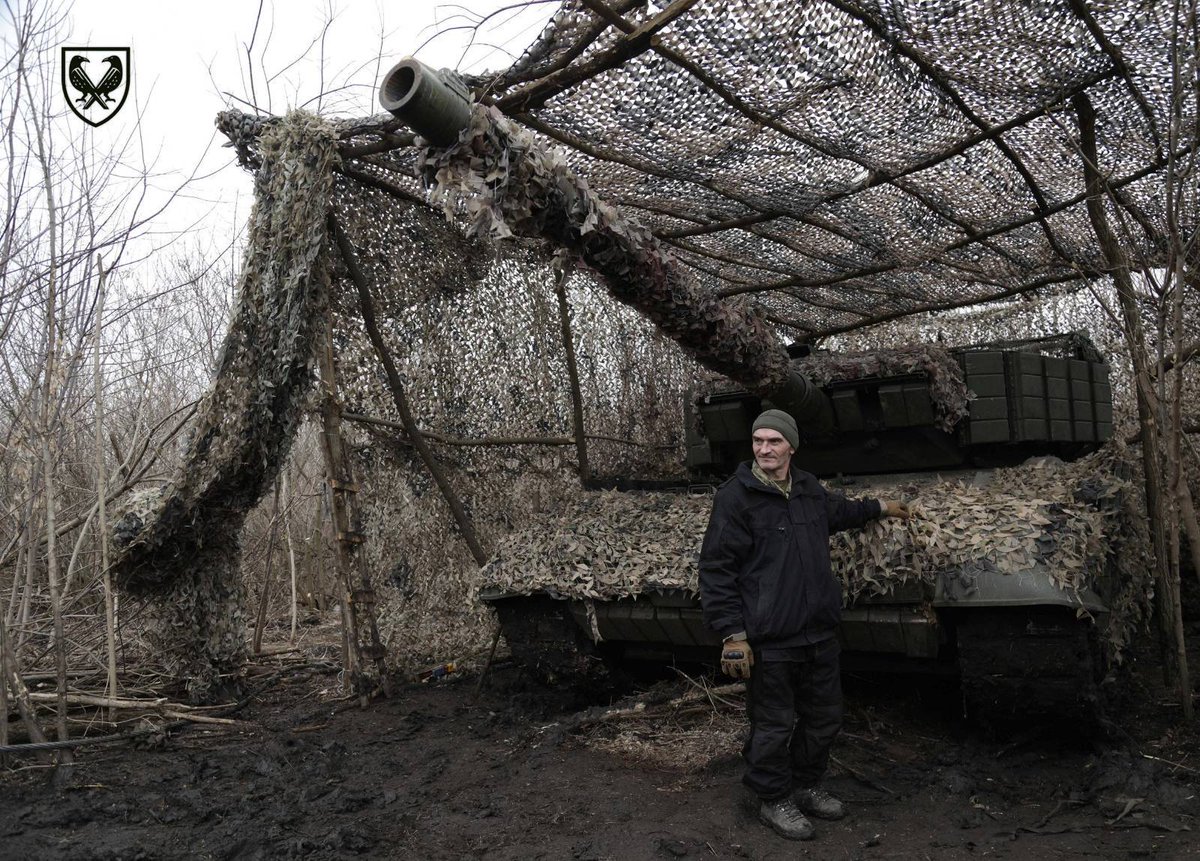
The 1st Tank Battalion of the 5th Heavy Mechanized Brigade has shared some very interesting details about the Ukrainian Leopard 1 MBTs and some upgrades in an interview with @Oboronka1.
Apparently one heavily up-armoured Leopard 1A5 withstood the impact of 52 (!) FPV drones over the course of a full day this February, with all crew members surviving the Russian attack. Another interesting fact was shared about upgrading the Leopard 1A5s.
@CharityPrytula is funding a proposal from the 1st Tank Battalion to retrofit an in-house 360° view into the Leopards. The system itself consists of four cameras and a single 10-inch monitor, through which the commander can see everything happening around him. The cameras were mounted on the turret, and for reliability, the footage is transmitted to the turret via cables.
Thanks to Starlink terminals installed on each tank, the footage from the cameras is uploaded to the battalion's command post, where the officers in charge are now able to more effectively assist the tank commander in carrying out his mission and warn the crew of approaching enemy drones.
Currently, the first 10 Leopard 1A5s are being equipped with these systems, which interestingly only cost about 40,000 hryvnias (€800) per unit.
H/t @NedSnow2019
🚨EXC: The captain of one of Britain’s nuclear-armed submarines has stepped back from his role this week after being investigated over his relationship with Joani Reid, the Labour MP whose husband has been arrested on suspicion of spying for China
https://t.co/XRHR0poRhU
🚨After 16 years of a covert intelligence operation, the engineer who disrupted uranium enrichment in Iran has been revealed.
An investigative report by a Dutch newspaper has uncovered the identity of the agent who introduced the “Stuxnet” worm into the main uranium enrichment facility in Natanz, central Iran.
Sixteen years after the largest operation targeting Iran’s nuclear program, the Dutch newspaper De Volkskrant revealed details of how U.S. and Israeli intelligence accessed the highly fortified facility, after a Dutch engineer successfully delivered virus-infected equipment into Natanz and installed it on water pumps.
According to the investigation, Dutch engineer Erik van Sabben, an agent of the Dutch General Intelligence and Security Service (AIVD), managed to reach the Natanz facility to carry out the operation, which was preceded by years of preparation and cooperation between the U.S. Central Intelligence Agency (CIA) and Israel’s Mossad, at a cost of $1 billion to develop the virus.
Regarding the decision to reveal the operative’s identity, the newspaper stated that his death “eliminated the risk of Iranian retaliation,” noting that his family agreed to disclose his name and publish his photo.
The report stated that the engineer carried out an extremely high-risk mission in Iran by infiltrating the Natanz facility in 2007, where he installed infected devices and equipment, leading to the disruption of around 1,000 centrifuges at the site.
According to the newspaper, the Dutch engineer, who was married to an Iranian woman, worked for a transport company in Dubai and traveled multiple times to Iran. The company, TTS International, said it had previously shipped spare parts for Iran’s oil and gas industry, but was unaware of its employee’s covert activities.
It remains unclear whether van Sabben used his job to import nuclear-related equipment into Iran or whether he knew that the equipment he delivered to Natanz contained a destructive virus.
At the end of 2008, van Sabben and his family traveled to Iran for a New Year holiday lasting ten days, but the day after arriving, he urged his family to leave immediately.
Two weeks after his mysterious departure from Iran, van Sabben died in an accident in Sharjah near Dubai, after losing control of his motorcycle, which overturned and broke his neck.
His death raised questions within Dutch intelligence, with concerns that it might be linked to his covert activities in Iran.
The two-year investigation was based on testimonies from 43 individuals, including 19 from the Dutch intelligence services (AIVD and MIVD), as well as former employees of the Mossad, Israeli Military Intelligence (Aman), and the CIA.
It is worth noting that the United States and Israel developed the “Stuxnet” virus, which was discovered in 2010 after being used to attack the Natanz facility, marking the first cyberattack of its kind targeting industrial equipment.
The virus is a malicious computer program designed to attack widely used industrial control systems produced by the German company Siemens AG, exploiting security vulnerabilities in Microsoft Windows.
🇷🇺🇺🇦 High speed chase between a Russian Geran-2 drone and a Ukrainian interceptor. The Geran deploying flares before racing to its target.
Kiev released the footage accusing Russia of dropping mines instead. No proof of such mines were provided.