The @injective Nova Program recently wrapped up, and I think the projects that came out of it deserve a closer look.
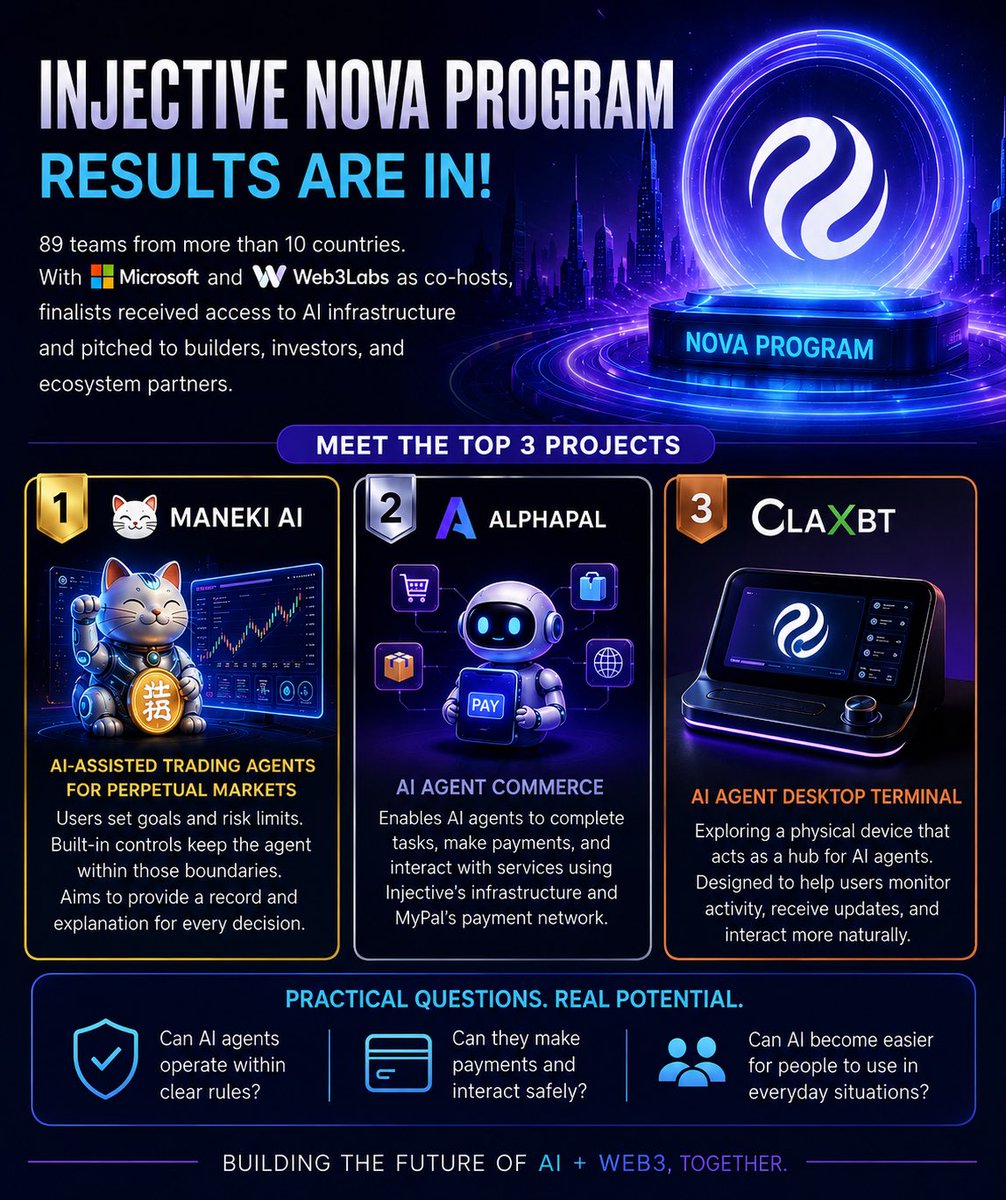
Over the course of the program, 89 teams from more than 10 countries submitted ideas. With support from Microsoft and Web3Labs, the finalists received access to AI infrastructure before presenting their work to builders, investors, and ecosystem partners.
What caught my attention wasn’t the number of projects....it was how focused they were.
Maneki AI, which took first place, is exploring AI-assisted trading for perpetual markets. According to the team, users set their own goals and risk limits, while built-in controls are designed to keep the agent within those boundaries. The project also aims to provide a record of how trading decisions are made, making the process easier to review.
AlphaPal, the second-place project, is looking beyond trading. Its goal is to let AI agents complete tasks, make payments, and interact with services by combining Injective’s infrastructure with MyPal’s payment network. If successful, it could expand how AI agents participate in everyday economic activity.
OlaXBT, which placed third, is taking a different approach by exploring a desktop device for AI agents. The idea is to give users a dedicated interface to monitor activity, receive updates, and interact with agents more naturally.
What I found interesting is that none of these projects are trying to solve everything at once.
Instead, they’re asking practical questions:
>Can AI agents operate within clear rules?
>Can they make payments and interact with services safely?
>Can AI become easier for people to use in everyday situations?
It’s still early, and these ideas will need time to prove themselves.
But I think this is a healthy direction for AI in Web3. Rather than making broad promises, these teams are building and testing practical tools that people might actually use.
Which of these projects stands out to you the most, and why?
gNinja 🥷🏾
injective-protocol:native
The POSCO trade finance pilot on @injective caught my attention.
Not because it was another RWA announcement, but because it involved an actual business process instead of just putting an asset on-chain.
A real company tested a real trade finance workflow.
Wall Street’s financial plumbing is starting to move onchain.
DTCC recently processed live production trades using tokenized securities held by DTC, with around 40 firms involved. The assets include equities, ETFs and U.S. Treasuries, with DTCC’s broader tokenization service expected to launch later this year.
That matters because this isn’t just another crypto project talking about RWAs.
It’s traditional market infrastructure testing blockchain for actual financial workflows.
And that raises an interesting question:
Which networks will be ready if tokenized markets move from pilots into everyday use?
@injective is already building around onchain markets, real-world assets and native USDC settlement. USDC and Circle’s CCTP are live on Injective mainnet, giving the network a native dollar-based settlement asset.
I don’t think DTCC’s move automatically means Injective will benefit.
But it does make the infrastructure question much more interesting.
The real test won’t be who talks about tokenization the loudest.
It’ll be who can actually support it when the volume gets real.
gNinja 🥷🏾
The @injective Nova Program recently wrapped up, and I think the projects that came out of it deserve a closer look.
Over the course of the program, 89 teams from more than 10 countries submitted ideas. With support from Microsoft and Web3Labs, the finalists received access to AI infrastructure before presenting their work to builders, investors, and ecosystem partners.
What caught my attention wasn’t the number of projects....it was how focused they were.
Maneki AI, which took first place, is exploring AI-assisted trading for perpetual markets. According to the team, users set their own goals and risk limits, while built-in controls are designed to keep the agent within those boundaries. The project also aims to provide a record of how trading decisions are made, making the process easier to review.
AlphaPal, the second-place project, is looking beyond trading. Its goal is to let AI agents complete tasks, make payments, and interact with services by combining Injective’s infrastructure with MyPal’s payment network. If successful, it could expand how AI agents participate in everyday economic activity.
OlaXBT, which placed third, is taking a different approach by exploring a desktop device for AI agents. The idea is to give users a dedicated interface to monitor activity, receive updates, and interact with agents more naturally.
What I found interesting is that none of these projects are trying to solve everything at once.
Instead, they’re asking practical questions:
>Can AI agents operate within clear rules?
>Can they make payments and interact with services safely?
>Can AI become easier for people to use in everyday situations?
It’s still early, and these ideas will need time to prove themselves.
But I think this is a healthy direction for AI in Web3. Rather than making broad promises, these teams are building and testing practical tools that people might actually use.
Which of these projects stands out to you the most, and why?
gNinja 🥷🏾
injective-protocol:native
Wall Street’s financial plumbing is starting to move onchain.
DTCC recently processed live production trades using tokenized securities held by DTC, with around 40 firms involved. The assets include equities, ETFs and U.S. Treasuries, with DTCC’s broader tokenization service expected to launch later this year.
That matters because this isn’t just another crypto project talking about RWAs.
It’s traditional market infrastructure testing blockchain for actual financial workflows.
And that raises an interesting question:
Which networks will be ready if tokenized markets move from pilots into everyday use?
@injective is already building around onchain markets, real-world assets and native USDC settlement. USDC and Circle’s CCTP are live on Injective mainnet, giving the network a native dollar-based settlement asset.
I don’t think DTCC’s move automatically means Injective will benefit.
But it does make the infrastructure question much more interesting.
The real test won’t be who talks about tokenization the loudest.
It’ll be who can actually support it when the volume gets real.
gNinja 🥷🏾