I asked my mum why she rebuys some supplements and never touches others.
The answer made A LOT of sense.
She orders every supplement under the sun, so it's a fair sample.
Two reasons.
Either she could tell it worked. Or she can't tell at all, believes it matters, and buys it for life.
Sleep product? If she's still awake at 2am on night three, it's gone. No email is bringing her back.
Collagen? She has no idea if it's working. She'll buy it for the rest of time.
Same customer. Same category. Opposite retention.
Retention doesn't have one playbook. It has buckets. And the bucket your product sits in decides the strategy before you open Klaviyo.
Three that matter most.
1) Can they tell it's working?
Know it works, know it doesn't, or hope it does.
If it's obvious (sleep, cramps, an infection that clears or doesn't), the product does the retaining.
Your job is getting them to the moment of proof: right dose, right timing, expectations set on day one.
If it's faith (collagen, omega-3, greens), retention runs on belief and habit.
Education, the science, proof by proxy like blood markers, a routine that makes it automatic. Subscription-native, if the belief is there.
2) Need to have, or nice to have?
Need to have (dog food, coffee, contact lenses) is a logistics business. Right plan from the start, easy skip and swap, and the number one churn reason will be "too much stock", not "didn't like it".
Nice to have (a candle, a treat, etc) is a desire business. Newness, moments, reasons to come back. Campaigns do the heavy lifting.
3) Is there a taste?
Like it, don't like it, or there is no taste.
Taste-led products (drinks, protein, juice) churn on flavour long before they churn on price...
The best-selling flavour is often the one that loses the most subscribers. Get them across the range early and make swapping easier than cancelling.
No taste? Skip this one. Habit and belief carry it.
Many brands sit in more than one bucket, and their hero product usually sits in a different one from their second product.
Which is exactly why you can't borrow a playbook from the brand next door.
The brand running collagen tactics on a sleep product is educating people who already have their answer.
The brand running replenishment reminders on a candle is nagging people who wanted a treat.
Work out the bucket first. Then build the retention around it.
A skincare brand wanted reorders at 60 days. Their hero product lasts 100.
They'd spent months rebuilding the replenishment flow. The flow was never the problem.
Here's a cycle almost every DTC brand has been through:
- Reorders are coming in slower than you want.
- So you build a replenishment flow. "Running low? Time to restock."
- It underperforms. So you add a discount.
- Still underperforms. So you blame the creative and rebuild it.
- Still nothing.
The flow is not the problem.
The clock is. And you don't own the clock.
Your customer's bathroom shelf does.
Someone who uses a serum sparingly in month one uses it sparingly in month ten.
Usage speed is one of the most fixed behaviours in e-commerce. You can educate around the edges, but you will not email someone into emptying a jar faster.
Which means "make customers reorder sooner" is the wrong instruction.
The right one is to change what they own, so reordering sooner becomes natural.
Three levers that actually move the clock:
1) The basket.
→ Pair the slow product with a fast-consuming one in the first order. Skincare lasts 4 months, a 30-day supplement doesn't. Now the fast product sets the reorder rhythm, and the slow one rides along in the same basket.
2) Size architecture.
→ Smaller first-order sizes shorten the clock. But this one has a real cost...lower AOV on order one.
3) Frequency that matches reality.
→ If you ship every 30 days to someone who consumes in 45, you're not accelerating reorders. You're manufacturing "too much product" cancellations.
Notice what all three have in common:
None of them ask the customer to behave differently.
They redesign the offer around behaviour that was never going to change.
That's the actual job of retention. Not persuading people to want more, sooner.
Building a product and basket architecture where wanting more, sooner, happens on its own.
DTC Brands: Repeat revenue is not the metric you think it is.
Rising repeat revenue feels like proof your retention is working.
It's actually a receipt for acquisition you did months ago.
And if you read it as permission to cut ad spend, you won't see the damage until it's too late.
Here's the trap, and a lot of DTC brands walk into it.
Acquisition gets expensive. So you pull back spend.
And for a while, everything looks fine:
- Returning-customer revenue keeps climbing
- Repeat share of revenue actually goes UP
- The dashboard glows green
You look at that and think the business is getting healthier.
It's not. It's coasting, if not shrinking.
Because total repeat revenue is a lagging indicator.
The customers repurchasing this month weren't acquired this month. They came in 2, 3, 4 months ago, and they're only now maturing into a second order.
So the returning revenue you're banking today is really a receipt for acquisition you did last quarter.
Which makes the collapse invisible:
1. You cut new customer acquisition today.
2. Repeat revenue keeps rising for months, because old cohorts are still maturing.
3. The dashboard tells you everything's fine.
4. Then the well runs dry, all at once, and repeat revenue falls off a cliff.
By the time the number moves, the damage is already 90+ days old.
Here's how you catch it early.
Total repeat revenue hides the truth, but cohort metrics reveal it.
Stop asking "is repeat revenue up?" Start asking:
→ Is each new cohort's 90-day repurchase rate higher than the one before it?
→ Is each cohort's 90-day LTV climbing, compared at the same age?
→ Is the January 2026 cohort worth more at day 90 than the January 2025 cohort was at its day 90?
That's the apples-to-apples test.
If cohort metrics are improving, your retention is genuinely getting stronger.
If only the total is improving, you're just harvesting old cohorts, and the harvest ends.
In the case study, the parts I'd actually read:
1) Why the first job was making the reporting less flattering, not more.
2) What 62% of second orders being a different product changed about the entire strategy.
3) The founder's own words on what nearly stopped her switching providers. It wasn't price.
If your ads are working right now, that's not the reason to leave retention alone.
It's the strongest reason you'll ever have to fix it.
https://t.co/lY4TU49AD2
Eight months later the wave receded, and it didn't matter.
New case study is live. Here's the short version.
The setup:
- A decade of R&D behind a genuinely differentiated product.
- Meta finally clicked and acquisition went vertical.
- And the founder felt like she was standing on a cliff, because she could see exactly what the growth was built on.
Underneath it, the numbers nobody wants on a slide:
- 15 in 100 customers ever came back.
- Roughly 1 in 7 subscribers cancelled every month.
- The retention engine that carried the business for years had gone unattended while everyone fulfilled the new demand.
Then the wave receded. New customers fell 42%.
Revenue grew anyway.
That's the whole point of the work.
Eight months in:
> Returning customers up 160%
> Returning-customer share of revenue went from 22% to 56%
> Subscription revenue up 118%
> Median time to a second order cut from 90 days to 64
A DTC founder doing 8 figures told me her scariest year was the one where Meta worked best...
All that growth, and the whole thing sat on one channel she didn't control.
She described her business to me in gears.
1. Meta is first gear.
→ It gets the car moving from a standstill, and nothing else can do that job. But first gear is loud, thirsty and violent. Nobody drives a long journey in it, and every new customer is another standing start.
2. Retention is fourth gear.
→ Same engine, same car, but now the machine covers distance without screaming. Repeat orders and subscriptions arrive without the fight, month after month, whether the ad account had a good week or not.
Most brands never get out of first. They rev harder, spend more, swap agencies, refresh creative, and wonder why the ride never gets smoother.
What struck me most was what she said about retail. Plenty of people have told her to scale into stores, because purchase orders and offtake agreements are what "real" stability looks like.
She's watched brands her size do it, shift more units than she does, and make less money, because the margin went to the retailer along with the customer relationship.
Her version of stability is a base of returning customers large enough to bank decisions on. She plans investment against it. She shows it to shareholders. It backs her growth plans the way a contract would, except she keeps the margin, the data and the relationship.
That's the part I'd want every founder to sit with. Predictable revenue isn't something you sign for. It's something you build, one retained customer at a time, until the business can cruise.
If losing your best ad account tomorrow would flatten you, you're still in first gear.
"I felt like I was standing on a cliff."
How a DTC founder I interviewed described the best acquisition period her brand ever had.
Meta had finally clicked. New customers flooding in, revenue multiplying, the moment every founder works years for.
And her reaction wasn't celebration. It was vertigo.
Because she could see exactly what the growth was built on.
One channel.
One algorithm.
One CPM spike away from falling hard and fast.
Worse, the growth itself was eating the safety net. All her attention went to fulfilling the demand: operations, stock, delivery.
The email account she used to run herself got dropped. The returning customers who had been the reliable base of the business for years were suddenly nobody's job.
So, record new customers coming in the front door, and nothing being done to keep them.
Here's what I took from it.
A lot of brands treat retention as the thing you fix when acquisition breaks. Ads get expensive, growth stalls, and suddenly everyone cares about LTV.
But by then you're building the safety net during the fall.
The time to build retention is while acquisition is working...
That's when you have the volume.
Every strong month on ads is thousands of first-time buyers who will either become a durable customer base or a leaky bucket, and that window doesn't reopen.
This founder made the call at the top, not the bottom. When acquisition later softened, as it always eventually does, the retention engine she'd built became the trajectory the business stood on.
If your ads are flying right now, that's not the reason to deprioritise retention.
It's the strongest reason you'll ever have to build it.
A bad ad loses you a stranger. A bad email loses you a believer.
A founder I interviewed this week put it in a way I haven't stopped thinking about:
"You can afford to lose a few customers at the top of the funnel through mistakes in your marketing. It hurts more when you lose them at the bottom."
Think about who's actually reading each message.
The person scrolling past your ad has no history with you. If the creative misses, you've burned some ad spend, which stings, but the relationship cost is zero.
They didn't know you existed before and they don't know you exist now.
The person opening your email is different. They found you, bought from you, maybe reordered, maybe told a friend. They opted in to hear from you.
Every message to that person is being read by someone who already believes.
Now, ads deserve their high standard. You can't retain a customer you never acquired, and every miss up there is real money. The agencies, the A/B tests, the creative reviews all make sense.
The mistake is thinking that standard only applies at the top.
Because plenty of brands run exactly that split: rigour for the strangers, then a rushed, salesy, discount-led blast for the believers. As if the channel talking to their best customers is the one that can afford to be sloppy.
The same founder had lived the consequence. A previous provider got so "salesy and markety" with her list that customers started asking her what was going on.
The channel meant to deepen the relationship was actively burning it.
An acquisition mistake costs you ad spend. Painful, recoverable.
A retention mistake costs you the people your business model depends on, and winning back a burned customer costs more than acquiring them did in the first place.
Both ends deserve the high standard. Only one end is talking to people who already trust you.
Last year a founder I work with nearly gave away a chunk of his company.
Not to fund growth. Just to survive another quarter of ad spend.
Twelve months later, he's funding trade shows, collabs and new channels out of cash flow, and the equity conversation is dead.
What changed wasn't acquisition. It was retention.
Rewind to the stagnant year...
The brand was acquiring plenty of customers but front-loading everything: money out on ads, one purchase back, repeat. Every month ended with nothing left over to try anything new.
He had a subscription program the whole time. But it was set and forget. Sign-ups came in one door while churn walked out the other, and the subscriber line stayed flat for a year.
So the business stayed on the treadmill, and the only lever left looked like raising cash. Which for a bootstrapped founder means one thing: dilution.
Then the retention & subscription program got rebuilt properly. The offer, the front-end presentation, the post-purchase experience, the reasons to stay.
Subscribers that used to wash out started sticking. Recurring revenue went from a flat line to a climbing one.
And the maths of the whole business changed.
Predictable money arriving every month, without re-acquiring the customer, meant he could fund his own risks. Things with no immediate ROI that were unthinkable a year earlier.
His words, more or less: I don't feel like I need to give equity away anymore. That's the biggest thing.
We talk about retention as LTV, repurchase rates, churn curves. All true.
But zoom out and it's simpler...
Recurring revenue is the cheapest capital you will ever raise.
DTC brands: Every billing reminder you send is an invitation to churn.
The customer sees the charge coming, pauses, and asks themselves the question you never want them asking: "do I actually need this?"
You can't avoid that moment entirely. But most subscription brands make it worse in two ways.
1. They trigger it far more often than they need to.
Here's the reframe we've been rolling out across accounts: stop selling frequency, start selling supply.
"Delivered every 4 weeks" becomes "30, 60 or 90-day supply."
Same product. But now the customer picking the 90-day option gets one billing moment a quarter instead of three.
The mechanics are simple...
It's a buy more, save more offer that just gets delivered less frequently. Bigger pack, better price per unit, fewer charges. Higher first-order AOV as a bonus, because you've front-loaded the purchase instead of drip-feeding it.
2. When the billing moment does come, they waste it.
Go read your own upcoming charge email. I'd bet it says some version of "we're charging your card on Thursday."
That's it. A transaction notice. One of the single highest-risk touchpoints in the subscriber lifecycle, and it reads like it was written by the billing system. Because it was.
That email is your chance to re-sell the subscription before the charge lands.
Remind them what the product is doing for them. The results they're working towards. What's coming next. The community they're part of. THEN the charge details.
If the only time a subscriber hears from you is when you want their money, don't be surprised when they start wondering why they're paying.
Ask less often. And when you do ask, give them a reason to say yes.
"Should we segment every campaign by what the customer bought?"
Got asked this on a call this week. My answer surprised him...
Mostly, NO.
Here's the split I run on accounts:
1. Flows get the heavier personalisation.
- They're always-on, so the setup cost is paid back every day. Bought an ankle product? You go down the ankle path, ankle cross-sells, ankle testimonials. Worth building once, works forever.
2. Campaigns are different.
- Roughly 80% of sends should be about maximising reach, and therefore earning potential, without hurting deliverability. The other 20% can go granular when there's a genuine reason to....
Because what often gets forgotten about segmentation is that the whole point is to create segments that allow for genuinely different messaging, different enough to produce an incremental uplift that justifies the extra resourcing.
Most of the hyper-segmented campaigns brands obsess over fail that test.
What actually happens - each individual send gets a slightly higher click rate. But absolute clicks are often much lower, so revenue lands the same or less.
Revenue per recipient looks great though!
So ask yourself what pays the bills. More absolute revenue and profit contribution, or a gamed revenue-per-recipient metric?
If a segment doesn't change what you'd say AND earn, it doesn't deserve its own campaign.
Segment your flows. Broaden your campaigns. Generate cashhhhh.
"Retention has improved, our subscribers are more engaged, and we're seeing real commercial impact from the channel."
That's from a testimonial one of our partners sent over this week. But the line that stuck with me was this one:
"We're never scrambling last minute because the calendar is already mapped out, the briefs are ready, and the thinking has been done."
Results in email and retention don't come from one big idea....
They come from a program that ships properly every single week, which allows decisions to be made fast.
If your retention partner only shows up when you chase them, the results will look like that too.
I recently started work with a skincare brand that 24x from $50K to $1.2M/month in just 3 months.
They could have scaled further if they had THIS sorted...
Most DTC brands dream of 20x growth in under a year.
This brand lived it through Meta ads.
But hypergrowth exposed every retention weakness they had.
- No understanding of who their most profitable cohorts were
- Campaign cadence went from consistent to sporadic
- 13,000 customers became unreachable (no multi-channel strategy)
- 90-day LTV growth stuck at 14.5%
- Subscription penetration plateaued at 10%
The acquisition engine was roaring.
The retention infrastructure wasn't built for it.
You spend months trying to crack acquisition. Then you finally do. Meta scales. Revenue explodes.
And suddenly your attribution becomes a mess because Klaviyo, Meta, and your subscription platform all claim different numbers.
You're not sure which customer cohorts are actually profitable. Systems that were "fine" at smaller scale become bottlenecks overnight.
This is what happens when you treat retention as something you fix after acquisition works.
Retention infrastructure needs to be built as you scale.
When you're doing $1M+/month, it's much harder to rebuild the engine while it's running.
If you're scaling acquisition right now, consider this:
- How are you using retention to fuel acquisition?
- Do you know which customer cohorts have the highest LTV?
- Can you reach customers across multiple channels beyond just email?
- Is your subscription strategy optimised or just switched on?
- Do you have content systems to feed consistent campaigns?
Build the infrastructure before you need it.
"Every email needs to feel new and different."
Wrong.
A client wanted to scrap one of their best-performing emails. Rebuild it from scratch.
It felt too close to a campaign we'd sent a couple months earlier.
Their reasoning: "we don't want to bore people."
Fair worry. Wrong data point.
That concept was outperforming everything else in the account.
Higher clicks. Higher conversion. Nothing close.
Boredom is a feeling.
It's not a metric.
Rebuild every email that feels familiar to the person who wrote it, and you're optimising for your own mood, rather than your customer's behaviour.
So we left the structure alone.
New copy.
New offer where it made sense.
Same framework that was already converting.
That's most of email, once you strip the mystique out of it.
Not constant reinvention
(although there should certainly be room for innovation).
Knowing which parts are already working, and having the discipline to double down on them.
We took a health brand's cancellation save rate from sub-10% to 26%.
I'm not celebrating yet.
When someone hits cancel, a good flow catches a chunk of them.
They skip the next order instead.
Or pause it.
Or push delivery back a few weeks.
Your subscription tool logs every one of those as a save. The rate climbs, the dashboard looks great.
But a skip is not a repeat order.
A pause is not a repeat order.
A three-week delay is not a repeat order.
They're all a maybe.
The customer said "not right now." The software wrote down "saved."
The number that actually matters turns up later: of everyone you saved, how many placed another order in the next 90 days?
If they did, brilliant. You kept them.
If they didn't, you didn't save that subscriber. You delayed them. Same churn, moved a month or two down the calendar, where it's harder to spot and easier to ignore.
The save rate went up. The business stayed still.
That's the catch with a save rate. It pays you in good feelings now for a result you can't confirm for another quarter.
So watch it, but don't trust it on its own. Put the 90-day repurchase rate next to it, every time.
A flow that defers churn looks identical to one that prevents it. Right up until you count the second orders.
"Don't use a billing reminder. You'll remind them to cancel."
Sadly, a lot of brands still try to do shady sh*t like this.
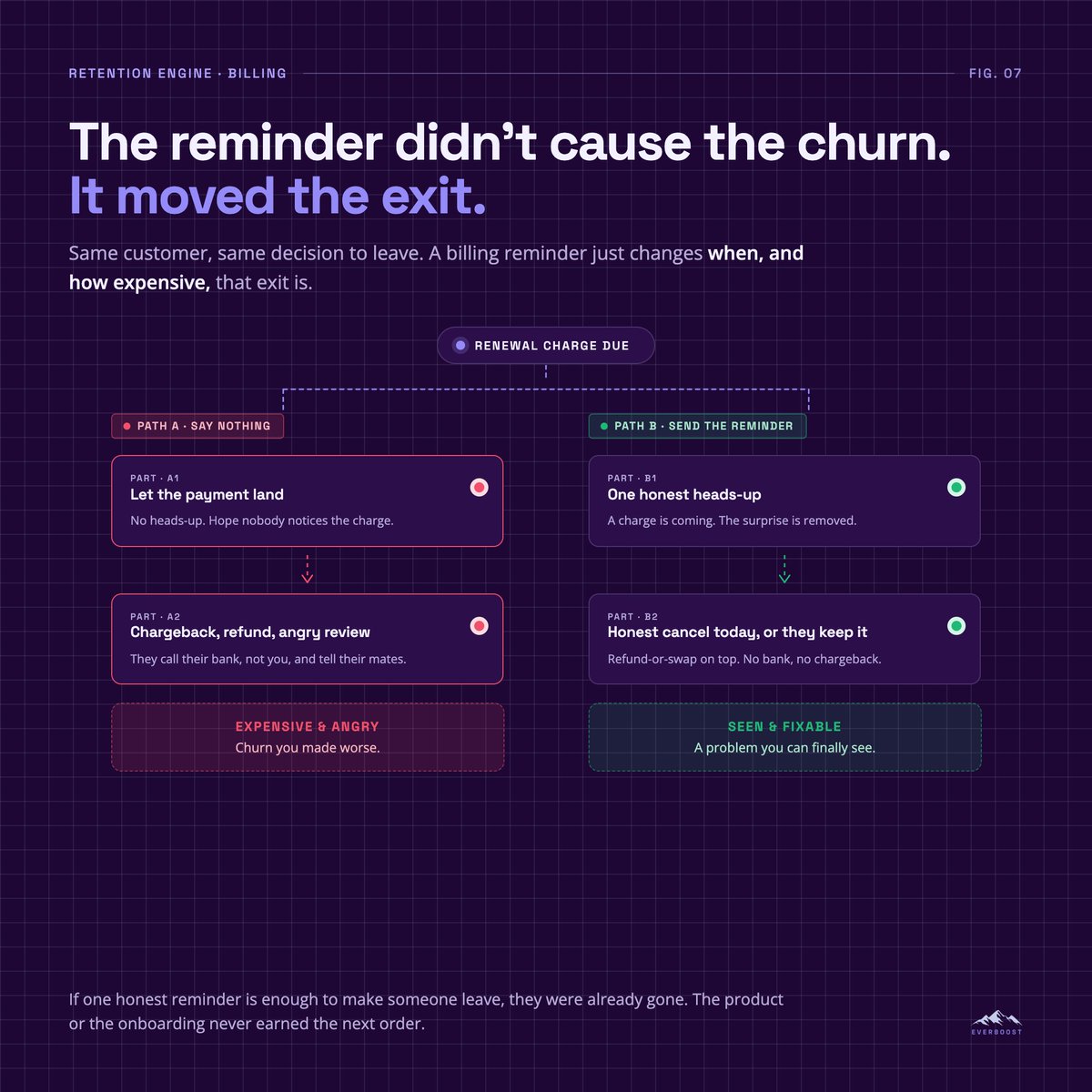
They say nothing.
Let the payment land.
Hope nobody notices.
Somebody always notices.
They get charged for something they'd forgotten they were still on.
They don't email you.
They call their bank.
Now it's a chargeback, a refund, and a customer telling their mates you took their money without warning.
Rather than preventing the churn, you made it expensive and angry.
A billing reminder does the opposite. It removes the surprise.
One brand we work with has built in reminders in for exactly that reason.
Then a simple policy on top: if you got charged and you'd forgotten, keep it, we'll refund or swap it. No return to argue over. And the surprise that sends people to their bank is gone.
"But some people still cancel the second the reminder lands."
Yes. And this is the part most brands get wrong.
The reminder didn't cause that. You've lined the two up and called it cause and effect.
If one honest heads-up is enough to make someone leave, they were already gone. The product didn't earn the next order, or the onboarding never gave them a reason to stay.
All the reminder did was move the exit. From a surprise chargeback next month to an honest cancel today.
This is a product and onboarding problem you can finally see.
The fastest way to kill your first-to-second order rate is to chase the second order too hard.
Sounds backwards. It isn't.
You're paying good money to acquire customers, and a huge chunk of them buy once and never come back. So the instinct is to chase that second order harder. More emails. A bigger discount on order two. Push, push, push.
For most health and wellness brands, that's the wrong lever.
The customer just bought. They're quietly wondering if they wasted their money, they haven't used the product properly yet, and they definitely haven't felt it work. Hitting them with a hard sell at that exact moment does nothing except make the doubt louder.
The second order is the goal. It's just not the thing you optimise for.
What you optimise for is the first experience. Get someone to actually use the product, use it correctly, build it into their day and feel a real result, and the second order stops being something you have to sell. They come looking for the refill themselves.
The first month is where that's won or lost.
Here's what that flow should be doing in that window:
- Killing the buyer's remorse before it has a chance to set in
- Showing them exactly how to use the product, and how often, so they actually get a result
- Running a simple challenge or streak that rewards consistent use over the first few weeks
- Showing how other customers and creators fit it into their routine, so they can picture it in theirs
- Giving them different ways to use it. If it's a powder, send the recipes. Let them find the version of taking it that they actually enjoy
None of that is selling, but all of it makes the sale.
Get the first experience right and the repurchase rate climbs on its own. Get it wrong and no amount of discounting on order two will save you.
Stop selling them the next order.
Get them to win with this one.
The sunset flow is built to win back your dead subscribers.
But it's quietly punishing your live ones.
What it is: a re-engagement flow. Someone stops opening, stops clicking, so you fire off a plain-text email. "Hey Gary, still want to hear from us?"
And that's the problem...
If that subscriber has already ignored your campaigns, your flows, every other touchpoint you've got, one more email won't wake them up. The odds are tiny.
And you're not sending it to one Gary. You're sending it to thousands of them.
Low opens. Low clicks. Every one a negative signal to Gmail, Outlook, Hotmail.
So your deliverability drops.
The people who do open your emails are now less likely to see them.
Campaign performance drops.
Which leaves you with even more disengaged subscribers to chase.
Round and round.
To win back the customers who left, you've taxed the ones who stayed.
Some email churn is just natural. You'll never keep everyone engaged forever, and that's fine.
Have SMS, direct mail, WhatsApp, built in from day one, so you're never down to a last-ditch flow.
Kill the sunset flow.
If I could only keep 3 email flows, abandoned cart wouldn't be one of them.
Here's what I'd actually run.
1️⃣ New customer post-purchase.
Most brands have a terrible one. That's the opportunity.
This is where you kill buyer's remorse, get people using the product properly, and turn a purchase into a habit.
Two brands sell the same thing. The one with the better post-purchase experience gets the reorder. Every time.
2️⃣ The welcome flow.
Not for the revenue. Klaviyo makes it look like a money machine, but most of that revenue would have landed anyway.
I keep it because it's the first thing a customer hears from you after the click. It sets the tone for everything that follows.
3️⃣ The replenishment flow.
The order one to two repurchase rate is the biggest bottleneck in most brands, and the most valuable.
A few points on that rate is the difference of hundreds of thousands over a year.
If you run a subscription, this is also where you can move people onto it.
Notice what all three have in common....
None of them are about today's sale. They're about the second order.
That's the whole game.