Wow, really cool!
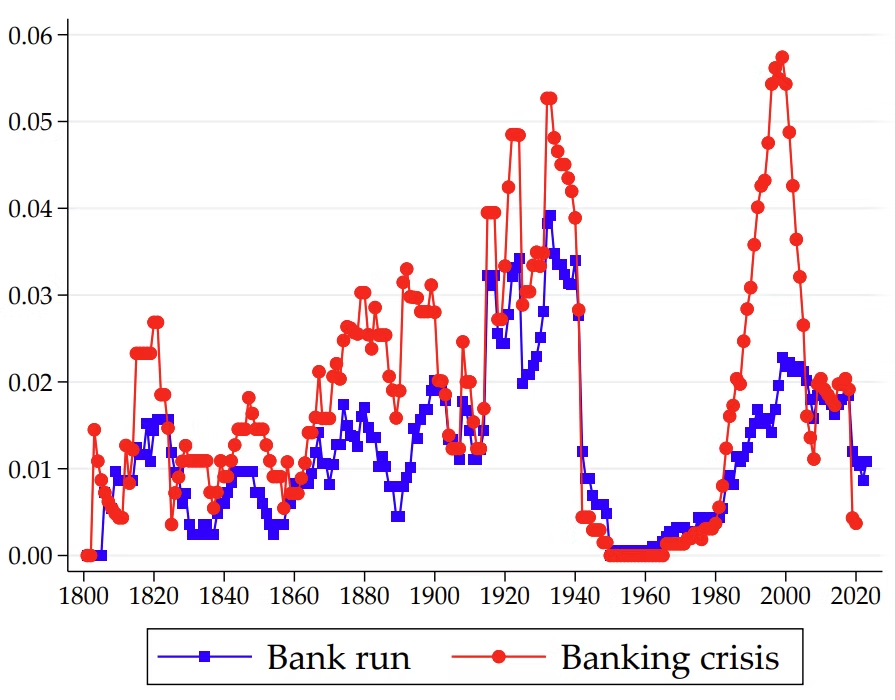
"Two Centuries of Systemic Bank Runs", a new "chronology of bank runs covering 184 countries... In addition, we assemble and harmonize a novel dataset of national banking sectors’ deposits"
by Jamilov, König, Müller, Saidi
https://t.co/WekvDsGAQ0
Check out the newest version of our paper "Two Centuries of Systemic Bank Runs". We made the chronology of bank runs and the deposit contraction data available on our website https://t.co/BHtSVN9oc6.
🚨 What do 200+ years of data tell us about bank runs? How often do they happen? Do they matter for the macroeconomy?
My recent paper provides some answers. Data and paper: https://t.co/qpw6jmaPUf.
🧵👇 based on joint work with @RustamJamilov, @Tobi_Koenig, and @farzado.
We are hiring postdocs in finance at the Department of Economics @UniBonn. Excellent conditions in a stimulating environment. We encourage Ph.D. students at all later stages of their programs, including but not limited to those on the job market, to apply: https://t.co/Z7uwjEbBUs
New paper on bank runs with @Tobi_Koenig , @farzado , @KarstenMueIIer. A new database of narrative bank runs + new dataset of deposit withdrawals for 180+ countries over 200 years. Detailed thread coming soon.
A new high for the track record of our PhD program @UniBonn: Congratulations to Philipp Strack (BGSE 2013) for winning this year’s John Bates Clark Medal! An incredible honor and yet another testament to the intellectual horsepower of our micro theory tradition in Bonn.
Hello! As you can tell I’m on the market this year! If you‘re interested, have a look at my website for my job market paper & further research: https://t.co/9JaSMdjiuU - thanks!
Working Paper Alert.🚨
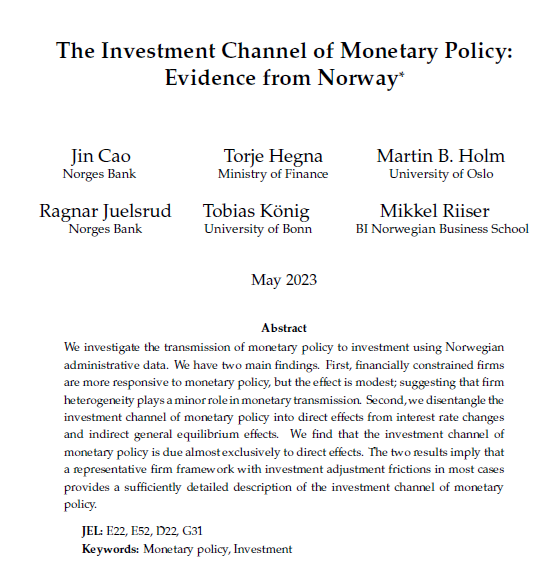
Our study "The Firm Investment Channel of Monetary Policy: Evidence from Norway" is available as Norges Bank Working Paper 2023|5.
We study the transmission of monetary policy on firm investment and disentangle direct from indirect effects.
You can find the entire working paper, that is joint work with Jin Cao, Torje Hegne, @BlomhoffHolm @RJuelsrud and @mikkelriiser , here:
https://t.co/lRkWTtQgRx
The indirect, general-equilibrium effects that are crucial for households' consumption responses to monetary policy (Holm et al., 2021; Auclert et al., 2020; Bilbie et al., 2022) might thus be kick-started by the firms' direct responses.