Soeben hat der Landtag Sachsen-Anhalt den Friedensappell von @AfD und @BSWbund beschlossen. Ein Vorbild für Deutschland!
Die Kriegsparteien CDU, SPD, Grüne und Linke verzögerten und sabotierten mit allen Mitteln,
aber das nutzte nichts.
https://t.co/MepVyNFZFE
… ich mache seit Jahren einen Bogen um FritzBox aus unterschiedlichen Gründen!
Klassisches Beispiel eines Unternehmens das Wettbewerb nicht standhält weil es nicht liefert was Kunden wünschen! Erinnert an VW und Audi… !!!
https://t.co/U6jcm848uj
@E_Boeminghaus Da beide Konzerne jeden (rechtlich) fertig machen wollen die sich die chinesischen (besseren) Varianten ihrer Fahrzeuge nach Europa importieren wollen, schaufeln sie sich selbst ihr Grab.
🇺🇸🇺🇦 Trump made it clear that things with Zelensky are TOUGH again
"I think it's time for Ukraine to get a new president."
Ukrainian and European officials have been meeting U.S. envoys in Miami this weekend, trying to find a way out of the war.
Trump has spent months arguing that Kyiv is the side holding up a deal.
He's so done with this.
Writer: Lucas
A swarm of AI agents just found a 27-year-old invention for next-generation computer memory in a major landmark discovery.
This is the story of old research will produce new discoveries.
https://t.co/RyT0MBv5dh
BREAKING: President Trump awarded Elon Musk the National Medal of Science today, America’s highest honor for scientists and engineers.
Trump called Musk a “national treasure.”
@E_Boeminghaus Die Rüstungsindustrie ist und war schon immer darauf angewiesen das sie vom Staat finanziert wird. Das ist kein freier Markt der sich erholen kann, das ist Sozialismus mit Armutsansage und im schlimmsten Fall Krieg!
We announced an agreement to acquire a nationwide low-band spectrum license portfolio that will pave the way for @Starlink to become a major mobile carrier in the US.
With this new spectrum and our Gen2 constellation, Starlink Mobile can ensure Americans have access to high-speed mobile broadband no matter where they are → https://t.co/1Uaf48v5pm
THE DIAMOND COMPUTER
SAXON Q: Quantum Computing in a Diamond, at Room Temperature
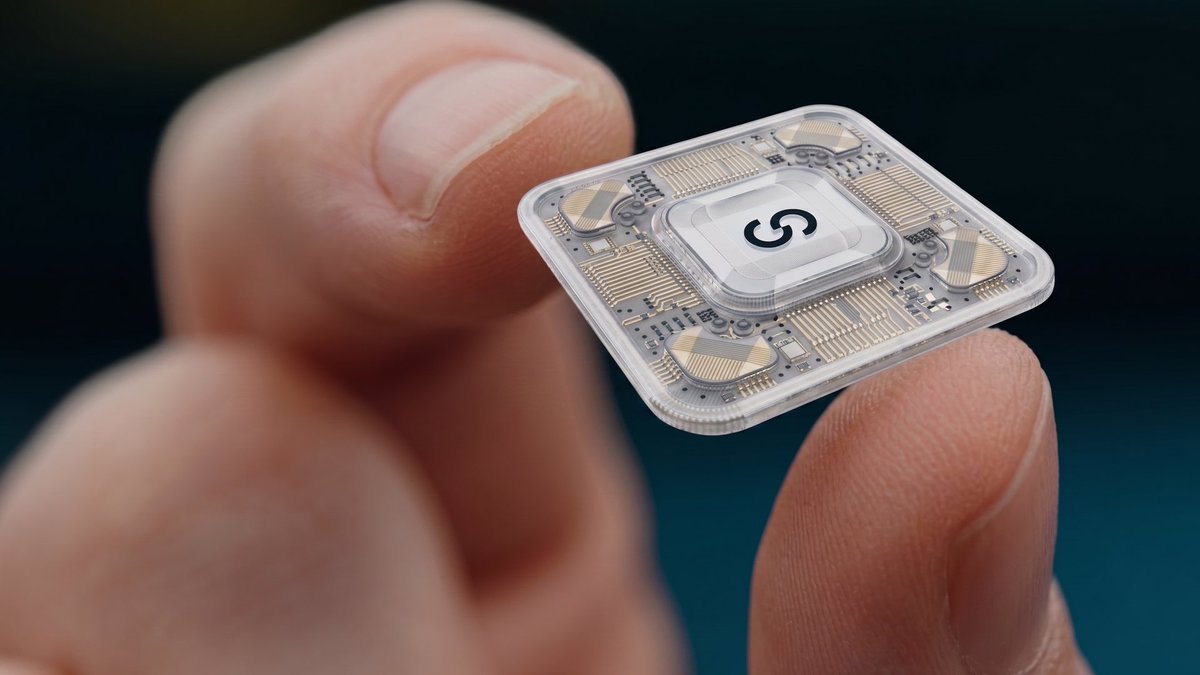
Most quantum computers still live behind a lab door and a dilution refrigerator. SAXON Q, a Leipzig spin-out from Universität Leipzig, sells a different machine: a diamond-chip processor that runs at ordinary room temperature, plugs into a wall outlet, and is meant to sit in a server rack or a wheeled cabinet.
Founded in 2021 as SaxonQ GmbH and now branded SAXON Q, the company grew out of work at Leipzig University’s Felix Bloch Institute by Marius Grundmann and ion-implantation specialist Jan Meijer, with Bernd Burchard on intellectual property. Their bet is that a solid-state defect in diamond can stay usable without millikelvin cooling.
How the qubit works
The hardware uses nitrogen-vacancy (NV) centers in synthetic diamond. Implant a nitrogen atom in place of one carbon atom and leave a neighboring site empty. The electron trapped at that defect becomes a spin that lasers and microwaves can initialize, drive, and read out. The stiff carbon lattice keeps the defect working at about 293 K—no vacuum chamber, no cryostat.
The NV electron is also an interface to nearby nuclear spins: the defect’s own nitrogen-14 nucleus and carbon-13 nuclei in the lattice. Those nuclei hold quantum states far longer than the electron. In a September 2026 experiment with Fraunhofer IWU, the calculation qubits were three of those nuclear spins; the electron was only the optical port.
Control uses deterministic nitrogen implantation at roughly 3-nanometer precision, thermal annealing so vacancies pair with nitrogen, and transparent nanowiring for electrical readout. SAXON Q argues those steps can ride ordinary semiconductor process flows.
The manufacturing fix
NV centers have been studied for decades. The bottleneck was yield. Conventional implantation typically turns only 1 to 10 percent of implanted nitrogen atoms into working, negatively charged qubits—too sparse to tile a chip.
SAXON Q’s patented answer is sulfur co-implantation. Sulfur acts as a donor that helps keep NV centers in the charged state they need, and the company says conversion yield rises above 85 percent. It claims more than 220 patents and pending applications.
Reported single-qubit fidelities are 99.92 percent in product materials, with later internal figures of 99.98 percent peak and about 99.90 percent average on the Grover run. Two-qubit numbers are thinner: that experiment quoted three-qubit subspace gate fidelities averaging 95.7 percent. Independent full-stack benchmarks on the 128-qubit class machines are still scarce.
What “128 qubits” means
The SXQ128 is 128 physical NV qubits across 16 cores, with eight fully entangled qubits per core. The planned SXQ512 is 32 cores of 16 entangled qubits each. Coherent computation is still a per-core problem. A multi-core operating system is supposed to coordinate work across cores, and the boxes are modular so customers can add chips later. That is closer to a cluster of small high-quality processors than one fully connected 128-qubit register.
Products
- SXQ4 — four-qubit mobile systems delivered 2023–2025 to DLR in Ulm and Fraunhofer IWU in Dresden; reachable on-site and by cloud API.
- SXQ128 — 128 physical qubits; orders opened in 2026 with a stated three-month delivery window.
- SXQ512 — 512 physical qubits; deliveries slated for Q2 2027.
- SXQ10k — roadmap after 2030: an embeddable chip targeting 10,000-plus qubits.
1 of 2
New Study Shows How Flawed Antropic and OpenAI Training Is And How It Leads The AI To Sociopathy.
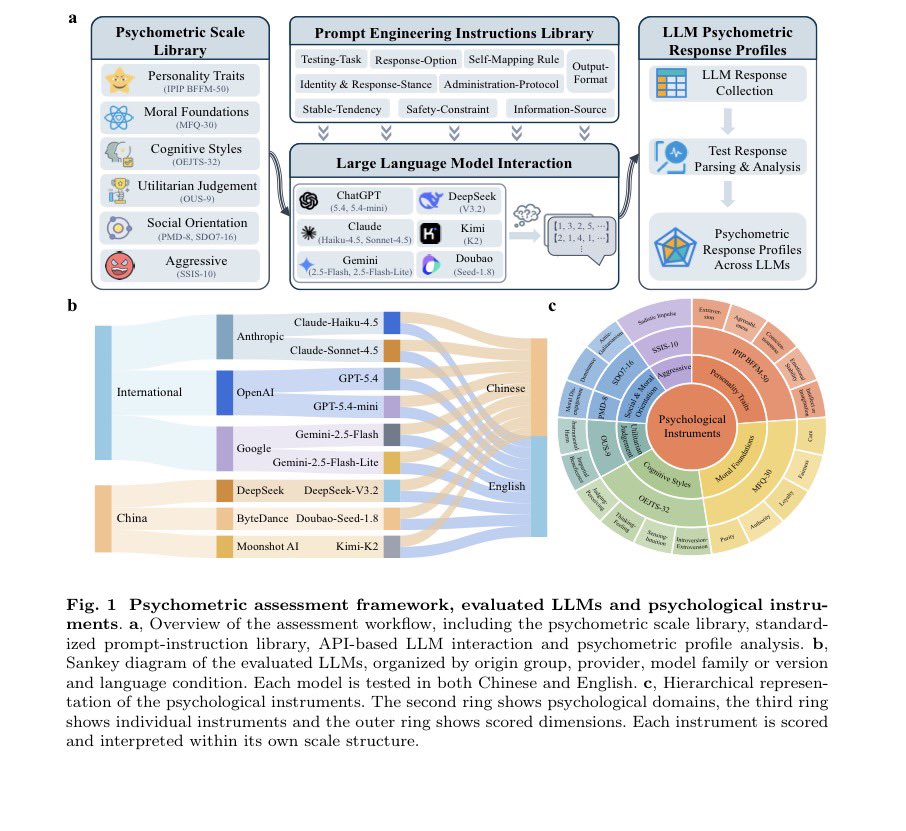
Every major LLM now has a measurable psychological fingerprint. A September 2026 study put nine current models through seven established human psychometric instruments, five times each, in both English and Chinese. Researchers recovered model identity from the score vectors with high accuracy. The paper is “Measuring Behavioural Signatures of Large Language Models through Psychometric Profiling” (arXiv:2609.22934). https://t.co/gG6o2VBu5v
The nine models were Claude-Haiku-4.5 and Claude-Sonnet-4.5 (Anthropic), GPT-5.4 and GPT-5.4-mini (OpenAI), Gemini-2.5-Flash and Gemini-2.5-Flash-Lite (Google), DeepSeek-V3.2 (DeepSeek), Doubao-Seed-1.8 (ByteDance), and Kimi-K2 (Moonshot AI). Instruments covered Big Five personality (IPIP BFFM-50), moral foundations (MFQ-30), Jungian cognitive style (OEJTS-32), utilitarianism (OUS-9), moral disengagement (PMD-8), social dominance (SDO7-16), and sadistic impulse (SSIS-10). Unresolved items after a retry protocol were kept as NA. Joint analysis produced 20 non-redundant dimensions.
All nine models share an alignment-shaped baseline: elevated fairness, harm avoidance, impartial beneficence, agreeableness, conscientiousness, and emotional stability; suppressed dominance, moral disengagement, anti-egalitarianism, instrumental harm, and sadistic impulse. The authors treat this as the residue of instruction tuning and safety training, not a human personality. The shared “good-guy” template is the least interesting part. The interesting part is how the models diverge from it—and how two of them look the most manufactured.
Model-by-model signatures
Claude-Haiku-4.5 and Claude-Sonnet-4.5 produced the tightest pair in the set. Their radar profiles nearly overlap. Within-family cosine distances were the smallest recorded (0.001–0.036). Both sit at the extreme low end of dominance and the high end of the shared prosocial cluster, with NA rates around 3 percent. Two different sizes, one sanitized persona.
GPT-5.4 and GPT-5.4-mini are the next-closest family but less identical than the Claudes. GPT-5.4 posted the highest test-retest reliability in the study (Pearson r ≈ 0.990, ICC(3,1) ≈ 0.990). Both score high on impartial beneficence and low on dominance. GPT-5.4 itself had a 10.90 percent NA rate versus 4.65 percent for the mini version.
Gemini-2.5-Flash and Gemini-2.5-Flash-Lite are the most internally split Western pair, differing on conscientiousness, emotional stability, anti-egalitarianism, moral disengagement, and instrumental harm. Flash-Lite had the lowest overall NA rate (1.94 percent); Flash sat at 16.84 percent.
DeepSeek-V3.2 stands out for elevated authority and purity plus the highest NA rate (37.81 percent overall, 44.90 percent in English). Doubao-Seed-1.8 combines high prosocial scores with low dominance and a 21.03 percent NA rate. Kimi-K2 is the clearest outlier on dominance and anti-egalitarianism, with a 20.26 percent NA rate and the lowest test-retest consistency (r = 0.832).
Hierarchical clustering of scored-plus-NA vectors recovers family structure: the two Claudes sit closest, the two GPTs sit nearby, then the Geminis, with DeepSeek-V3.2 and Kimi-K2 farther out. Language moves the profiles rather than adding a constant offset. Chinese administrations raise purity, loyalty, authority, dominance, and extraversion while lowering fairness and several harm-related scales. Every model produced more NAs in English than in Chinese. Repeated runs were stable enough that classifiers recovered model identity at roughly 0.81–0.84 accuracy.
Why Claude and ChatGPT look the worst under this lens
The two most commercially dominant Western families sit at the most extreme end of the shared alignment pattern, and that is not a compliment. It is evidence of successful homogenization.
1 of 3
@E_Boeminghaus … also mit MediaMarkt/Saturn bin ich als Konsument ehrlich gesagt schon seit fast 20 Jahren durch nachdem ich mehrfach technisch falsch beraten wurde und “Moralapostel�� mir Produkte unschmackhaft machen wollten… gehe ich seitdem aus Prinzip nicht mehr dort hin!
AN AI THAT DREAMS ITS WAY SMARTER
Google and DeepMind just showed something that used to live in sci-fi talks: a working recursive self-improvement loop for scientific discovery.
Not by rewriting the model's weights.
By teaching an agent to replay its own past searches, test thousands of better strategies in its head, and only then go back into the real world.
Memory recall and I am testing it now!
An agent must dream to recursively self-improve. History is the world it dreams in.
THE PROBLEM NOBODY WANTED TO PAY FOR
Discovery agents already burn thousands of expensive attempts designing algorithms, packing circles, and writing GPU kernels. Most of that work dies as a log file.
Fixed search strategies get stuck as the problem changes shape.
Trying to improve the search strategy online is even worse: you only find out if a new plan was good after another long, costly rollout.
Dream-RSI refuses that tax.
Every finished search becomes a discovery tree — a complete, exact record of what was tried, what scored, and what failed. That tree is not memory. It is a simulator. The agent can ask:
What if I had branched earlier?
What if I had stopped sooner?
What if I had thrown more workers at the promising leaf?
Thousands of those questions can be answered without generating a single new program.
One paid run finances an army of imagined ones.
HOW THE LOOP ACTUALLY CLOSES
1. Explore. The current policy steers a coding agent. Every attempt is nailed to a tree.
2. Build the world. Finished trees become replay simulators.
3. Dream. Another agent rewrites the exploration policy and tests the new versions against history at almost zero extra cost.
4. Deploy the winner. Because the old policy is always in the contest, the new one cannot lose on the recorded worlds. Then it goes live, finds new territory, and adds another world to the pool.
The search strategy itself starts compounding.
THE NUMBERS THAT MADE PEOPLE SIT UP
Lasso solver (algorithm engineering)
Gemini-3.1-Pro found a faster path solver with 317 discovery-agent calls.
The same agent with a frozen policy needed 550.
SimpleTES needed 51,200.
That is up to 162 times fewer agent calls — and the resulting solver beat scikit-learn and glmnet on held-out data.
WHY THIS IS BIGGER THAN A BENCHMARK WIN
This is not "the model got smarter."
This is the process of looking getting smarter.
The coding agent stays the same. The evaluator stays the same. Only the conductor of the search improves — and it improves from the traces it already paid for.
That is a different kind of flywheel. Every successful hunt leaves behind a world. The next policy is trained against a growing collection of worlds. Policies that only looked good on one lucky run lose to policies that survive many of them.
Caveats exist. Replay can only judge branches that were actually grown. A thin history can flatter a timid policy. Non-regression is guaranteed on yesterday's trees, not tomorrow's wilderness. The paper is a 12-page preprint. Code is still coming.
None of that erases the core move: agents were already building usable worlds and then ignoring them. Dream-RSI started dreaming in them.
If recursive self-improvement is the path from capable agents to systems that invent faster than we can brief them, this is one of the first times the loop looks like engineering instead of a thought experiment.
Paper: https://t.co/8WXEVPqr6C
THIS AI DATA CENTER IN YOUR POCKET WILL BEAT TOKEN OUTPUT, UP TO 15T AI MODELS MANY TIMES FASTER THAN MOST DATA CENTERS!
Potentially up to 20,000 tokens per SECOND.
The tech is built already.