This is very bad for SpaceX, Musk, and everyone involved.
It is becoming increasingly clear that STARSHIP will win massively. But if others don't catch up fast enough to fill the void left by Falcon 9, we will never hear the end of monopoly accusations against SpaceX.
SpaceX actually needs competitors to catch up. Otherwise, the "nationalize SpaceX" rhetoric will only grow louder, eventually translating into major regulatory hurdles that could jeopardize its ambitions for a lunar base - cities - and mass drivers.
SpaceX needs a healthy launch industry around it, not an industry it completely dominates.
$ASTS needs launch. and they have the funding, IF they get the early birds up... which requires launch... which isn't going well. So the funding isn't there. Until they get their birds up.. which isn't going well... so they build instead... they have they funding... they just need to get the first birds up... which needs launch... which isn't going well...
$ASTS Most of X is focused on rocket galore, but lack understanding of the strategic landscape of the space application layer.
Without a doubt third party launch will be a fantastic business, especially after Falcon 9 will withdraw from the market. However there is one glaring issue ignored by most analysts. You see rocket CEOs talk about keys to space and a $350B space application opportunity. (inflated figure)
What they don’t tell you is that they are already locked out of a majority of that space application layer before they ever get to the pad.
What nobody tells you is if strip out terrestrial consumer electronics (like $125.8B in GPS/GNSS chipsets) and look strictly at money earned by space operators, satcom makes up over 95% of all downstream satellite service revenue (with Earth observation accounting for the remaining ~$3.6B to $5B).
Two verticals in Satcom are growing massively which are consumer fixed broadband and consumer d2d. Everything else is declining aside from US GOV space systems procurements (technically hardware, not a service)
In consumer fixed broadband the two wealthiest men in the world compete with the best rockets in the world (Starship and New Glenn) first in consumer segment and now increasingly in the enterprise segment disrupting companies like Viasat, Iridium and others. Amazon is about to go live and start a price war with its massive distribution network. Essentially the majority of this market is locked out for folks even if they have a launch vehicle like Neutron, Terran R, Nova etc. Nobody has the scale and capital to compete with SpaceX and Amazon. The trick here first you capture the massive scale of consumer and then you squeeze out high margin niche providers like Viasat and Iridium in enterprise.
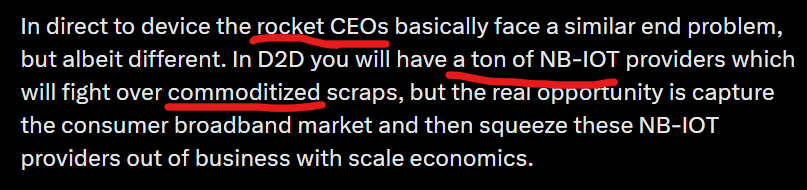
In direct to device the rocket CEOs basically face a similar end problem, but albeit different. In D2D you will have a ton of NB-IOT providers which will fight over commoditized scraps, but the real opportunity is capture the consumer broadband market and then squeeze these NB-IOT providers out of business with scale economics.
The first problem is that outside of AST nobody demonstrated true d2d broadband from space yet. For the record SpaceX is close, but everyone else is atleast 3-5 years behind. So while people were working on their rocket engine the D2D opportunity literally got pulled from under them.
Another problem is that there is not enough spectrum for broadband D2D for more then 3 players. This is why Brendan Carr named D2D in the US a three horse race between AST, SpaceX and Amazon. Future auctions are planned of lesser spectrum, but will not change this outcome, instead it will enforce it. Internationally S-band is now re-allocated and guess which winners are constantly showing up across countries: AST and SpaceX.
So you essentially have people locked out of broadband d2d by spectrum aside from that they have a 3-5 year technology disadvantage. Next you enter a market where MNO’s are locked up by their primary D2D provider whether that’s AST or SpaceX. Maybe MNO’s let you become the fifth wheel, but you don’t have broadband spectrum so why?
Wait then the next best idea is to become the Viasat and Iridium of D2D. Well newsflash. The consumer broadband d2d players are going to follow the fixed broadband playbook and with economics of scale are going to give the d2d NB-IOT players a run for their money in specialized applications.
So in a reality check you have rockets getting to the pad of which the owners are essentially locked out of all massively growing satcom opportunities. Some buy a desperate overpriced entry ticket for literally to eat d2d scraps, but just like in fixed broadband AST, Amazon and SpaceX are also coming for these scraps in enterprise in an economies of scale play.
AST is an execution story, but for new MLV rocket CEOs is there even a space app story beyond breadcrumbs? Now is the time to start praying for datacenters in space I guess.
Rocket launches are really, really hard.
But apparently if you start to build one with an unqualified engine that hasn't flown, use all of your expertise in building satellites to build the rest of the rocket from scratch, and not have any real launch pad agreement in place, you can launch in two years. How easy!
Meet some of the people behind Neutron and take a look across our sites for engine builds and hot fires, production of our largest carbon composite structures, and flight hardware testing on the launch mount at Launch Complex 3.
This is utterly terrible for DoD and NSSL. From the NSSL wiki page, SpaceX has 3 phase 2 launches and 17 phase 3 launches planned for 2027.
Vulcan has 19 phase 2 launches and 2 phase 3 launches, also all planned for 2027.
This is not a path for success. DoD has hard choices...
Based on data received by our Launch Director, we confirm that the Vulcan vehicle launched from Space Launch Complex 41 suffered an anomaly 10 minutes into the flight and failed to deliver the Amazon mission to orbit.
Every flight generates data, and every flight teaches us something. Since the anomaly just occurred, we don’t have any specific data yet to understand what occurred today.
ULA exists to provide assured access to space for our nation and for the customers who depend on us. That purpose is why we take on some of the hardest missions in spaceflight, and why we hold ourselves to the standard of mission success. Today, we did not meet that standard.
We will work closely with our customer and other appropriate organizations to find the cause, determine the appropriate corrective action, and return to flight as quickly as possible.
ULA is committed to full transparency with our customers, and they will have visibility into the investigation process, which utilizes rigorous methodology and corrective action.
We will provide further updates when new information becomes available.
Wild Wild Space is an awesome documentary based on the book ‘When the Heavens Went on Sale’ by @ashleevance.
The film tells the stories of $PL, $RKLB, and Astra Space (delisted 😅), and Ashlee is now exploring making a sequel.
Pledges to help fund the film are currently at $1M+ but we need $3.5M for this thing to have any real legs.
Please pledge what you can afford to help make this documentary a reality!
Link in the post below.
JUST IN: The U.S. government has selected four space companies to help develop a new regulatory approval process for commercial activities in orbit and on the Moon.
The Commerce Department's Office of Space Commerce selected four companies from nearly 40 applicants:
> Cowboy Space
> Portal Space Systems
> SpaceMD, a subsidiary of Redwire $RDW
> Starcloud
The companies will participate in the inaugural Space Commerce Certification pilot, designed to simplify how emerging commercial space missions obtain federal authorization.
The initiative will help develop a more coordinated regulatory process for activities including orbital manufacturing, satellite servicing, space-based data centers and operations on the lunar surface.
Today, many of these activities fall between existing regulatory frameworks designed primarily for launches, satellite communications and remote sensing.
The pilot aims to reduce that uncertainty by coordinating reviews across federal agencies through a common application process.
@AlexfromBabylon@RKLBMan@grok how many of the domestic or international flights flying from the US currently have iridium hardware installed and currently use the Iridium Network for official pilot communications?