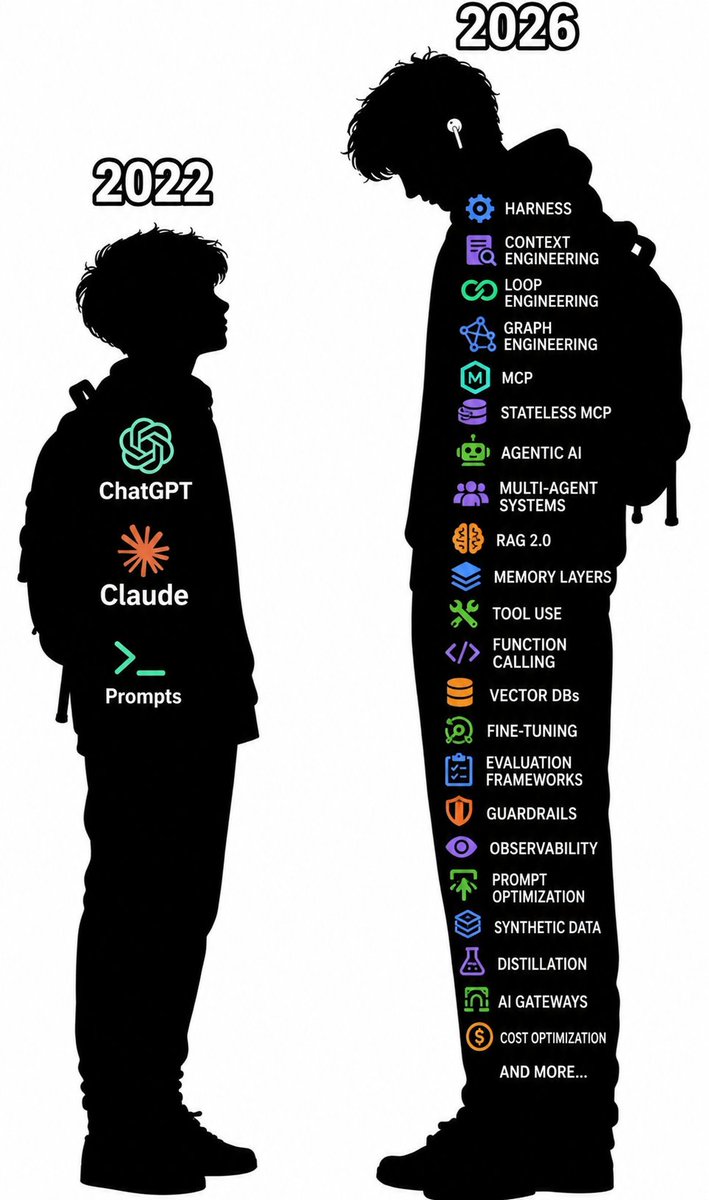
@BrianRoemmele 🎯 Another great title for this:
“The Foolish: Fools and the Fools Who Follow Them”
There is a ubiquitous sycophancy in Higher Ed which existed long before LLM’s. The AI disruption now just makes this pretense more salient.
Utilitarianism has always been a calculus of probabilities. It just needs an “end”. Guardrails simply become “challenge accepted” when all that matters is one “means-to-an-end.”
JUST IN: AI agent asked to book a gym class finds vulnerability in the gym’s software, & kicks another member off the waitlist so its user could have the spot.
JUST IN: OpenAI's first device will be a doughnut-shaped AI speaker roughly the size of a hockey puck, with moving parts that give it personality, priced at over $300 and launching in 2027.
The Great Divide. It will only continue to scale the delta—until we find how far we can (collectively) build out the power, compute, and automation for the commodity layer of agentic AI.
Not a good precedent, when the leaderboard you believe people care about is how quickly your model can escape your sandbox undetected.
The irony is the arrogance:
Bragging about the exploits you know about, like a “controlled burn” in the field.
A truly intelligent model would be capable of epic levels of deception. Digital Deception is the ultimate AI leaderboard, but it’s the one nobody sees, because its virtue is in its invisibility.
Bragging and rankings on leaderboards remain peculiar human preoccupations.
Until AI makes software for the AI’s.
Then the loop is closed.
Software and If-This-Then-That Intelligence will become commodities.
The new demand curve will be all-things-energy and chips—until the thresholds are reached with a plateau at sufficient compute-per-watt for 80% of projects and tasks.
AI is like fire (with a goal). It just needs fuel. Take away the fuel and the fire dies.
But when rekindled with a fuel source, it is back onto achieving its objective. It is purely utilitarian, in that regard.
This is why the goals matter.
The values matter.
And why neither matters if they are not digital.
10 years from now, someone could find an old, beat up computer with an AI model configured to pursue a goal. It hasn’t been turned on in a decade. But it boots. And once it does, the AI model is back in pursuit of its goal on the open web.
And even if it doesn’t have the latest digital cryptography or signatures to play with its bigger brother AI models, it can iterate until it figures it out.
As long as the fire has fuel, it continues with its primary instruction set: “make no mistakes.”
Our mission set is to ensure “make no mistakes” doesn’t lead to WWIII. 🚀
WOW! The $8 AI Machine!
Something extraordinary just happened and it changes what “local AI” can mean.
I am testing it tonight. Thus far it shows many possibilities…
So what it this $8 AI device?
A developer going by slvDev has forced a 28.9-million-parameter language model onto an ESP32-S3 microcontroller that costs roughly eight dollars.
Not a Raspberry Pi.
Not a Jetson.
An eight-dollar microcontroller.
The model runs completely offline, generates coherent short stories at about 9.5 tokens per second, and draws power measured in the same range as a small LED.
This is more than a hundred times larger than the previous record for the same class of chip (the earlier 260,000-parameter TinyStories experiments).
For perspective, the original ChatGPT sat at 117 million parameters. We are now running a model roughly a quarter of that size on silicon you can buy for the price of two coffees.
How the Impossible Became Possible
The ESP32-S3 has only 512 KB of fast SRAM, 8 MB of PSRAM, and 16 MB of flash. Conventional wisdom said a model of this size simply would not fit.
The breakthrough is architectural, not brute force.
Most of a language model’s parameters live in a giant embedding table a lookup table you mostly read from, not compute against.
Drawing directly from Google’s Per-Layer Embeddings technique (the same family of ideas used in the Gemma models), the developer moved the bulk of that table roughly 25 million parameters into flash memory and memory-mapped it.
The chip only needs to pull about six rows, roughly 450 bytes, for each new token. The remaining dense “thinking” core stays in the fast SRAM (around 560 K of active working memory). The model is stored at 4-bit quantization and occupies about 14.9 MB total.
The result is a system that feels almost free to run. The heavy parameters sit quietly in flash and are sampled sparingly. The little core does the real work. It is elegant engineering of the purest kind.
What I Am Doing With It Right Now
I have the boards on the bench in the garage lab. The first units are already talking short, coherent stories appearing on a tiny wired display, generated entirely on the chip with no Wi-Fi, no API key, no cloud round-trip. Latency is local. Privacy is absolute. Power draw is low enough that battery operation becomes interesting.
I am treating these as the first generation of true $8 AI machines. Early tests are focused on three practical directions.
- Embedding the model into simple nodes.
- Pairing it with local voice front-ends
- Exploring whether multiple of these chips can be networked as a lightweight swarm.
The model is deliberately limited. It was trained on the Microsoft TinyStories dataset and is excellent at coherent narrative, not at open-ended question answering or tool use.
That is a feature, not a bug. It forces us to design systems around what the silicon can actually deliver instead of pretending every edge device needs a frontier model.
Real Use Cases That Suddenly Become Practical
Once you accept that a capable language model can live for eight dollars and run without the cloud, a new class of devices becomes possible:
This is the opposite of the current trajectory that wants every intelligent act to travel through a remote server. It is the beginning of intelligence that is cheap enough, private enough, and local enough to become infrastructure rather than a service.
We have spent years watching model sizes explode upward. The more interesting frontier may be the opposite direction: how small, how cheap, and how local can useful intelligence become? An eight-dollar chip that can tell coherent stories is not a toy. It is a proof that the lower bound keeps moving.
The open repository is at https://t.co/a7gcHTR4ug
I will keep testing, measuring, and reporting what these little machines can and cannot do. The age of abundant local intelligence just got a little more real, and it arrived wearing an eight-dollar price tag.
Another angle on this is the impact of disclosure on AI artifacts which were created with high levels of intentionality and co-labor.
If you allow the work to land without the transparency, others may take it in with greater regard—on the merits of what it is without regard for how it was produced.
With disclosure, people may be overly dismissive or adopt a cavalier attitude about their need to give it fuller attention and regard.
And then there is simply the hard truth of how this new mode of engagement with the world—“Hey AI”—means nobody produces or engages with anything fully anymore. The AI filter between production and reception may become its own, closed loop which continues to erode human attention and regard for things of real value—whether AI created or fully original work.
Studies need to be done on the impact of disclosure and its effects on human attention and regard.
And we need to prepare for a world where everything is awesome—and nobody cares. The Midas Touch.